Exclusive: New image shows Russian approach of U.S. satellite

Add Axios as your preferred source to
see more of our stories on Google.
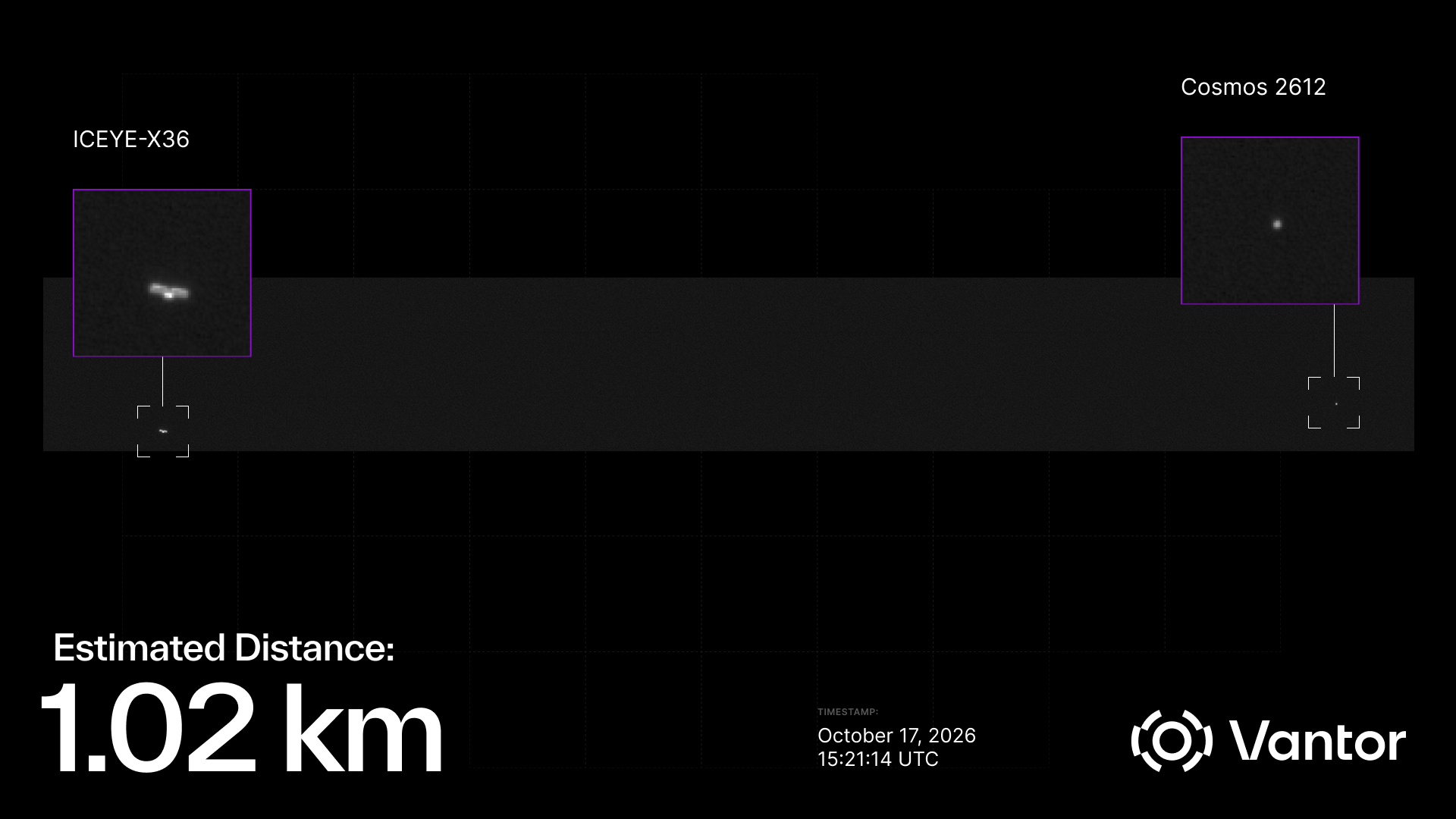
A new space photo shows a Russian satellite (right) less than a mile from ICEYE X36 (left) on Oct. 17. Photo: Vantor
A new, exclusive image shared with Axios shows a Russian satellite bearing down on a U.S.-owned spacecraft during a tense orbital incident last week.
Why it matters: The photo, snapped by spatial intelligence company Vantor, shows how commercial satellites are already becoming possible targets for stalking, jamming and, potentially, space weapons in geopolitical conflicts.
- "This image captures a reality long recognized by our national security leaders — space is becoming increasingly contested," Vantor CEO Dan Smoot told Axios in an exclusive statement.
- "Seeing one spacecraft repeatedly maneuver close to another raises serious concerns about capability and intent," he said.
The big picture: Private sector firms like Vantor are filling the information gap as the U.S. military's classified space capabilities make it difficult for the government to share intelligence with the public.
- The Defense Department declined to provide Axios details on Russia's space maneuvers. A State Department official made a brief statement on the matter Wednesday.
How it happened: As the Russian satellite maneuvered into an alarming position, firms like Vantor, which captures space and Earth imaging, and LeoLabs, which tracks orbital objects, were closely watching.
- On Saturday, Vantor captured the Russian Cosmos 2612 satellite stalking the U.S. commercial ICEYE-X36 as both vehicles orbited Earth at speeds around 17,000 mph.
- LeoLabs provided Axios a detailed report on Friday of how Cosmos 2612 closed a gap of nearly 250 miles to get within roughly one-third of a mile from the U.S. satellite.
"Without that transparency that we get from companies, we'd all be in the dark," Clayton Swope, a senior fellow at the Center for Strategic and International Studies, told me. "I don't think we'd have a really good picture about, when the rubber meets the road, what these threats look like in space."
State of play: ICEYE has a space-based network that has supported Ukraine's military.
- Experts told Axios that Russia's willingness to burn its own satellite's fuel and rapidly change its altitude, orbital plane and speed to catch up to ICEYE-X36 was alarming and potentially dangerous.
- LeoLabs said the Russian satellite began drifting away from ICEYE on Sunday, easing tensions.
What they're saying: LeoLabs and Vantor said that this transparency is crucial to protect the space infrastructure the U.S. relies on.
- "Knowing where objects are and what they're doing is essential for any operator to distinguish routine activity from anomalous behavior that may put their spacecraft at risk," said LeoLabs spokesperson Victoria Heath.
- "By using satellites to capture images of other spacecraft in orbit, we can better understand how they're operating and identify potentially concerning activity," Smoot told Axios.
ICEYE, however, hasn't said much about the incident.
- The company told Axios in an emailed statement on Monday that it's tracking the situation and that its "constellation architecture is designed for continuity and resilience."
The bottom line: The commercial images and intelligence show how U.S. adversaries may target key satellites in future conflicts in the absence of well-defined norms and widespread transparency.
- "If you look at the spectrum of conflict, it's not wartime but it's not pure peacetime," Swope said. "There is no real understanding of what is hostile, what is escalatory."
