New space mission aims to grab Mars moon soil

Add Axios as your preferred source to
see more of our stories on Google.
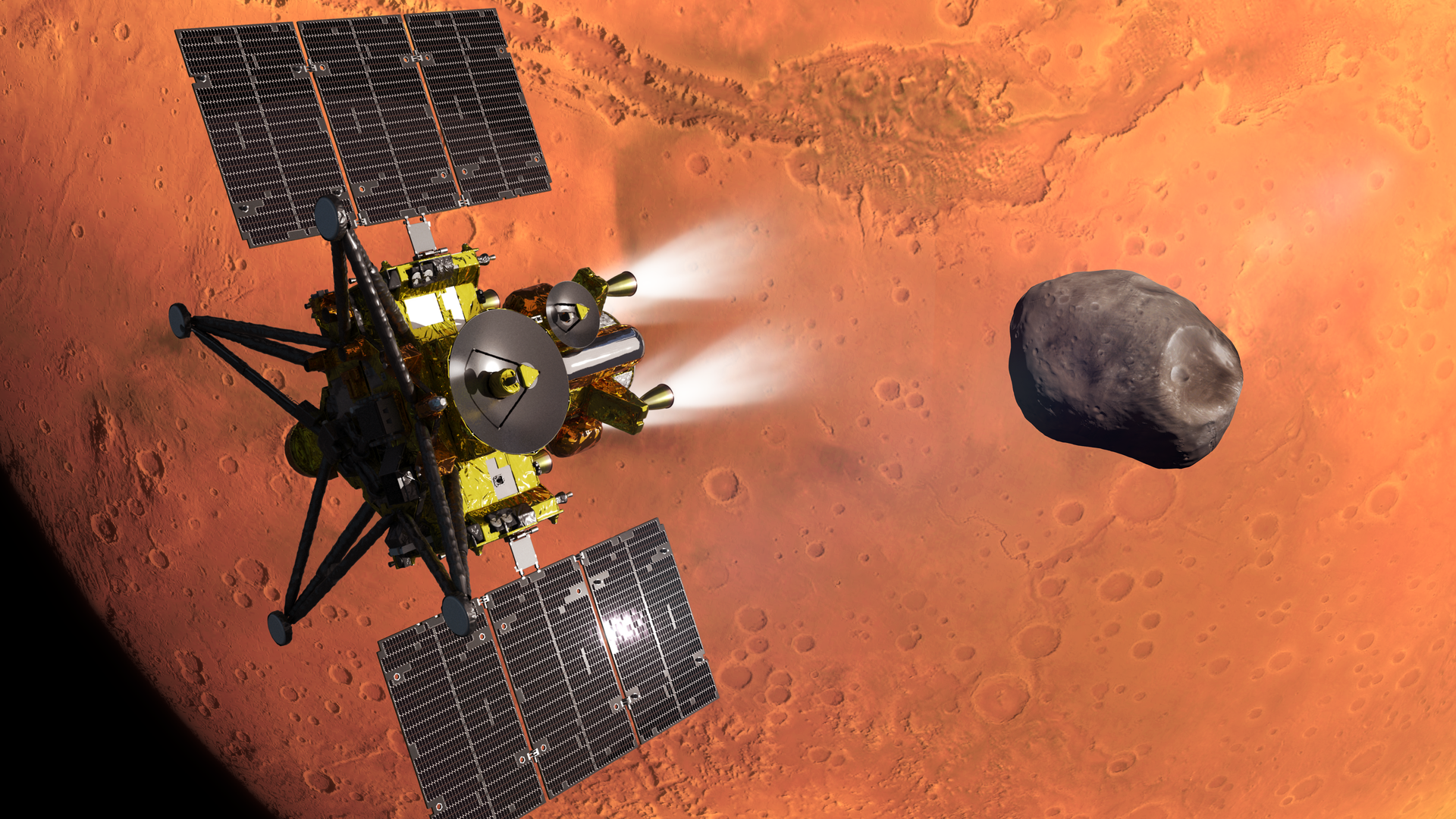
A rendering of Japan's MMX probe reaching Mars' moon Phobos. Image: JAXA
Japan has launched a potentially historic mission to scoop up soil samples from Phobos — one of Mars' two lumpy, potato-esque moons — and return them to Earth.
Why it matters: The Martian Moons eXploration (MMX) mission could reveal how the red planet's two weird little moons came to exist.
- Some researchers believe they're remnants of a long-ago collision between Mars and some other body. Others think they're former asteroids captured by Mars' gravitational pull.
Driving the news: MMX launched on a Japanese H3 rocket from Tanegashima Space Center early Tuesday morning local time.
- It's set to arrive near Mars next summer, then spend three years collecting data and samples.
- The five-ton MMX has three modules: one for propulsion to Mars' neck of the cosmic woods, another to sample and investigate Phobos' surface, and a third to return those samples to Earth.
How it works: In late 2028 or early 2029, MMX will deploy Idefix, a German–French-made rover, to Phobos' surface to scout promising sampling sites.
- Later, MMX itself will land on Phobos to take at least 10 grams of surface and subsurface samples — plus collect data with its multinational instrument suite.
- After taking back off, MMX will do several flybys of Mars' other moon, Deimos, to make observations without landing.
- The return module will then head back to Earth and drop the sample capsule to land in Australia in 2031.
What they're saying: "Despite their potential importance, Martian moons have never been fully investigated," project manager Yasuhiro Kawakatsu tells AP.
- "They are known as the most important unclimbed mountains in the solar system."
The intrigue: If Phobos was formed in an ancient Martian collision, it could contain trace amounts of Martian soil — and that means MMX could bring the first little bits of Mars to Earth.
The big picture: Sample-return missions have been hot lately, with several ambitious efforts to collect pieces of planets, moons and asteroids for further study on Earth.
- NASA's OSIRIS-REx mission brought a chunk of asteroid 101955 Bennu back to Earth in 2023. China's Tianwen-2 mission is set to do the same with asteroid 469219 Kamoʻoalewa.
- China is also planning to collect Martian samples with its Tianwen-3 mission, due to launch in 2028 and return in 2031.
Yes, but: A joint NASA–European Space Agency effort to collect samples directly from Mars was effectively killed earlier this year amid budget concerns.
