What's at stake in U.S.-China talks

Add Axios as your preferred source to
see more of our stories on Google.
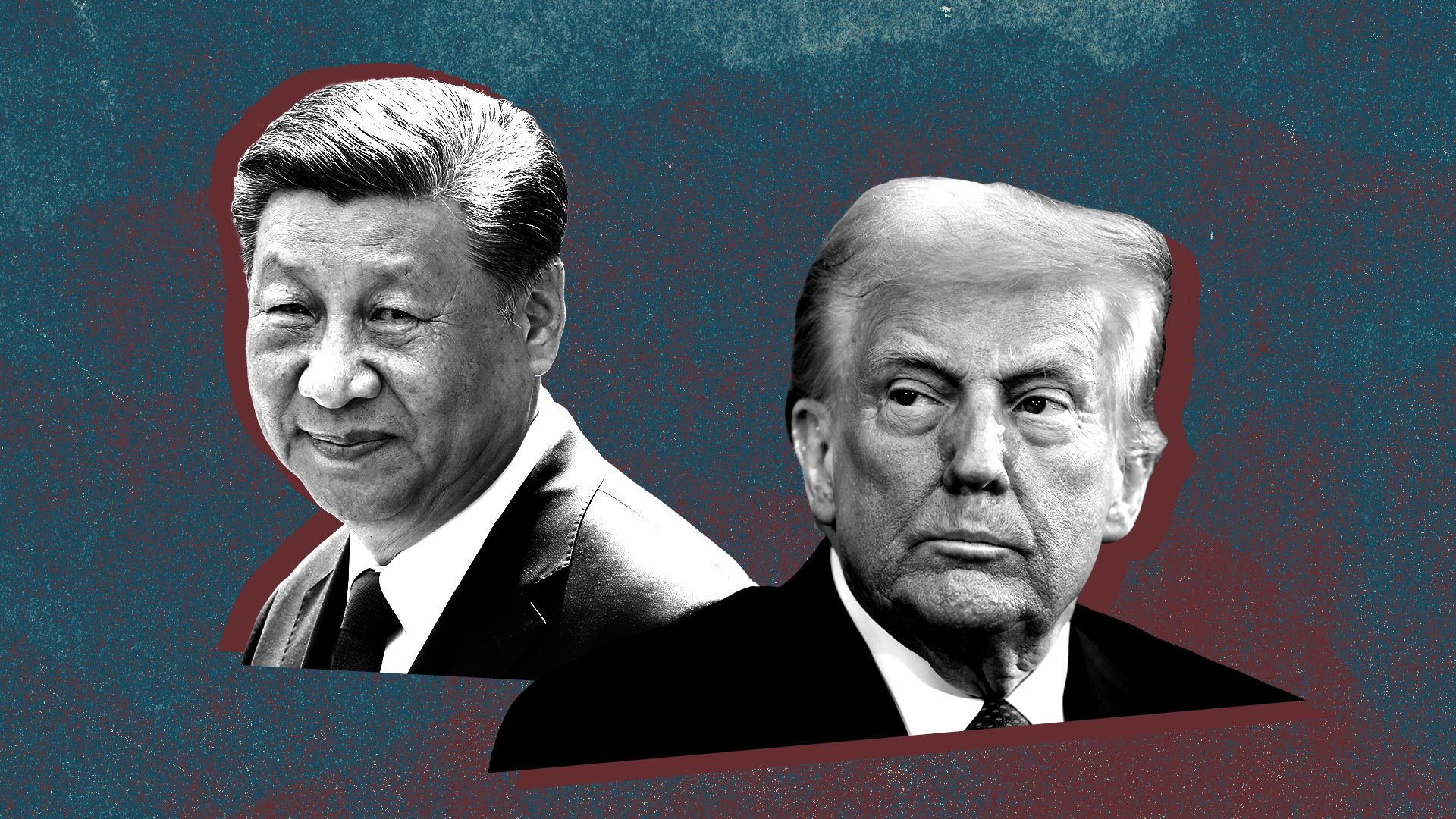
Photo illustration: Brendan Lynch/Axios. Photos: Antoine Gyori Corbis via Getty Images and Chip Somodevilla/Getty Images
This time last year, the U.S. and China were locked in a fight over tariffs and critical minerals. Now, the globe's two largest economies are exploring deeper economic ties in some cases and common ground on AI risks.
Why it matters: Xi's visit to Washington this week tests whether the economic thaw that has persisted for the past year has staying power.
- The two sides have found more areas of overlapping interests without necessarily resolving the giant disputes that drove them apart in the first place.
What they're saying: "In many ways, the visit is the message," Edgard Kagan, a former State Department official and senior adviser at the Center for Strategic and International Studies, told reporters last week.
- "Neither of them has an interest in — at least at this point — an escalation on trade issues," Kagan said.
- Xi wants room to focus on China's sluggish economy, while President Trump is betting that time will strengthen the U.S. on AI and critical minerals.
- Iran is the summit's "wild card," Kagan added.
Driving the news: Xi arrives on Wednesday for a three-day state visit, just over four months after Trump traveled to Beijing. It's Xi's first U.S. state visit in more than a decade.
The big picture: AI will be a focus of the talks, with the two sides exploring ways to manage shared risks from increasingly powerful models, according to a senior White House official.
- Treasury Secretary Scott Bessent met his Chinese counterpart, Vice Premier He Lifeng, at JPMorgan Chase's Manhattan headquarters last night — talks aimed at laying the groundwork ahead of the Trump-Xi summit.
- Bessent told reporters that the U.S. pitched a system to notify each other about AI incidents that rise to the level of a national security threat. The two sides also discussed creating a formal U.S.-China AI dialogue.
Yes, but: AI cooperation is only expected to go so far, with the U.S. still committed to trying to maintain a technological edge over China.
- Trump's top trade official, Jamieson Greer, said that U.S. restrictions on advanced chips and chipmaking equipment were not part of the talks.
Zoom in: Xi's visit could show whether China is prepared to put new money into the U.S., for which Trump has previously signaled an appetite.
- After the last visit in May, the two leaders created a U.S.-China Board of Investment, a forum set up to work through investment issues.
- But the prospect of Chinese investment in the U.S. auto industry is already drawing pushback from American automakers. A senior White House official said existing national security restrictions on Chinese investment remain.
Of note: Trump brought more than a dozen U.S. CEOs to Beijing in May. This week Xi is expected to arrive in Washington alongside his own group of Chinese business leaders.
Friction point: Trump is expected to press China to keep rare earths and critical minerals flowing to U.S. buyers, after a senior White House official said Beijing's performance on those exports has not been up to par.
- That issue is central to the so-called Busan trade truce, the deal struck last fall under which the U.S. held off on new tariffs in exchange for China keeping those exports flowing.
- The deal expires on Nov. 10. The official said a potential extension will be on the agenda but declined to predict whether Trump and Xi will agree to one.
What to watch: How hard Trump is willing to push China on Iran without jeopardizing the year-long economic truce.
- China is the biggest buyer of Iranian oil, making it crucial to Operation Economic Outcast — the administration's effort to choke off Tehran's remaining revenue.
- The administration has so far avoided its toughest measures against Beijing. It has targeted Chinese companies and smaller refineries that facilitate Iranian trade, but stopped short of sanctioning major Chinese banks.
