Axios Finish Line: Simplify your life

Add Axios as your preferred source to
see more of our stories on Google.
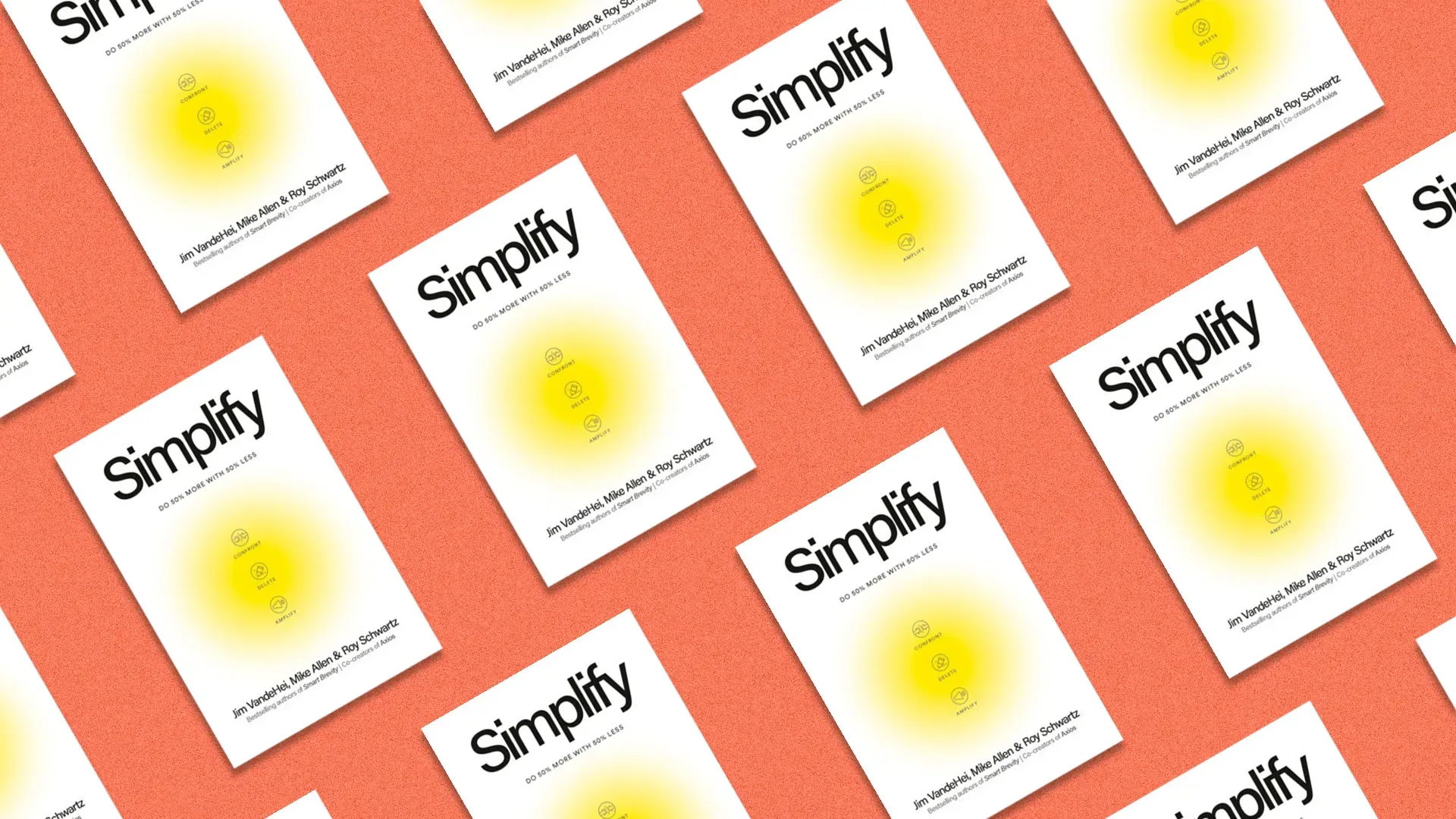
Cover: Crown Currency
Our new book — "Simplify: Do 50% More with 50% Less" — is out Tuesday. Please order it! The content has been literally life-changing for us.
We think our lives are unavoidably complicated. Nope.
- We fritter away most of our waking hours doing stuff we don't want to do or don't need to do. It's among the strangest genetic flaws of our species.
Why it matters: We're to blame. We clog up our minds and days through bad habits, bad decisions to say yes instead of no, and an odd refusal to think more deeply about how we spend our time.
- "Simplify," which I wrote with Axios co-founders Mike Allen and Roy Schwartz, shows you why we do this — then how to fix it at home and at work, step by actionable step.
The big picture: The numbers capture the urgency. You get 168 hours a week. Sleep takes 50–60. Work takes 40+. Getting ready, commuting and complaining about work take another 20. That leaves about 50 hours you kinda, sorta control.
- Harvard researchers found we then spend half our day thinking about irrelevant things. So most of us are truly controlling about one-sixth of our lives.
We discovered the only way to shift this, both at home and at work, was to create a new mindset or personal operating system. We came up with a simple formula for making choices: Confront, Delete, Amplify.
- Confront how you spend your time — and ask why.
- Delete the pile of stuff you don't need to do.
- Amplify what brings you joy and reward.
But you need to start with half an hour of reflection about what you truly want out of life.
- Here's a great example: Have you ever bothered to spend even 15 minutes thinking about what you want to accomplish with your existence — what you want to be true about you on your deathbed? Most people haven't.
- Try it, then take the wild step of writing it down and revisiting the list from time to time. This'll be the best filter you could possibly find to determine how you should spend your time.
Let me share an example from my life:
- I want to be able to say that I was an excellent and attentive son, brother, father, husband.
- That requires me to make some really hard choices. I have to say no or delete things to make time to do this. I have two parents, three kids, two siblings and a wife. No shot I can pull this off without a plan to prioritize.
So I made the conscious decision to say no to almost any social engagement related to work, even though there's a lot of pressure as a media CEO to be public-facing. I also decided to focus on a very few friendships instead of seeking new ones. Think about the countless hours this frees up.
- That's the big stuff. But it's also a million small things that lard up our minds and make doing what we want to do impossible.
Start by looking at your closet. We accumulate so much stuff, which requires us to spend time sorting and thinking, when most people wear only a few things. That might seem trivial, but it literally drains our brains.
- UCLA researchers measured cortisol in saliva and found people whose homes have high object density — lots of stuff — are measurably more stressed.
- I took the small step of wearing the same brand of jeans, the same two brands of shirts and the same shoes.
- We all can do our own version of this.
If you think we don't have an epidemic of too much crap, sit with this: There are nearly 10 times as many self-storage centers in America as hospitals. We're paying rent on things we'll never touch again.
The bottom line: "Simplify" walks you through a dozen or so ways to confront what you waste time doing, how to delete it, then how to amplify the stuff that makes us feel good.
