Waymo's cheaper robotaxis collide with China crackdown

Add Axios as your preferred source to
see more of our stories on Google.
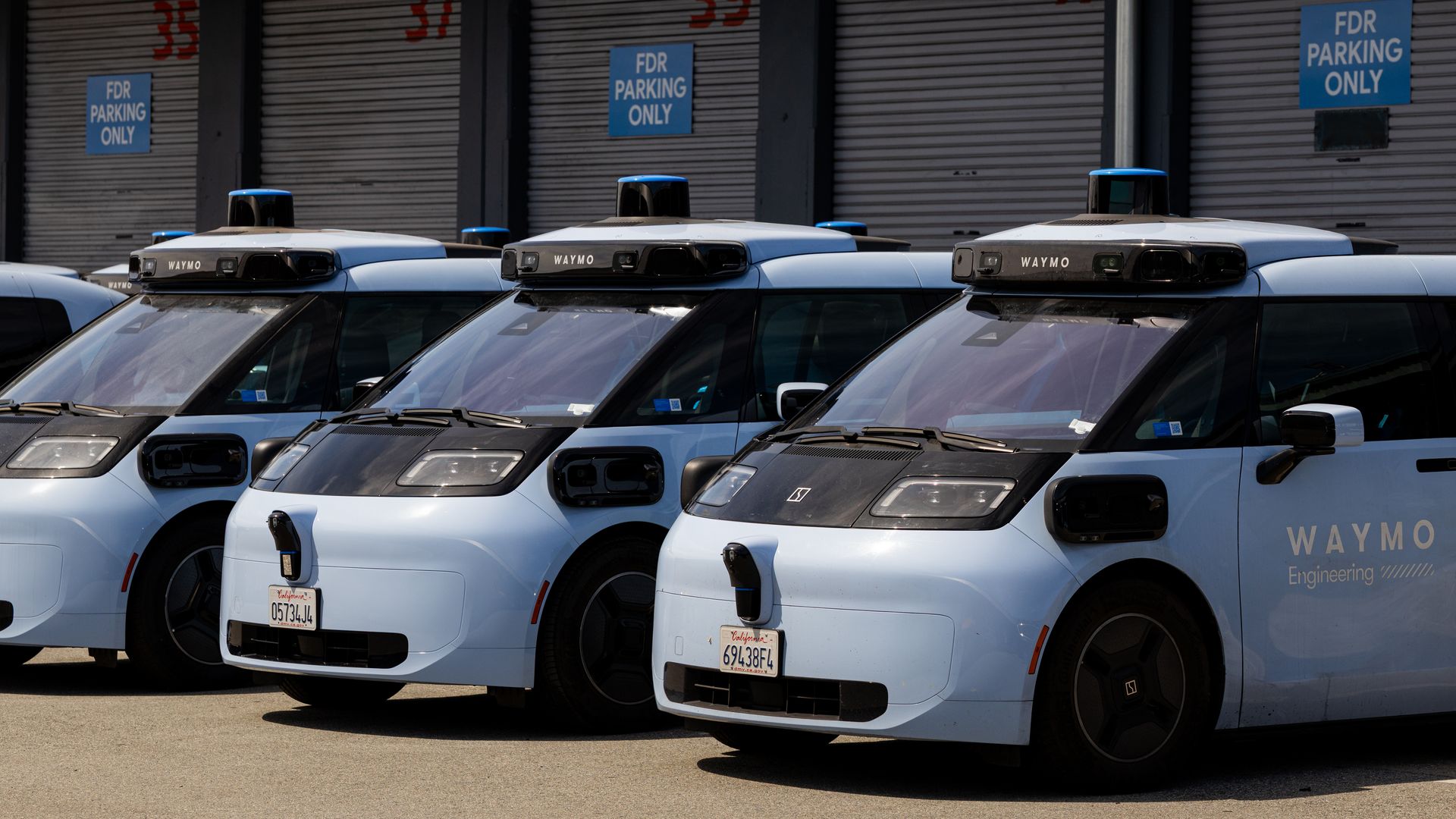
Waymo's newest robotaxi, the Ojai, is built on a Chinese platform. Photo: Jason Henry/Bloomberg via Getty Images
Waymo is accelerating its nationwide expansion with cheaper, next-generation robotaxis — thousands of which are built in China and could eventually run afoul of tightening U.S. restrictions.
Why it matters: The Alphabet subsidiary is betting its next phase of growth on cheaper robotaxis built for massive scale — just as Washington could move the goalposts on where those vehicles can come from.
Driving the news: Waymo will begin carrying public passengers today in Denver, San Diego and Tampa, pushing its nationwide commercial fleet beyond 4,000 vehicles.
- While Tampa will see the familiar white Jaguar I-Pace SUVs, Denver and San Diego will be the first markets served exclusively by Waymo's new powder-blue, snub-nosed Ojai robotaxi.
- The expansion to Denver is also important because it's the first Waymo market with meaningful winter weather, adding snow, cold, elevation and challenging road conditions.
Zoom in: The Ojai features the sixth-gen Waymo Driver, which has fewer sensors and is cheaper to build and maintain.
- The system is designed to be modular, so it can migrate to other vehicles, including future Hyundai Ioniq 5 robotaxis, which are still in testing.
The Ojai is based on a stripped-down vehicle manufactured by Zeekr, a brand owned by China's Geely Holding Group and subject to huge tariffs.
- TechTimes estimates a $38,000 Ojai chassis costs about $78,000 after tariffs, before Waymo adds roughly $20,000 worth of self-driving equipment — still far below estimates for the earlier-generation I-Pace Waymo.
Friction point: The Ojai could become problematic for Waymo as the U.S. government tightens technology import restrictions to protect national security.
- A current Commerce Department rule restricts Chinese software and hardware in connected vehicles, including automated-driving software.
- Waymo says it complies because Zeekr is supplying only the basic vehicle, while Waymo installs its own autonomous-driving and connectivity technology in Arizona.
Yes, but: A bipartisan bill from Sens. Elissa Slotkin (D-Mich.) and Bernie Moreno (R-Ohio) would close that door by targeting where the vehicle itself comes from, not just its technology.
- The bill would prohibit the import and sale of connected vehicles manufactured in China or linked to foreign adversaries — even if their AV software and connectivity systems are American.
What they're saying: "We support the broader aims of the industry and the bill's authors," a Waymo spokesperson tells Axios, noting that its Waymo Driver software system is American made.
- "The bills considered by the House and Senate include strict protections with which we intend to comply. We will continue to work with Congress to secure America's leadership in automated vehicle technology," the spokesperson said.
State of play: Waymo is on track to import 5,000 Zeekr vehicles by year-end, according to MoffettNathanson, which tracks shipping data, TechCrunch reported, and it is quickly ramping up Ojai production in Arizona.
What we're watching: If the U.S. blocks Chinese-built vehicles, one option is that the company could redirect future Zeekr production to overseas robotaxi markets.
- If that happens, Hyundai's Ioniq 5, built in Georgia, could soon become the Waymo Driver's new taxi in the U.S.
