Americans spend more than 2.5 hours in the ER

Add Axios as your preferred source to
see more of our stories on Google.
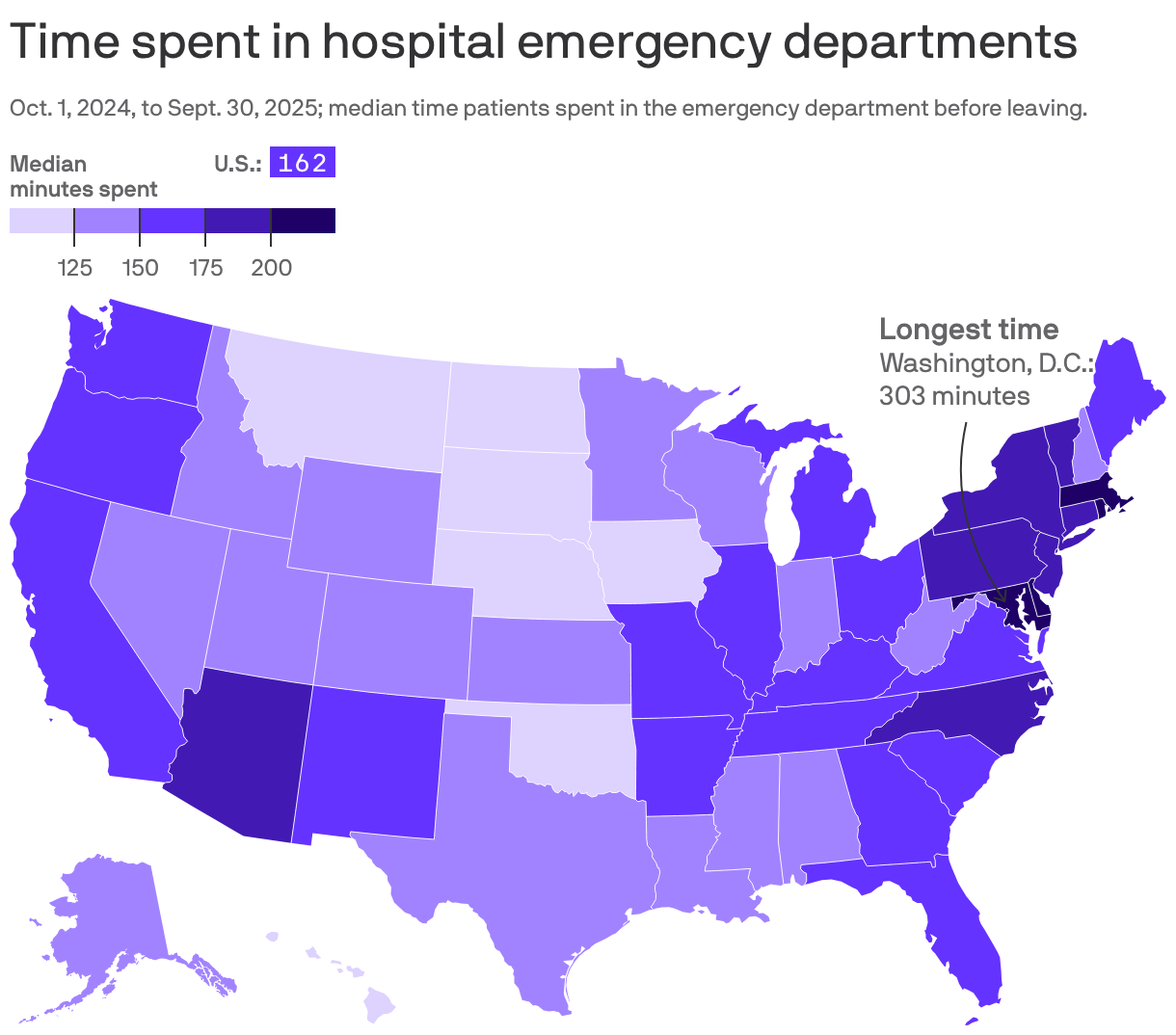
Patients now spend an average of more than two and a half hours in hospital emergency departments, and visits have been getting longer in nearly half of the states, new federal data shows.
Why it matters: Forthcoming insurance eligibility and cost changes could lead people to put off care until their health reaches a crisis point, sending even more patients to an ED.
- Longer visits may also mean longer waits to see a clinician — a driver of negative experiences and increased costs for the health care system.
Driving the news: The median time spent in the emergency department was 162 minutes during the year ending Sept. 30, 2025, according to the Centers for Medicare and Medicaid Services.
- Washington, D.C., had the highest median visit length at 303 minutes. North Dakota had the lowest, at 110 minutes. The national median visit length stayed the same from the previous year.
- The data also shows that an average of 2% of patients nationwide left the emergency department before being seen.
Median visit lengths increased in 24 states and D.C. compared with the prior 12-month period, per Axios' analysis of the CMS data.
- Oregon and Arkansas each saw a 15-minute jump in visit times. Twenty states saw decreases.
Between the lines: More than 20% of patients spend more time waiting for an ED visit than recommended for their triage level, according to the most recent data from the Centers for Disease Control and Prevention.
- Reducing ED wait times is one focus in a federal effort to improve health care by 2030.
Zoom out: Once patients are seen in the ED, they can face more long waits before they're actually admitted to the hospital.
- The vast majority of emergency departments report overcrowding, and nearly a quarter of people requiring inpatient care have to wait at least four hours for a bed to open up, according to a study published last week in JAMA.
- The Agency for Healthcare Research and Quality convened a summit in 2024 to address what happens to patients who are sick enough to require inpatient care.
- But the health services research agency has been gutted since the Trump administration took office last year, and the Department of Health and Human Services didn't respond when asked if the emergency room improvement work is continuing.
The big picture: Hospitals are facing a perfect storm of changes that could make it hard to focus on emergency visit and wait times, including Medicaid funding cuts, scrutiny of the federal discount drug purchasing program and a shift toward site-neutral hospital payments.
- "Beneath the surface of longer emergency department wait times, there will be a range of impacts from delays in accessing care to a loss of services," Beth Feldpush, senior vice president of advocacy and policy at America's Essential Hospitals, told Axios.
What we're watching: AI-powered technologies have already started to help lower emergency room wait times, a 2025 review found.
- But data quality issues, biased algorithms and ethical concerns could make it hard for emergency rooms to adopt the technologies widely.
Go deeper: Medical groups sound alarm on emergency care for kids
