Exclusive: How Zoox decided its robotaxi was safe

Add Axios as your preferred source to
see more of our stories on Google.
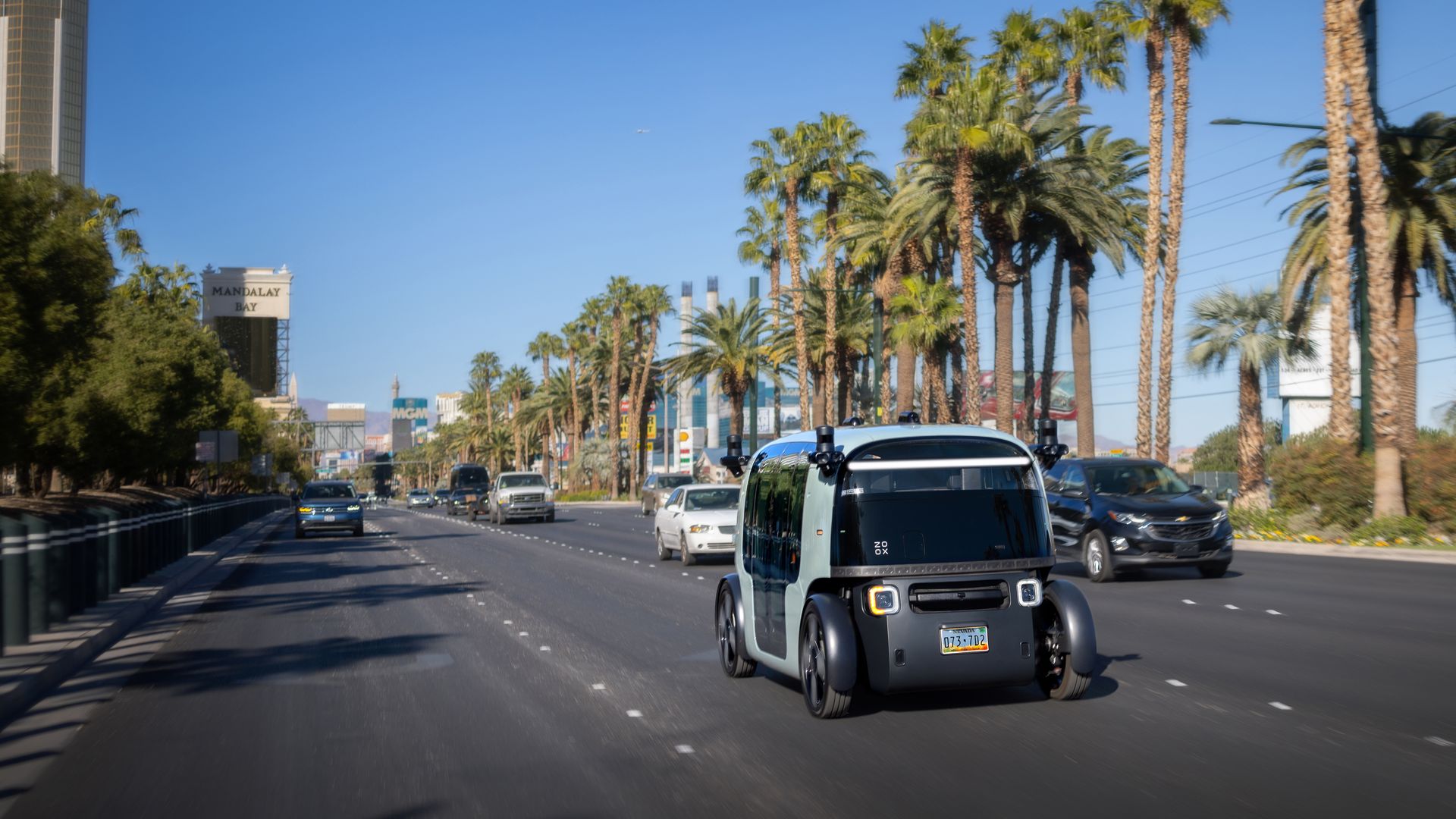
Zoox is now charging passengers who hail a robotaxi in Las Vegas. Image courtesy of Zoox, Inc.
As Zoox begins charging passengers in Las Vegas this week, the Amazon-owned company is revealing how it decided it was ready to deploy a robotaxi with no human controls.
Why it matters: With no federal performance standards for autonomous vehicles, AV developers largely determine when their cars are safe enough to operate on their own.
- The rest of us know very little about how such decisions are made.
- Even Waymo's industry-leading transparency hasn't dispelled a lack of public trust surrounding AVs.
Driving the news: Zoox aims to begin building such trust by publishing its comprehensive safety case framework, which it shared first with Axios.
- Instead of just declaring that its vehicles are safe, Zoox lays out the process it used to reach that conclusion.
- It describes how engineers identify potential hazards, test for failures, measure risk and decide whether a software update or vehicle change can be deployed safely.
Think of it as the company showing its work on a math problem.
Between the lines: Having a purpose-built robotaxi — one with no steering wheel, pedals or mirrors — is both an advantage and a challenge for Zoox when it comes to safety validation.
- On the one hand, designing the vehicle from scratch meant Zoox could build multiple layers of safety into every part of the system, from the vehicle itself to the software and fleet operations.
- On the other hand, with no human controls to enable real-world testing, Zoox used a fundamentally different safety methodology than Waymo, which racked up millions of supervised miles before launching driverless operations.
- "We had to go with a more analytical simulation, data-based approach rather than just driving a lot of miles," explained Qi Hommes, Zoox's vice president in charge of system design and mission assurance.
How it works: Zoox evaluates the safety risk of the entire system — the driving software, the vehicle itself, and the people and processes that support its fleet.
- It combines data from computer simulations, closed-course testing and real-world driving to come up with an aggregate risk metric.
- "We calculate the total safety risk. I believe no one else does this — from hardware, software, all the way to operation. We add all the risk up," Hommes said.
- Zoox then compares its projected safety performance against publicly available U.S. crash and fatality data, adjusted for the specific roads and conditions where its robotaxis operate.
Zoox's benchmark: To be "significantly safer" than human drivers.
- "We started very small, with a small fleet," Hommes said, and compared the real-world performance of its robotaxis to the calculated safety predictions, updating the data regularly.
- "At this point, we have enough real-world driving data. We have 3 million miles... to have quite a high confidence in our analytical prediction."
Reality check: Publishing a safety case doesn't prove a robotaxi is safe. The framework reflects the company's own methodology and assumptions, not an independent certification.
- Still, making that methodology public gives regulators, academics and safety experts something concrete to scrutinize instead of relying solely on company claims.
State of play: Zoox was cleared to charge for rides after securing a critical exemption from federal regulators for a limited run to operate a vehicle without the human controls required under current law.
What's next: It plans to expand its paid service to San Francisco, Austin and Miami, cities where it's in various stages of testing.
