Zoox's regulatory win is a win for Tesla, too

Add Axios as your preferred source to
see more of our stories on Google.
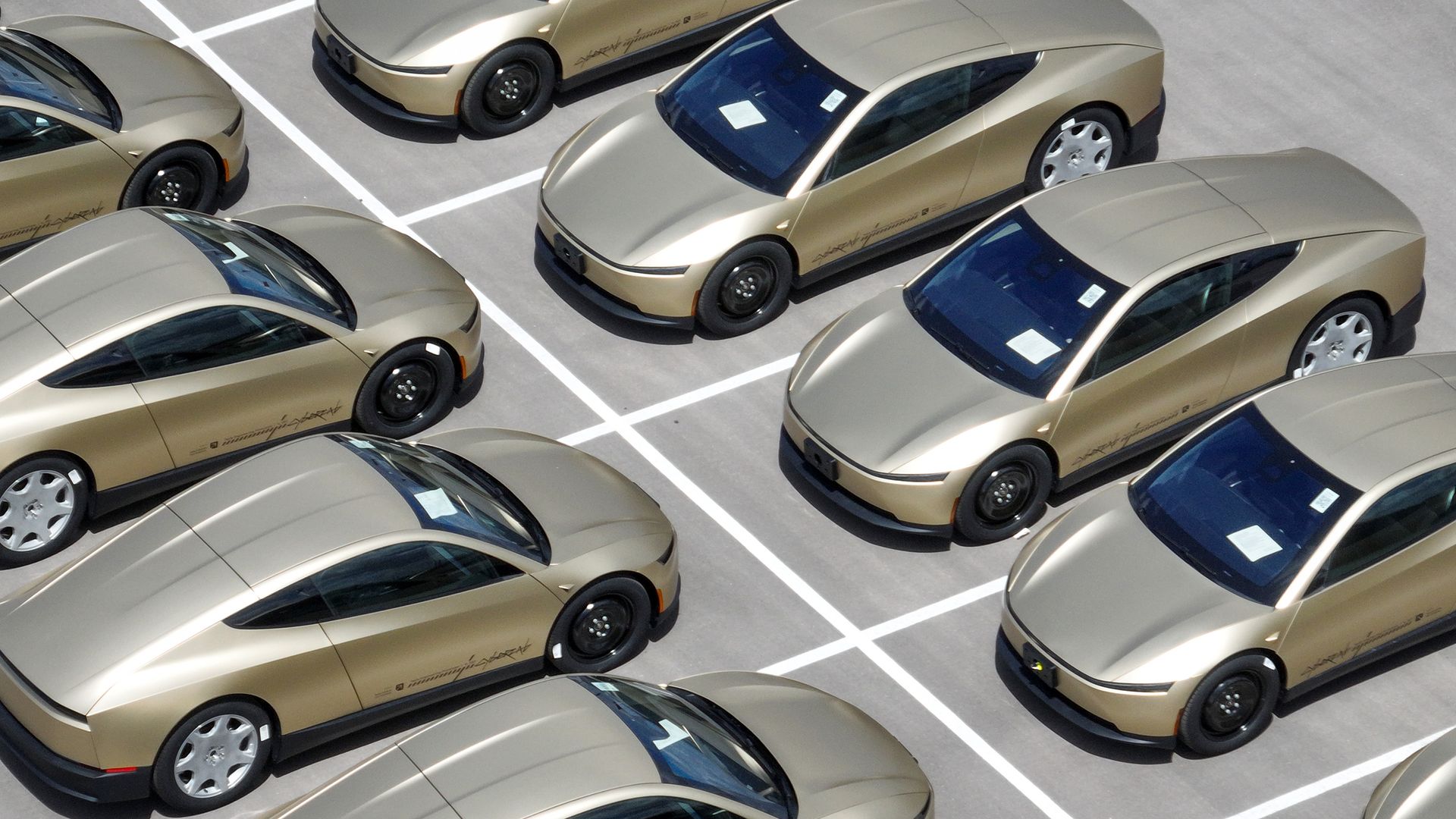
Tesla Cybercabs parked in Austin, Texas. Photo: Jay Janner/The Austin American-Statesman via Getty Images
Tesla hasn't tried to seek regulatory approval for its driverless Cybercab — nor is it likely now that the U.S. cleared Zoox to deploy its own robotaxi with no steering wheel or pedals.
Why it matters: Tesla's bet has long been that it doesn't need permission to launch the two-seat Cybercab because the Trump administration is dumping outdated regulations that would prevent it from coming to market.
- The fine print in the National Highway Traffic Safety Administration's Zoox ruling should make Tesla even more confident that it can skip the red tape.
Catch up quick: Zoox sought, and received, an exemption from federal motor vehicle safety standards for its purpose-built robotaxi, which lacks driver-centric features like a steering wheel, brake pedal and mirrors.
- The exemption for up to 5,000 vehicles over two years clears the way for Zoox to convert its current demo fleet of 105 vehicles into a paid, commercial robotaxi service.
Between the lines: The most interesting part of NHTSA's ruling was the agency's acknowledgement of its limited authority when it comes to autonomous vehicles.
- "The Agency notes, however, that there are no performance requirements for an [automated driving system] that is replacing a human driver performing the dynamic driving task and NHTSA has no authority to require a higher level of safety performance in the context of deciding whether to grant an exemption," it wrote.
- In other words, exemption decisions must be focused narrowly on vehicle performance, not the overall safety of the self-driving technology.
- For example: Is the vehicle's stopping distance equivalent to or better than a car with a brake pedal?
What they're saying: That regulatory limitation will make it easier for Tesla to self-certify the safety of its camera-only driving system, which has been heavily scrutinized, says Rob Grant, a former exec at Cruise, Aurora and Lyft, who co-leads AV research firm AUTNMY AI.
- "ADS performance is not a central consideration of meeting the standards. NHTSA has now put that on the record," Grant says.
- "That removes any question of Tesla's ADS performance, and that helps them toward self-certification."
Safety advocates, meanwhile, are concerned that NHTSA is moving too fast.
- "It seems there is a finger on the scale toward the mass deployment of autonomous vehicles, but there's no evidence yet that they're safe," Cathy Chase, president of Advocates for Highway Safety, tells Axios.
What we're watching: NHTSA is partnering with technical experts at SAE Industry Technologies Consortia (ITC) to try to develop the first-ever automated vehicle performance standards over the next three years.
