Worried about the diarrhea outbreak? Here's what foods are under scrutiny

Add Axios as your preferred source to
see more of our stories on Google.
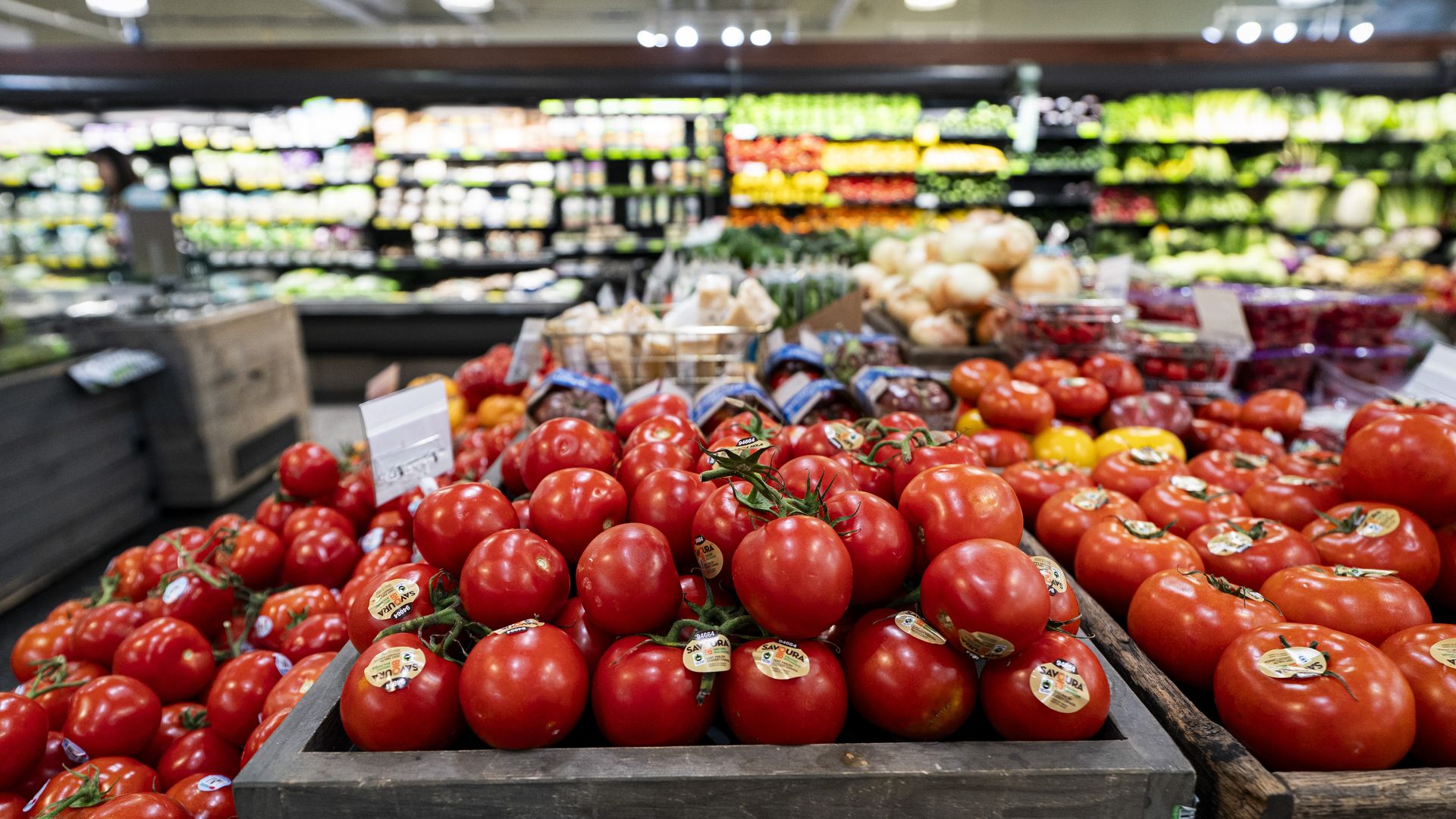
Tomatoes are displayed for sale at a grocery store in Washington, D.C., as rising produce prices have become a focus of grocery inflation. Photo: Al Drago/Getty Images
A growing diarrhea outbreak has put fresh produce under scrutiny as investigators continue to search for the source of the crisis.
Why it matters: Investigators still haven't identified a common contamination source for the cyclosporiasis outbreak, limiting the guidance health officials can give consumers as the outbreak grows.
- Fresh produce remains the focus of investigators, with lettuce and other ingredients pulled from some Taco Bell restaurants also under scrutiny.
Driving the news: Thousands of cyclosporiasis cases — an illness that can cause "explosive" or "watery" diarrhea — have hit at least 34 states this summer, according to the CDC and state health data.
- No deaths have been reported related to the outbreaks.
- Michigan reported Tuesday at least 2,640 cases after a sharp increase this month. More cases are expected.
Threat level: The surge of cases is outpacing testing labs' capacity, potentially delaying diagnoses as investigators race to identify the outbreak's source.
- "We anticipate that case counts will continue to rise as data are received," the CDC says.
Are fresh greens to blame?
What we know: Fresh produce remains a focus for investigators, and some experts advise temporarily avoiding bagged salads until the source is identified.
- "Early information has shown lettuce as a common product that regularly comes up during the investigation," Natasha Bagdasarian, Michigan's chief medical executive, says in a statement.
- Some Taco Bell restaurants temporarily stopped serving lettuce, cilantro, guacamole and other ingredients while the investigation continues, according to multiple reports.
What they're saying: "The foods most commonly implicated — fresh produce like berries, leafy greens, cilantro, and basil — are widely consumed, mixed into salads and dishes, and have short shelf lives," Steven Goldberg, chief medical officer at HealthTrack, tells Axios.
Flashback: Produce has caused cyclosporiasis outbreaks since the 1990s, according to the U.S. Department of Agriculture.
- Many outbreaks stemmed from people eating raspberries, basil, salad mixes, cilantro, berry and fruit mixes, lettuce, and snap peas, the department said.
How cyclosporiasis spreads onto produce
Zoom in: The disease is caused by the Cyclospora cayetanensis parasite, which can be found in human waste and feces.
- The parasite spreads when contaminated water is used to grow, clean or wash vegetables and fruits, according to the CDC. This often happens during the agricultural supply chain.
- Symptoms usually appear about a week after consuming contaminated food or drink.
- Human-to-human transmission doesn't occur because the parasite's eggs — called oocysts — must develop in an environment outside the host to become infective, the CDC says.
Yes, but: The oocysts, which can infect the produce, are resistant to chemical disinfection and sanitizing methods — making them difficult to fight and avoid.
- "In terms of prevention, the honest reality is that there is no foolproof way for consumers to eliminate the risk at home," he says.
How to stay safe from cyclosporiasis
Staying away from produce altogether might be the safest move, health experts say, as officials look to identify a source.
- "People should still thoroughly wash all fresh fruits and vegetables under running water, as this can reduce — though not eliminate — contamination," Goldberg says.
What we're watching: Contaminated water.
- Robert Mandrell, a microbiology researcher and former USDA official, tells Axios that water and sewage systems deserve more scrutiny because it can help spread the parasite.
- "Flooding and sewage overflows can introduce contamination into recreational water and local water systems," he says. "That combination is exactly why water deserves a much closer look than it's gotten so far."
The bottom line: Until investigators identify the contamination source, consumers should follow public-health guidance while officials trace the outbreak.
