D.C. has come for the Fed's headquarters before

Add Axios as your preferred source to
see more of our stories on Google.
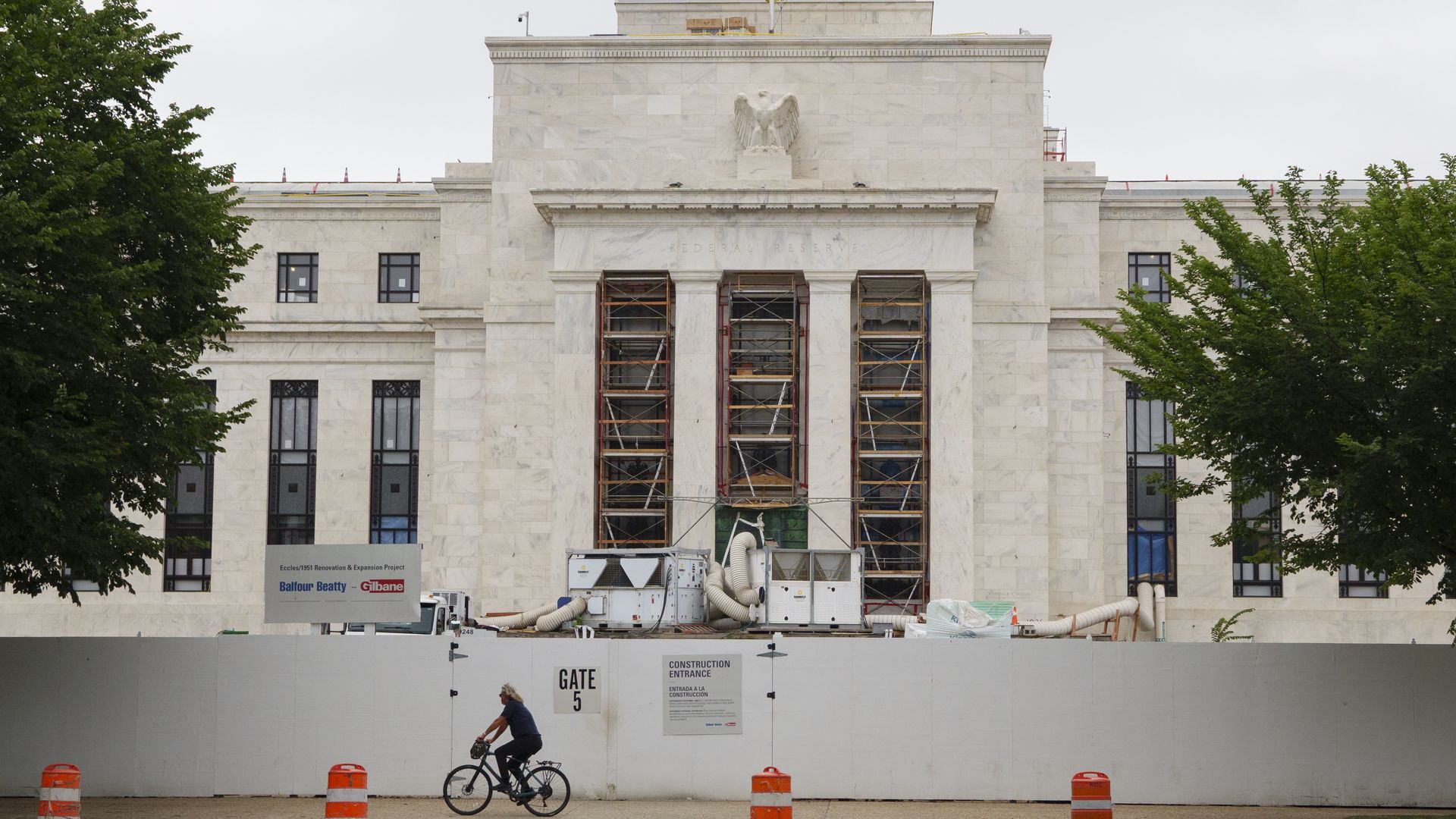
The Marriner S. Eccles building last week. Photo: Kevin Carter/Getty Images
The Federal Reserve's grand headquarters building on the National Mall has been a source of controversy over the last year — and not for the first time.
- An episode from the 1940s, which the Fed's official historians wrote about last week, shows how the building has long been part of fraught debates around central bank independence.
Zoom in: The building now known as the Marriner S. Eccles Building — named for the Fed chairman at the time — was completed in 1937.
- The District of Columbia government claimed that the Fed, because of its unique structure consisting of quasi-private reserve banks, was not a government agency and therefore owed property tax on the building.
- The dispute came to a head in 1941, when the D.C. government went so far as to list the building, which Time magazine called "Eccles' opulent marble and bronze mausoleum," for sale in a tax auction.
Flashback: "The most improbable building in the U.S. to go on the auction block was last week advertised for sale," Time magazine wrote.
- "It was Washington's magnificent $3,500,000 Federal Reserve (Board) Building, and the District of Columbia was claiming it for non-payment of $315,000 in taxes."
Just days after the auction's listing, the Japanese attacked Pearl Harbor and the U.S. entered World War II, and everyone involved seemingly had more urgent business to attend to.
- The dispute was not resolved until 1944, when the reserve banks signed paperwork disclaiming ownership of the building and property taxes were waived.
What they're saying: "The resolution required the Fed to not just point to statute, but to persuade, negotiate, and creatively solve the problem," the Fed historians wrote.
- "In this way, the tax dispute illustrates a broader theme about the Federal Reserve's independence: It rests not only on law but also on how that law is interpreted, applied, and understood by others."
- "The quitclaim deed from the 12 Reserve Banks ultimately reinforced both the Fed's physical independence, symbolized by its Constitution Avenue headquarters, and the Board's status as a federal agency," they wrote.
Of note: "Chairman Eccles understood that the Board's legal status had to be actively defended, not just assumed, which is why he fought for five years rather than simply pay the tax bill."
- Former chair Jerome Powell is remaining in place as a governor, objecting to the Trump administration's criminal investigation of the headquarters renovation as a threat to Fed independence.
- The last Fed chairman to stick around for a prolonged period as a governor? That would be Eccles.
