Alan Greenspan, former Fed chairman, dies at 100


Add Axios as your preferred source to
see more of our stories on Google.
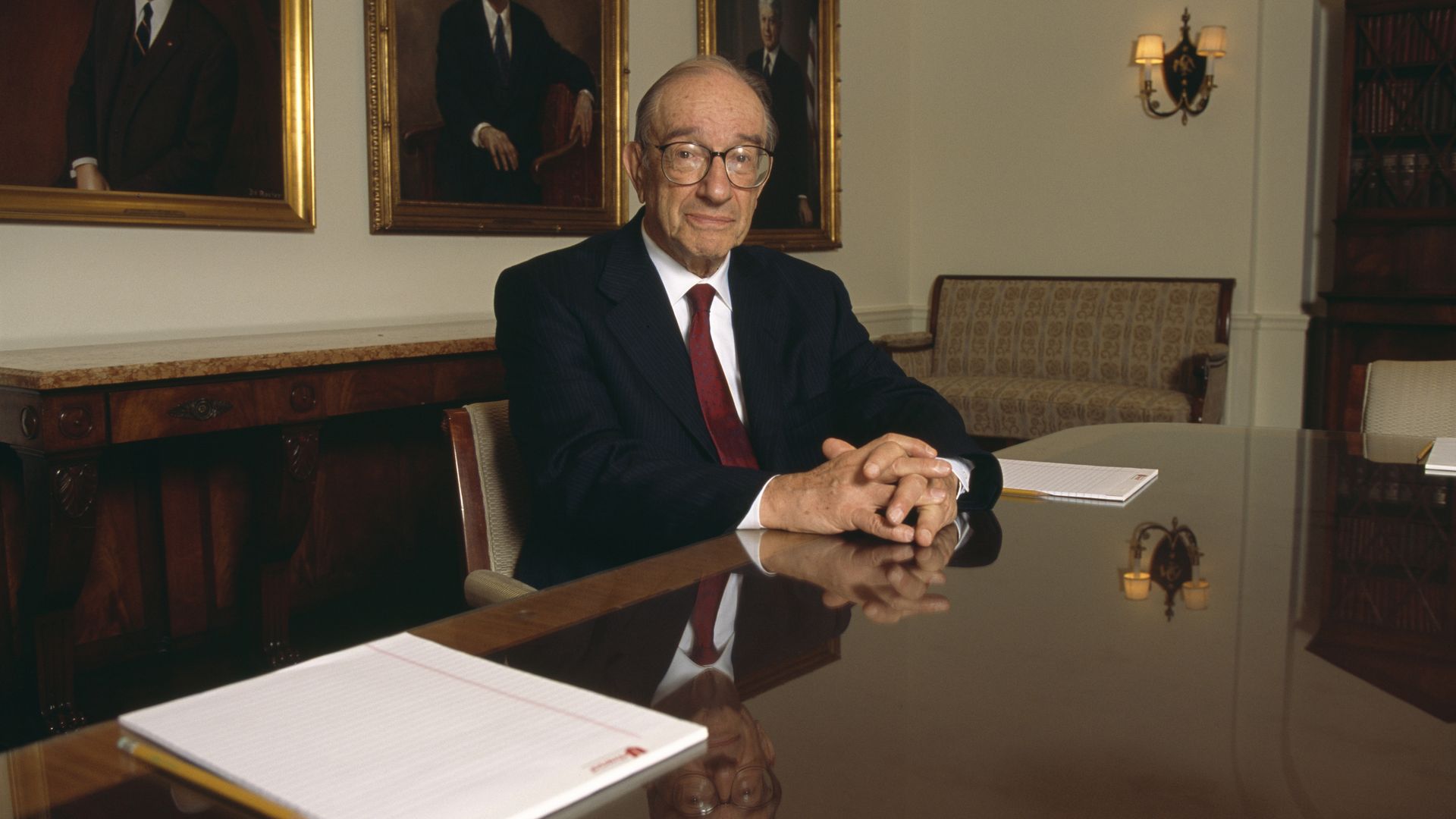
Alan Greenspan in 2004. Photo: Diana Walker/Contour by Getty Images
Alan Greenspan, who died Monday at age 100, created the modern Federal Reserve, and with it the underpinnings of an era of American prosperity.
The big picture: When Greenspan became Fed chief in 1987, the central bank's victory over inflation was recent and tenuous, a stock market crash was imminent, and the Federal Reserve itself was a black box, not even announcing its interest rate decisions publicly.
- Greenspan steered the institution, and the U.S. economy, through nearly 19 years of crises, quashing inflation and steadily making the Fed's actions more legible to the world, his own arcane speaking style notwithstanding.
- The Great Moderation, as this period is often called, was his signature legacy — two decades of steady growth, rare recessions and well-contained inflation that Greenspan engineered.
- The major asterisk to his historic standing is the Global Financial Crisis, which began barely a year after he stepped down.
Zoom out: It's hard to overstate how different the pre-Greenspan Fed would look to modern eyes. Traders parsed its actions based on movements in money markets rather than on carefully crafted policy announcements. His predecessors would hardly be recognized in public settings.
- While Greenspan himself was a reserved man who often spoke in elliptical turns of phrase, he became a bona fide economic policy celebrity.
- It reflected the prosperity he played a major role in achieving and his sheer longevity in the job — appointed to five terms as Fed chairman by four presidents of both parties.
What they're saying: "He brought rigorous analytical discipline to monetary policymaking and helped establish the credibility that remains one of the Federal Reserve's most important assets," the Fed said Monday in a statement.
- "Chairman Greenspan's legacy endures at the Federal Reserve — in those he mentored directly, in the economists and public servants he inspired, and in the frameworks and practices he helped shape."
Yes, but: Economic historians will long debate how much responsibility Greenspan bears for the financial crisis, whose rumblings emerged in 2007 before becoming a conflagration in 2008.
- His ardent enthusiasm for financial deregulation may have made the Fed slow to see the risks building in the banking system.
- There is a more nuanced story that says that Greenspan's greatest successes — foaming the runway after smaller financial implosions in 1987, 1998 and 2001 — fueled a complacency on Wall Street that made the 2008 crisis more severe.
- "I found a flaw in the model that I perceived as the critical functioning structure that defines how the world works," he told a congressional committee in October 2008.
Reality check: With nearly two decades of hindsight now, it's not as obvious that Greenspan's decisions were a primary cause of that crisis.
- It was fueled by global imbalances over which he had little control, including over-levered banks worldwide and the buildup of risks in institutions, like the insurer American International Group, over which the Fed had no authority.
The bottom line: Individual decisions of the Greenspan era can be questioned and rethought. But the fundamental narrative of his life is straightforward.
- He applied an uncanny knowledge of how the economy, in all its nooks and crannies, really works, to public service. And the result was an era of economic prosperity in which the U.S. led the world.
Today's "Maestro" moment
Greenspan's death comes as top Trump administration economic officials cite his response to the 1990s internet boom as a precedent for keeping interest rates lower in the age of AI.
Why it matters: The same question that helped Greenspan's most celebrated years sits at the center of U.S. economic policy today: Can new technology expand the economy's capacity to grow without generating inflation?
- Then, it was the internet boom. Now: the possibility that AI will usher in a productivity surge.
"The Fed needs to have merely an open mind. The open-mind maestro, former Fed Chairman Alan Greenspan, resisted premature rate hikes during the technology boom of the 1990s — and history proved him right," Treasury Secretary Scott Bessent said earlier this year.
- "Greenspan decided that if you're getting a positive supply shock, then you can let low unemployment stay without having to lift rates, and he gave us three or four really great boom years," top Trump economist Kevin Hassett told Neil at an Axios event in April.
- "I think that the Fed has an opportunity like that right now," Hassett added.
Unlike the arguments of the late 1990s, today's productivity debate unfolds against the backdrop of a war-driven price surge and several years of too-high inflation.
- Separately, by 1999 — after the productivity boom had become widely recognized and asset prices had surged — the Greenspan Fed raised rates.
What to watch: Greenspan's moment goes beyond the productivity debate.
- The current Fed chairman, Kevin Warsh, has not explicitly embraced Greenspan-style communication. But as we wrote last week, his push for fewer projections, speeches and policy precommitments would move the Fed closer to the model that prevailed under Greenspan.
Warsh shouted out his legacy during his swearing-in ceremony, the first to be held at the White House since Greenspan in 1987.
- "I've known five of my predecessors in this job, some of them quite well, but chairman Greenspan was the first to tell me and show me what this role demands," Warsh said.
- "Like Alan, I intend to fill the role of chairman with energy and purpose just the way chairman Greenspan did," he added.
Editor's note: This story has been updated to add details about Greenspan's legacy.
