Fed leaves rates steady in Warsh's first meeting

Add Axios as your preferred source to
see more of our stories on Google.
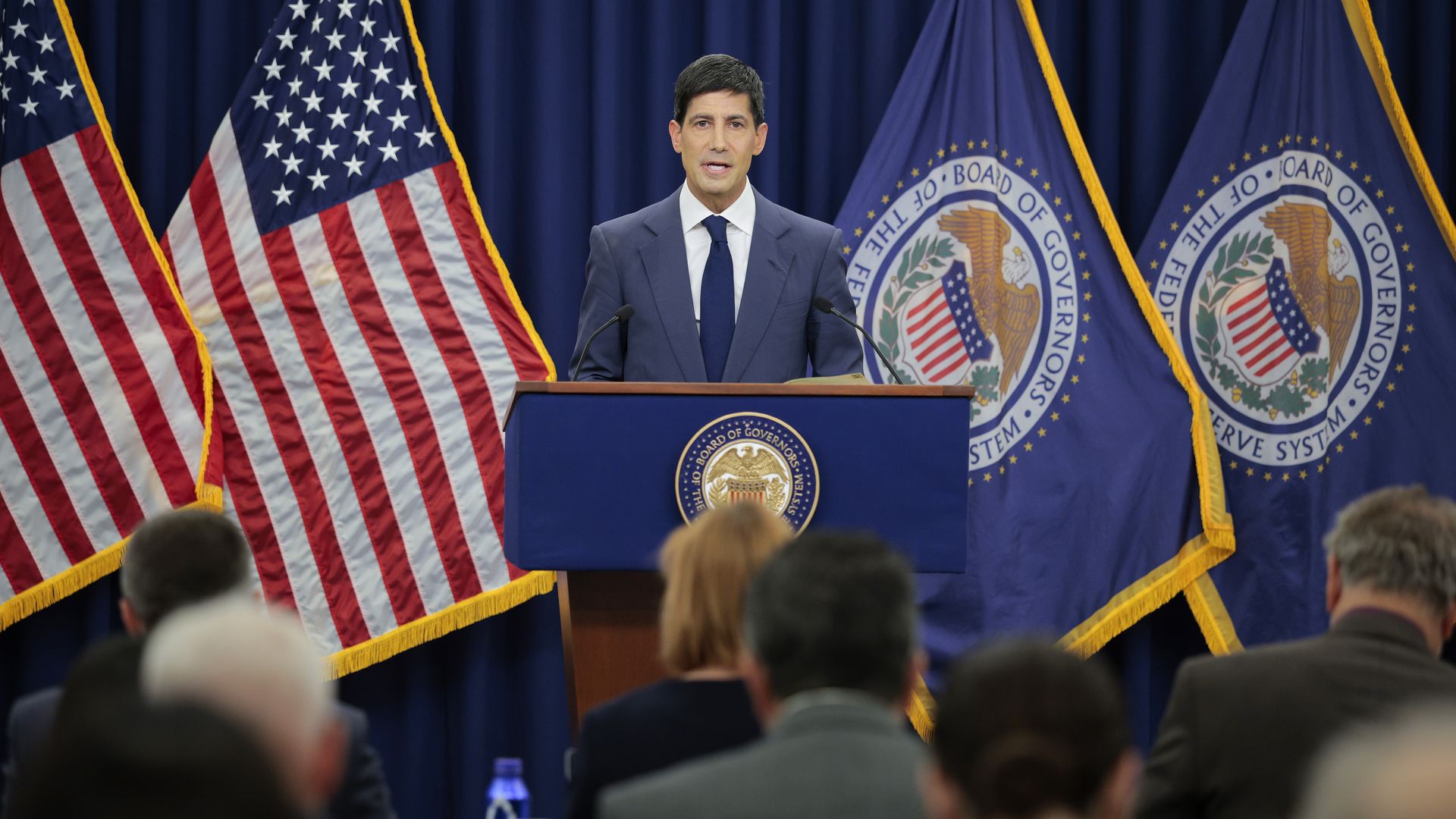
Federal Reserve chairman Kevin Warsh on Wednesday during his first news conference since taking the helm at the central bank. Photo: Chip Somodevilla/Getty Images
The Federal Reserve left its target interest rate unchanged in Kevin Warsh's first meeting as its chairman, alongside new projections showing that many top officials now anticipate raising interest rates this year.
Why it matters: Warsh is taking charge of the central bank amid a renewed surge of inflation that has dashed hopes for interest rate cuts this year.
- Against that complex backdrop, Warsh indicated that the ways the central bank conducts monetary policy are set for significant changes in the months ahead.
Driving the news: The policy-setting Federal Open Market Committee on Wednesday left its main interest rate target unchanged in a range of 3.5% to 3.75% for the fourth consecutive meeting. The decision was unanimous.
- The closely watched statement omitted earlier language about future moves to rates, in line with Warsh's desire to get away from giving guidance about future policy moves.
- Warsh declined to offer his own projection for appropriate interest rate policy in the coming years.
What they're saying: "The statement just gives you the facts as best we can judge it," Warsh told reporters at a press conference. He added that so-called forward guidance "was not well suited to the current policy conjuncture."
- The central bank drastically shortened and simplified its policy statement, in line with Warsh's stated goals, to 130 words compared with April's 341 words.
Zoom out: Warsh has sought big changes in how the Fed communicates and shapes its policy decisions. The shorter statement is the first, clearest example of that.
- He hinted at more changes, potentially significant ones, to come.
- Warsh said he was establishing five task forces to assess key areas for Fed policy: Fed communications; the central bank's balance sheet; data gathering; productivity and jobs, and the inflation framework.
- It will include outside experts, with plans to begin in the weeks ahead and conclude by year-end.
- The task force members will "have a straightforward charge: Start with first principles, ask hard questions, examine current practice, consider alternatives, and ultimately propose next steps for policymaker consideration," Warsh said.
Zoom in: The statement did say that economic activity was "expanding at a solid pace despite elevated uncertainty that owes, in part, to the conflict in the Middle East."
- It also noted that the Fed "will deliver price stability," noting that inflation has been elevated "in part reflecting supply shocks that have driven price increases in certain sectors, including energy."
The backdrop: Financial markets had a mixed reception Wednesday to the new Warsh era that offered much less certainty about the path ahead for rates.
- The S&P 500 sank in the immediate aftermath of the statement release, but recovered ground during the press conference, only to resume falling afterward.
- The yield on the two-year Treasury note — most sensitive to Fed policy changes — soared, reflecting expectations for higher rates.
What to watch: President Trump appointed Warsh in hopes of securing lower interest rates, but economic circumstances haven't cooperated.
- New quarterly projections showed nine officials thought a rate hike would be justified, eight saw no change through year-end, and only one envisions a rate cut.
State of play: The consensus view of Fed leaders for much of the year has been that inflation was sufficiently quiescent that rate cuts are justified, but in recent months an inflationary surge — and not just energy prices inflated by the Iran war — has thrown that into question.
- In March, the median Fed official anticipated 2.7% inflation this year. Now, the median official anticipates a 3.6% rise in the Personal Consumption Expenditures price index.
- Inflation has run hot even outside of the Iran war-fueled energy price surge. The median forecast is now for 3.3% core inflation this year, up from 2.7% in March.
Editor's note: This story has been updated with details from Kevin Warsh's press conference.
