More than half of states have taken up menopause legislation

Add Axios as your preferred source to
see more of our stories on Google.
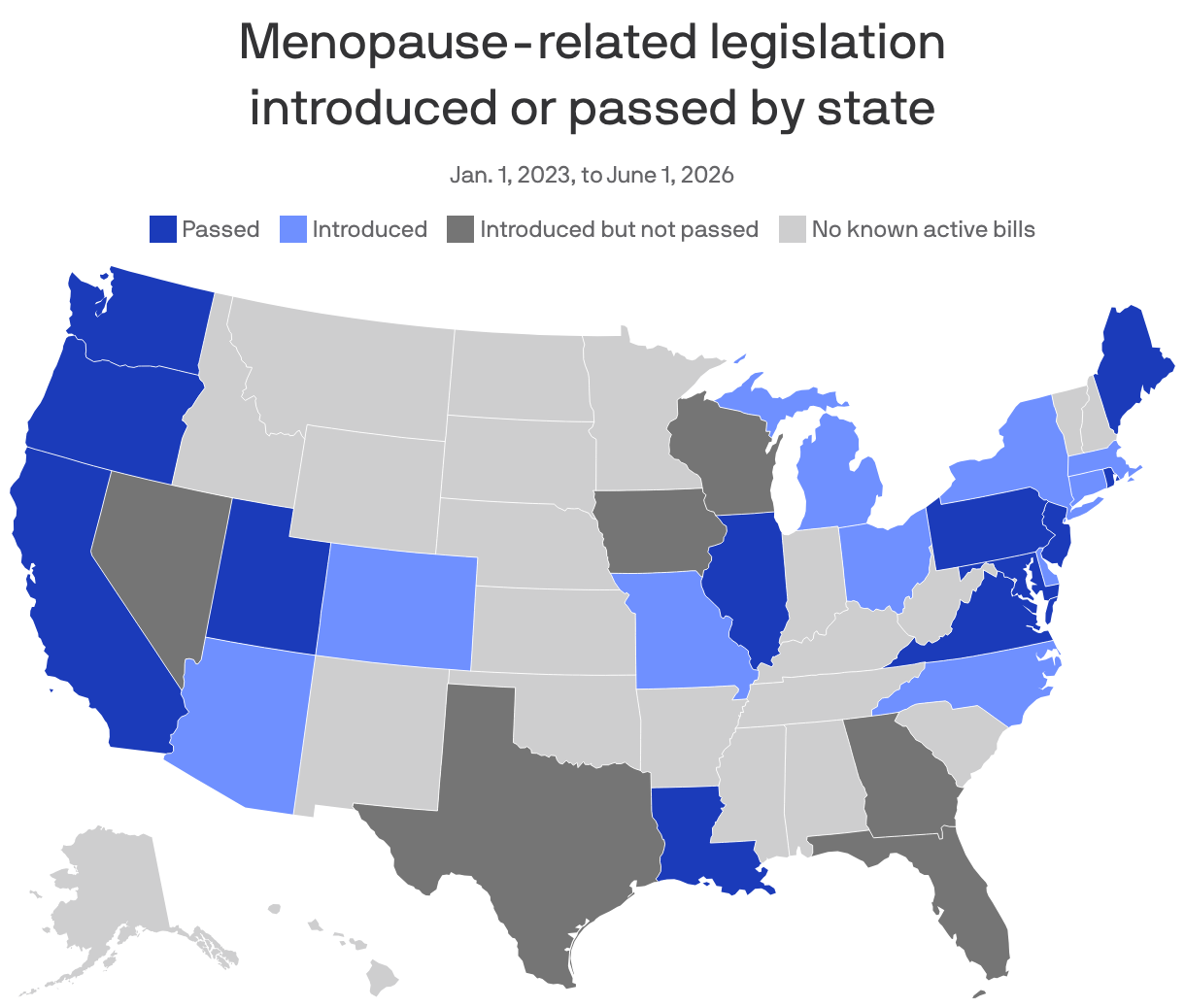
Dozens of state legislatures are leading changes across the country in policies for menopause care and coverage.
Why it matters: Menopause has moved from a taboo subject to a public policy priority.
"Why state action is so interesting and exciting right now is that nimbleness," Jennifer Weiss-Wolf, menopause policy advocate and author of the forthcoming book "When in Menopause," tells Axios. "It's a laboratory almost, and we're seeing what can work and why and how and what's good, better, best."
By the numbers: More than half of U.S. states have seen menopause-related legislation introduced or enacted since 2023.
- Recent examples include Maryland's sweeping menopause law that requires insurance coverage and continuing clinician training, New Jersey's menopause insurance coverage mandate and Utah's move to expand hormone therapy coverage for state employees.
The big picture: These moves come as menopause gains new attention from employers, health systems and investors. Growing awareness of its toll on workplace productivity has coincided with a surge in demand for care, fueling growth among telehealth companies and menopause-focused clinics.
Zoom in: States are taking different approaches toward menopause policy.
- California illustrates one type of push and pull. The state became the first to require menopause-related clinician education in 2024 but efforts to go further have stalled, with Gov. Gavin Newsom (D) vetoing two bills that would have mandated insurance coverage for treatment. Newsom is now pursuing similar goals through his 2026–27 budget proposal instead.
What's next: Politically competitive "purple" states like Pennsylvania are the ones to watch, Lisa McDonald, who tracks legislation for The 'Pause Life, tells Axios.
- Philadelphia enacted what advocates describe as the nation's first municipal workplace anti-discrimination protections addressing menopause, and lawmakers are now considering broader statewide measures.
- "Workplace protection is emerging as a stronger bill," McDonald said.
The bottom line: States are shaping what menopause care looks like in America.
