Why the International Space Station keeps leaking

Add Axios as your preferred source to
see more of our stories on Google.
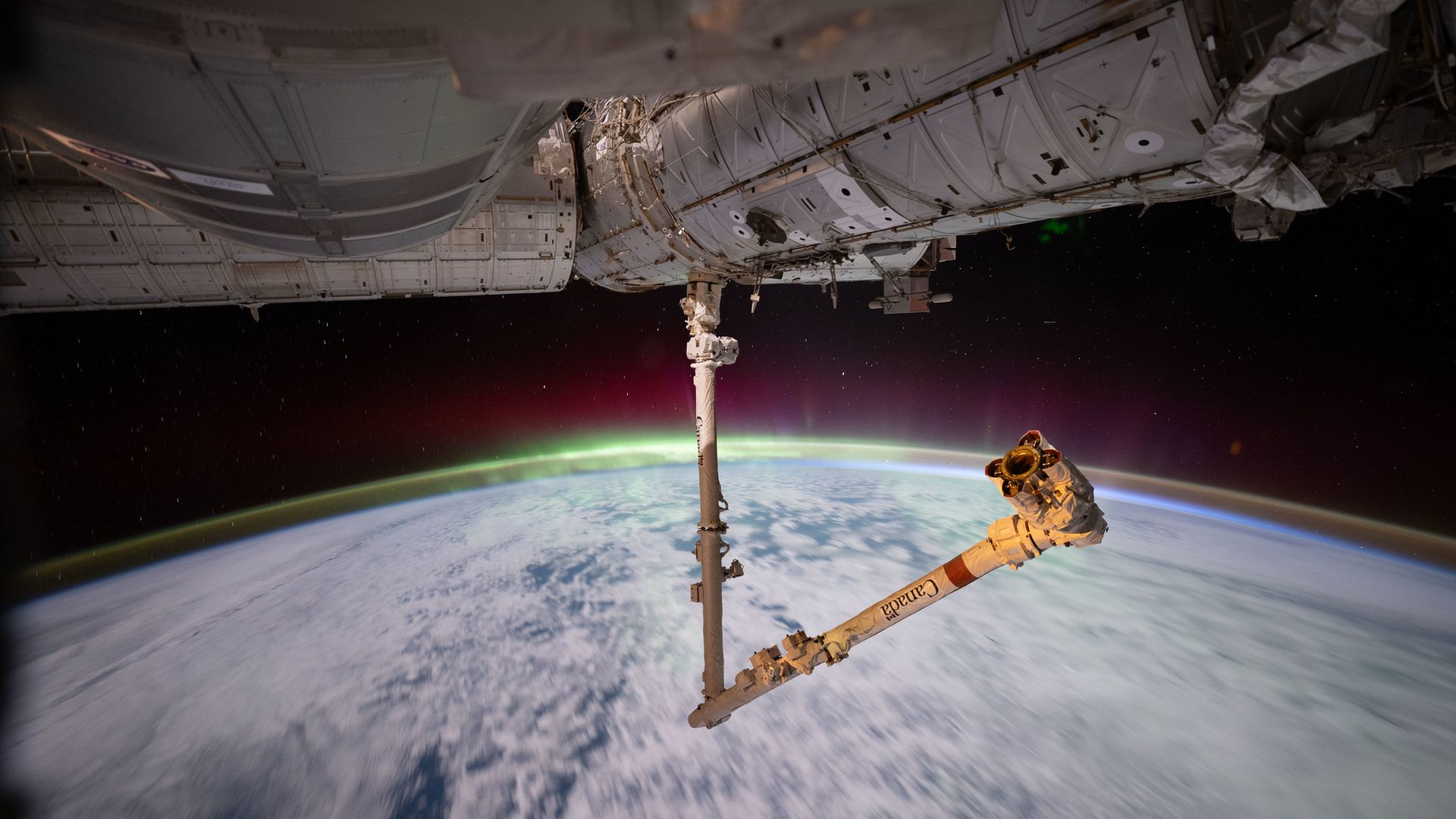
The Earth seen from the International Space Station on April 3, 2026. Photo: NASA/Chris Williams
NASA's decision to order International Space Station astronauts to prep for a hasty departure Friday was the latest — and most dramatic — episode in a years-long saga tied to mysterious leaks in a Russian module.
Why it matters: The ISS is nearing the end of its expected lifespan, but it's still invaluable for America's crewed spaceflight and scientific ambitions.
Driving the news: NASA on Friday ordered five astronauts to assume the "safe haven" configuration: Board the SpaceX Crew Dragon spacecraft currently docked with the ISS, and prepare for an emergency departure.
- NASA later said that order came after Russian space agency Roscosmos decided to investigate — and hopefully fix — persistent leaks plaguing its Zvezda service module.
- The astronauts didn't actually evacuate.
Roscosmos later paused "and did not perform the structural repair work," NASA said in a statement.
- The Russian agency instead conducted "additional measurements and data assessments, which included inspection of suspected areas of interest and review of areas where sealant was previously applied."
- "NASA strongly supported that decision, and as a result, following that decision, [the astronauts] ended their safe haven activities and returned to normal operations aboard the orbiting laboratory."'
Zoom out: The ISS has experienced several leaking problems over its nearly three-decade lifespan.
- The latest, involving Russia's Zvezda module, has been an on-and-off issue since Sept. 2019.
Zoom in: "Engineers believe the leaks are caused by microscopic cracks in the module's structure," Ars Technica reports.
- "Russian cosmonauts have repeatedly inspected and attempted to seal the cracks, but a permanent fix has eluded them."
Threat level: Roscosmos says there's "no threat to crew safety or onboard systems" — but any leak on a laboratory flying 250 miles above the Earth's surface at speeds of 17,500 miles per hour obviously presents a concern.
- Astrophysicist Jonathan McDowell tells Scientific American: "The worry is that a small crack could suddenly get catastrophically bigger."
- "That's unlikely but not impossible, and that would risk loss of the station and crew."
Between the lines: Friday's episode underscores the complex relationship between NASA and Roscosmos.
- The two major ISS partners represent nations that once competed against one another in the Space Race.
- They now have shaky relations at best in matters both terrestrial and celestial, and don't always agree on actions affecting the station as a whole.
What's next: The ISS is set to be de-orbited in 2031, with a fiery death in Earth's atmosphere offering a dramatic end to over three decades of unprecedented international cooperation in space.
