Rubio offers "new relationship" to Cuban people

Add Axios as your preferred source to
see more of our stories on Google.
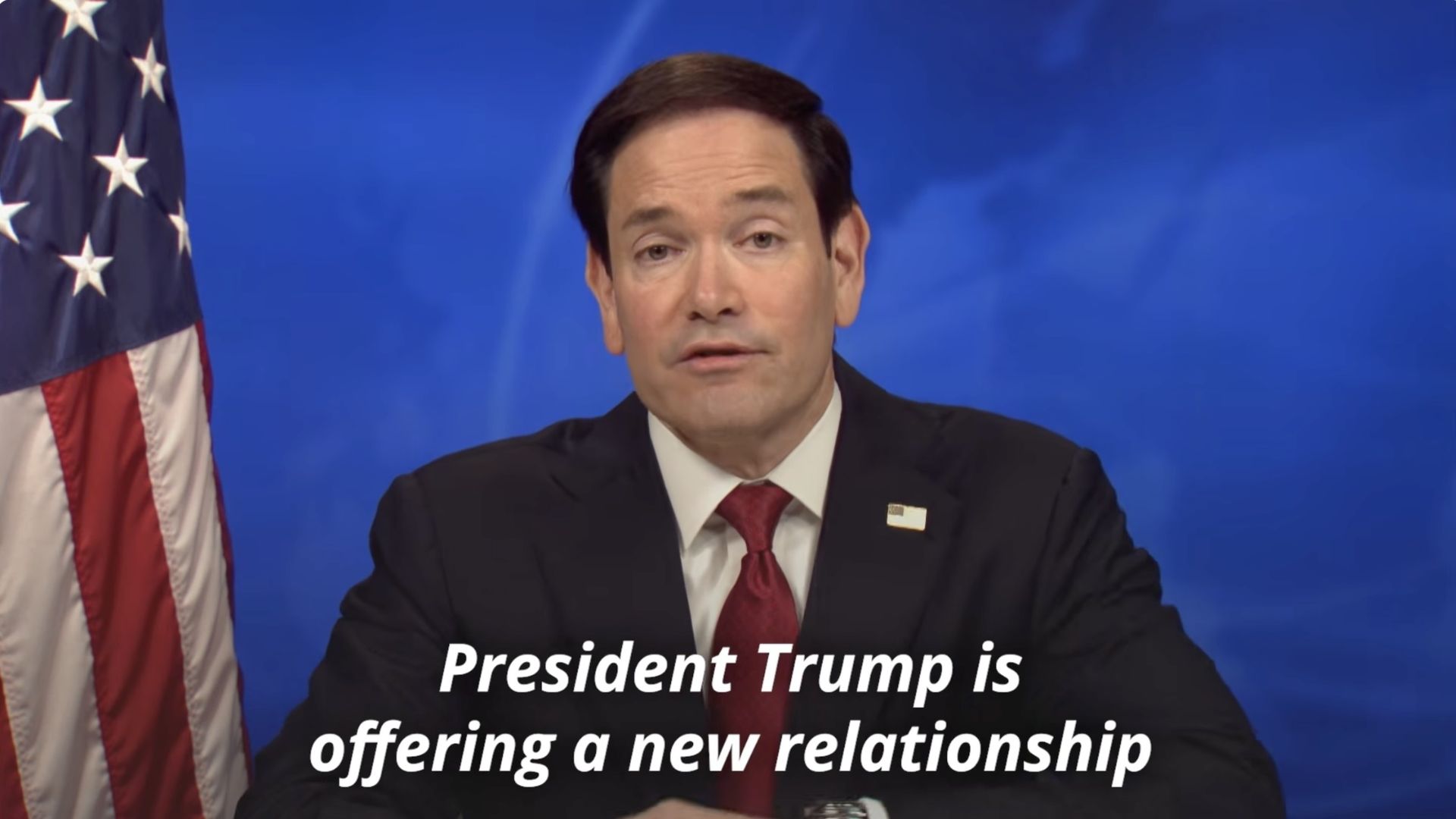
Screenshot: State Department via YouTube
Secretary of State Marco Rubio marked Cuban Independence Day on Wednesday with a Spanish-language video message to the people of the island that blamed their "unimaginable hardships" on their communist leadership.
Why it matters: This is the first time Rubio has addressed the Cuban population directly as secretary of state. It's part of the Trump administration's multi-layered pressure campaign targeting Havana.
- "The real reason you don't have electricity, fuel, or food is because those who control your country have plundered billions of dollars, but nothing has been used to help the people," Rubio says in the speech.
- Later Wednesday, the Justice Department will unveil the indictment of Cuba's de facto leader, Raúl Castro, for allegedly ordering the shootdown of two Miami-based rescue planes in 1996.
Zoom in: Rubio's speech focuses on the Cuban military business conglomerate known as GAESA — founded by Castro — that has an estimated $18 billion in assets and controls 70% of Cuba's economy through its control of hotels, construction, banks, stores and cash remittance from the U.S.
- Rubio contrasts the wealthy elites who run GAESA with the lives of destitute Cubans, seeking to show that revolutionary communism is a kleptocratic sham.
- "Cuba is not controlled by any 'revolution.' Cuba is controlled by GAESA," Rubio says.
- 'The only role played by the so-called 'government' is to demand that you continue making 'sacrifices' and repressing anyone who dares to complain."
- He adds: "Today, from media to entertainment, from the private sector to politics, and from music to sports, Cubans have reached the top of virtually ALL industries, in all countries, except one ... Cuba."
The other side: Cuba's government and supporters blame the island's troubles on the longstanding U.S. embargo, the Trump administration's new sanctions and the lack of oil it used to receive for free from Venezuela before the U.S. seized leader Nicolas Maduro on Jan. 3.
- "Acting as the world's policeman and in blatant violation of international law and the fundamental principles of free trade in goods and services, the sovereign right of all states that have or wish to maintain economic, commercial, and financial relations with Cuba is being explicitly, blatantly, and directly attacked," read a May 8 editorial in state-run media that criticized Trump's recent executive order imposing new sanctions.
- At Rubio's suggestion, Trump's executive order was issued on May 1 because it coincided with the communist International Workers Day.
The big picture: Cuba's economy and government have never been in such an advanced state of decay as it is now. Food and fuel are scarce. Electricity is available for only two hours a day in some places.
- "President Trump is offering a new relationship between the U.S. and Cuba. But it must be directly with you, the Cuban people, not with GAESA," Rubio says.
- The Trump administration is offering "$100 million in food and medicine for you, the people," he says, but it needs to be distributed by the "Catholic Church or other trusted charitable groups. Not stolen by GAESA to sell in one of their stores."
Meanwhile, U.S. officials told Axios, Cuba's government has found enough money to buy at least 300 attack drones from Russia and China in case hostilities erupt.
- Cuba also hosts Iranian, Russian and Chinese military and intelligence officials.
Flashback: In Trump's first term, Rubio was a U.S. senator from Florida and helped the president in 2017 construct a new sanctions regime that revolved around starving GAESA of money.
- A year later, Rubio and his fellow Cuban Americans from Miami called for the indictment of Castro by the Justice Department, which will officially happen today.
Between the lines: The Castro indictment signifies that U.S. negotiators aren't making significant progress with Cuban leaders in negotiating a peaceful transition to a more democratic country that's no longer considered a state sponsor of terror by the U.S.
- State Department personnel and CIA Director John Ratcliffe have flown to Cuba and spoken to leaders there, including Castro's grandson, Raulito Castro, who has also met with Rubio.
- All U.S. officials have delivered the same message urging Cuba to free political prisoners, hold free elections and return land to U.S. persons and businesses that were seized after the 1959 revolution.
Zoom out: May 20 marks Cuba's birth as a republic in 1902 following the Spanish-American War, but the holiday isn't celebrated on the island itself.
- Fidel Castro's government scrapped the holiday after the 1959 revolution.
What's next: More indictments of other Cuban officials and more sanctions announcements are likely on their way from the Trump administration.
- Rubio's speech doesn't mention that, but instead offers "you, the ordinary Cuban, and not just GAESA," the right to own a business, whether it's a gas station or a media company.
- "A new Cuba," Rubio says, would be a place where people can vote on their government officials and "where you can complain about a failing system, without fear of going to jail or being forced to leave your island."
- "This is not impossible. All of this exists in the Bahamas, the Dominican Republic, Jamaica and even just 90 miles away, in Florida. If owning your own business and having the right to vote is possible around Cuba, why is it not possible for you in Cuba?'
