Scoop: Trump AI executive order seeks early government access to advanced models

Add Axios as your preferred source to
see more of our stories on Google.
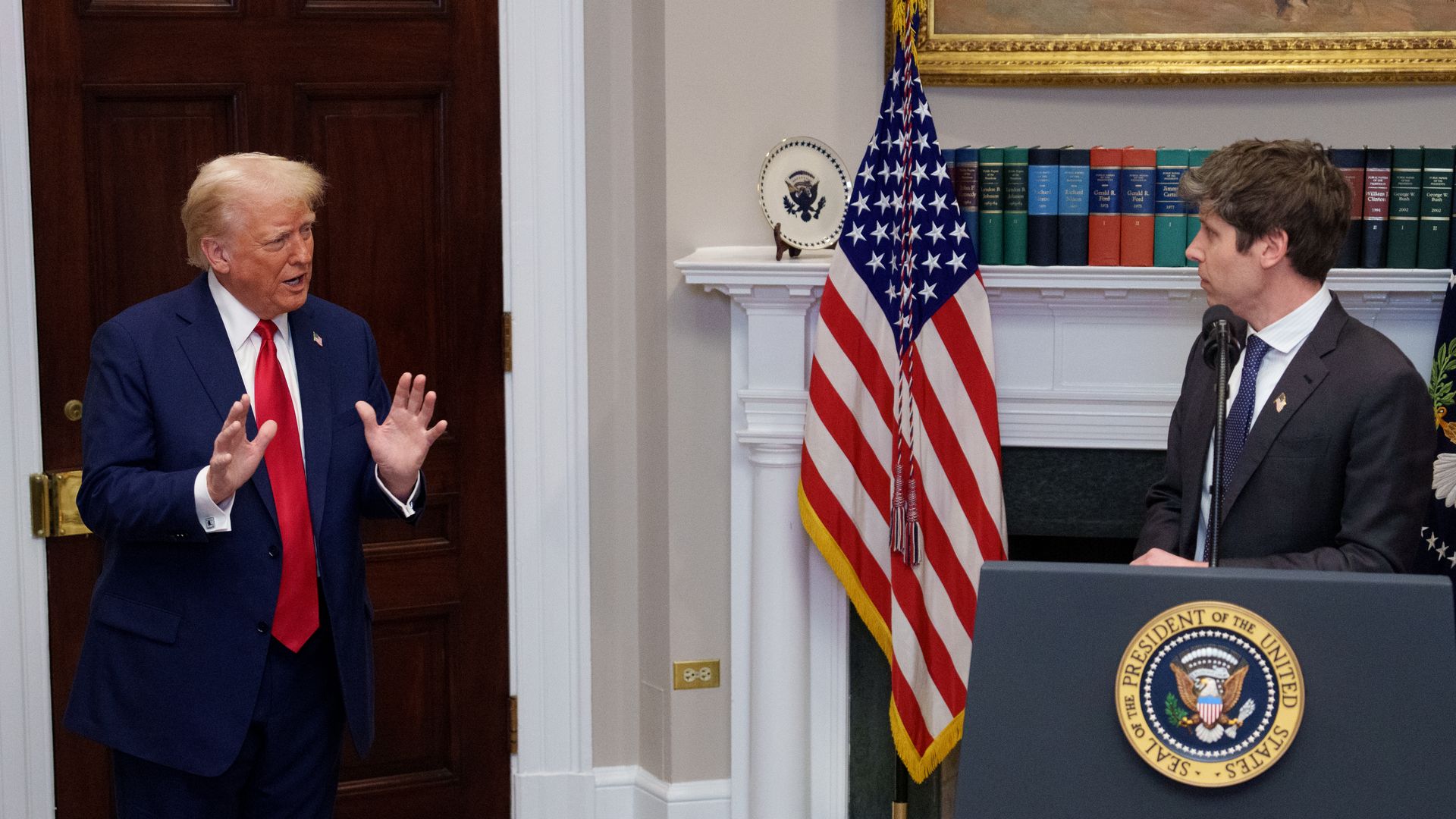
President Trump with OpenAI CEO Sam Altman in January 2025. Photo: Andrew Harnik/Getty Images
The White House plans to release its much-discussed executive order on cybersecurity and AI safety as soon as this week, sources familiar with the matter told Axios.
Why it matters: In its current form, the order seeks to bolster cybersecurity around advanced AI models and outlines plans for a voluntary framework for AI developers to inform the government about new releases, according to a readout shared with Axios and confirmed by a second source familiar with the plans.
The big picture: Should the plan work as intended, the Trump White House will have made good on its promise to address AI safety after the latest cyber-capable models like Anthropic's Mythos spooked the government.
- Still, the measures described to Axios are far short of what some more hardline voices in Washington and across the country have been pushing at a time when anti-AI sentiment is rising.
- The Mythos conundrum has softened the Trump administration's full-speed-ahead approach to AI, but the convoluted process around drafting the executive order has exposed how conflicted the administration is on the matter.
- "Any policy announcement will come directly from the president. Discussion about potential executive orders is speculation," a White House official told Axios.
What's inside: The executive order as described in its current form has at least two sections, the sources say: cybersecurity and "covered frontier models."
- The cybersecurity component aims to secure the Pentagon and other national security agencies, boost cyber hiring, shore up cybersecurity systems across the country at places like hospitals and banks, and encourage threat sharing about breaches between the AI industry and government.
- The frontier model component would involve multiple layers of government review to determine what qualifies as a "covered frontier model," and then to assess such models prior to their public release.
The intrigue: The draft, in its current form, calls for a "voluntary framework" to be established under which AI labs would share their models with the government at least 90 days before public release and also give access to certain critical infrastructure providers.
- It's not entirely clear which parts of the government would be involved in that framework, but both national security and civilian agencies appear to have roles in the EO's enforcement.
- Some details of what are expected in the order were previously reported by Bloomberg.
Between the lines: Cybersecurity was not initially a high priority for the administration. Trump significantly cut funding and staffing at the Cybersecurity and Infrastructure Security Agency, for example.
- But Mythos and OpenAI's latest model, GPT-5.5-Cyber, have raised alarm bells both inside and outside government due to their ability to find and exploit software vulnerabilities with unprecedented speed.
