Johnson, Jeffries launch bipartisan effort to combat sexual misconduct in Congress

Add Axios as your preferred source to
see more of our stories on Google.
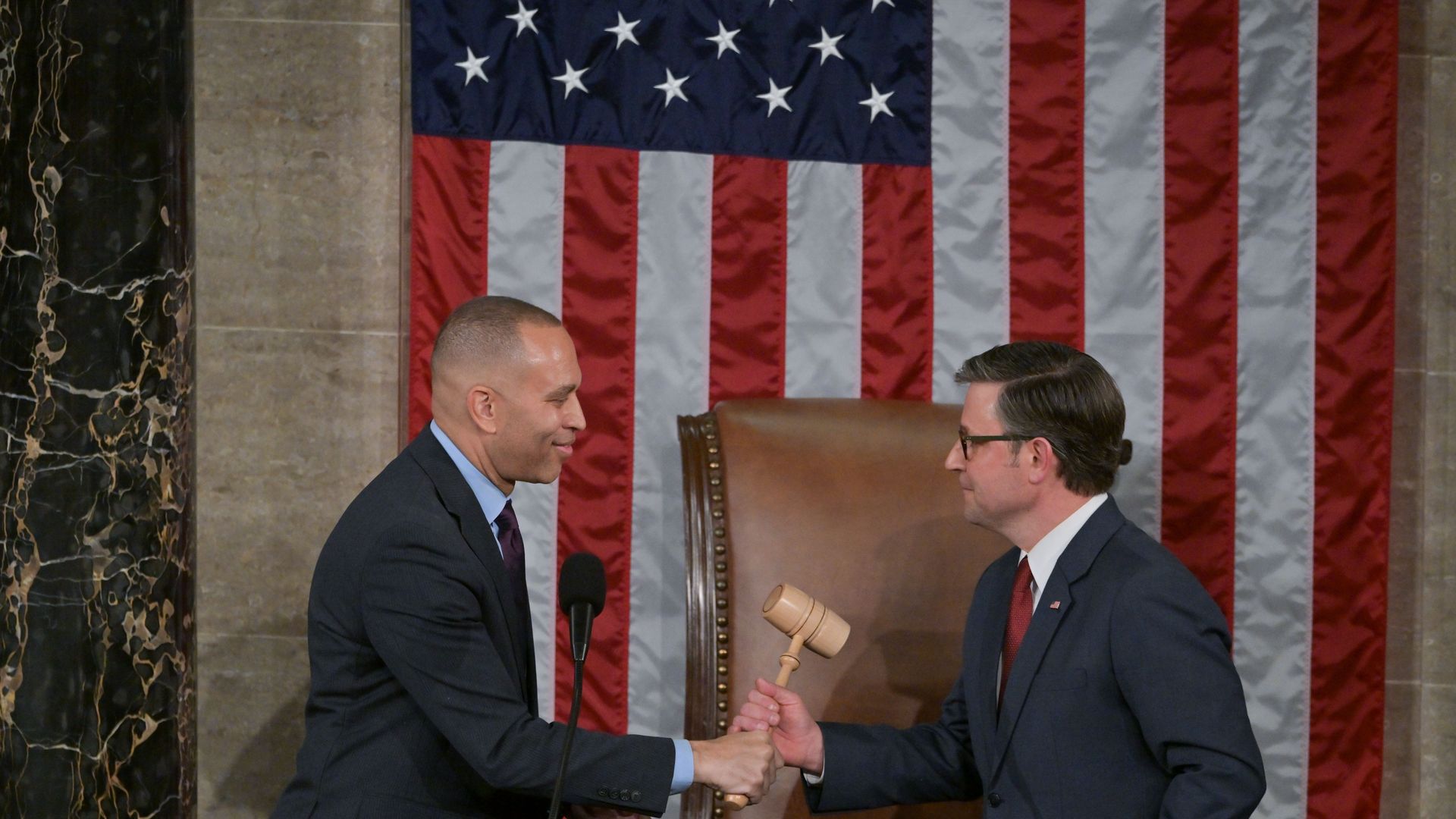
House Minority Leader Hakeem Jeffries., left, hands the gavel to newly reelected House Speaker Mike Johnson during the opening day of 119th Congress at the U.S. Capitol on Jan. 3, 2025. Photo: Ricky Carioti/The Washington Post via Getty Images
House Speaker Mike Johnson (R-La.) and Minority Leader Hakeem Jeffries (D-N.Y.) are forming a bipartisan "partnership" between the Republican and Democratic women's caucuses to combat sexual misconduct in Congress.
Why it matters: Congress is going through its biggest reckoning over workplace culture and sexual misconduct since the #MeToo movement rocked Capitol Hill in 2017 and 2018.
- The renewed scrutiny intensified after two lawmakers — Reps. Tony Gonzales (R-Texas) and Eric Swalwell (D-Calif.) — resigned last month amid allegations of sexual misconduct.
- Swalwell also faces allegations of sexual assault, which he denies. Gonzales admitted to an affair with a staffer who later died by suicide.
Separately, Axios reported Wednesday that a young female staffer whom Rep. Chuck Edwards (R-N.C.) singled out for special attention told another person that she feared retaliation from the congressman.
- Edwards' conduct toward young female aides has prompted a House Ethics Committee investigation. He has denied wrongdoing.
Driving the news: Johnson and Jeffries designated the chairs of the two caucuses — Reps. Kat Cammack (R-Fla.) and Teresa Leger Fernández (D-N.M.) — to lead the effort
- Proposed reforms from the two caucuses will be developed in coordination with the House Administration Committee, which has jurisdiction over congressional workplace policies, member conduct procedures and employment protections for House staff.
"To state the obvious, all women should feel comfortable and safe working in the halls of Congress. As a father who has two daughters working on Capitol Hill — this is as personal to me as it is to anyone," Johnson said in a statement first shared with Axios.
- Ledger Fernández said that the group wants to address the "procedural and cultural problems that have led to pervasive sexual misconduct on Capitol Hill."
Potential reforms under discussion include changes to reporting systems, retaliation protections, and increases in education and training resources.
- "The reality is that coming forward is extraordinarily difficult. Fear of retaliation, damage to careers, public scrutiny, and institutional pressure often silence victims long before justice has a chance to speak. We cannot claim to support women while ignoring the very real barriers that prevent them from reporting misconduct in the first place," Cammack said in the statement.
- NOTUS and CBS first reported on the existence of the effort.
Between the lines: Pressure has been building on congressional leaders to respond to accusations of sexual misconduct.
- Johnson told reporters last month that he would lead the charge himself to overhaul reforms to how sexual harassment cases are handled in Congress.
- The move marks one of the clearest signs yet that congressional leadership views the growing misconduct scandal as an institutional crisis.
- "We support an ironclad policy so we can bring about a safe, professional atmosphere for all Congressional staff members," Jeffries said in a statement.
The intrigue: The loudest demands for accountability have been coming from three Republican women: Reps. Anna Paulina Luna (R-Fla.), Lauren Boebert (R-Colo.) and Nancy Mace (R-S.C.).
- Boebert and Luna told Axios on Wednesday that they have not been involved in the new effort from Johnson and Jeffries.
- "Isn't it interesting that they don't want me to be on that since I'm very vocal on it? I don't care, I'm more effective off panels anyways," Luna said.
- "I'm sure at some point I will be involved in it," Boebert said.
The bottom line: "I didn't come to Congress to be the bedroom police. It's really frustrating that this stuff sucks up all the oxygen here," Boebert told Axios.
