SCOTUS' voting rights blow reverberates through state and local races



Add Axios as your preferred source to
see more of our stories on Google.
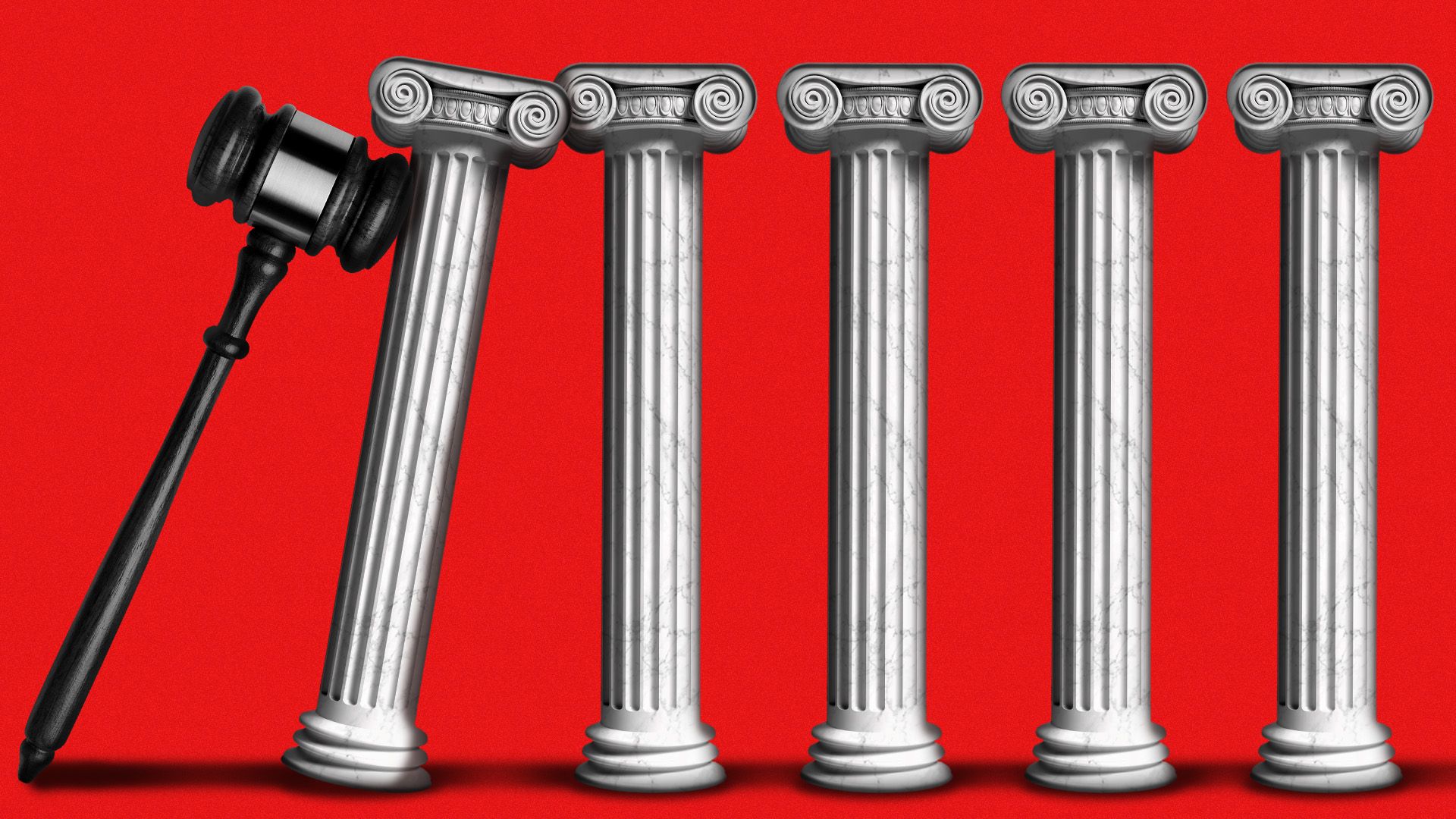
Illustration: Sarah Grillo/Axios
Statehouses, county commissions and city halls — not the halls of Washington — will absorb the heaviest blow from the Voting Rights Act's collapse.
Why it matters: Most Voting Rights Act lawsuits have targeted local and state governments: the entities that decide what's taught in schools, who polices the streets and which neighborhoods get sidewalks.
- Those suits typically fall under Section 2 of the Act, which lets minority voters challenge maps and election rules that weaken their voting power.
The latest: The U.S. Supreme Court gutted the Voting Rights Act with a Wednesday decision that essentially gives local and state bodies carte blanche to ignore minority voters as long as it serves some other purpose, like partisan gerrymandering or protecting incumbents.
- Section 2 cases were already notoriously hard to win, with challengers needing to clear three procedural hurdles to prove a violation. The new ruling makes each of those hurdles even harder to clear.
- The impact of the decision could mean that "city council, county commission, school board maps being redrawn around the country, because people will say, 'Oh, now we're free to do what we want,'" Michael Li, of the Brennan Center for Justice, tells Axios.
The big picture: Some of the earliest victories under the Voting Rights Act forced cities, counties and state legislatures to scrap at-large elections — countywide or citywide votes that drowned out minority neighborhoods and blocked Black and Hispanic representation.
Yes, but: Without Section 2's teeth, jurisdictions can reinstate at-large elections.
What they're saying: Press Robinson, a plaintiff in the case that led to Louisiana's second majority-Black district, said in a Wednesday press call that he foresees politicians elected by people of color disappearing on the local and state level in the not-too-distant future.
- "We'll be back where we were at the time that slavery was declared illegal in this country, but this country doesn't seem to want to advance beyond that time," he said.
Charles Taylor, the executive director of the Mississippi NAACP, tells Axios that the decision is a "betrayal to Black voters" with implications "up and down the ballot."
- In Mississippi, state lawmakers are set to reconvene in 21 days to reassess state Supreme Court districts — one of which a federal judge previously ruled violated the Voting Rights Act.
Threat level: The Voting Rights Act guaranteed representation for "thousands of communities through the drawing of districts," Michael McDonald, a political science professor at the University of Florida, says.
- In some states, redistricting in time for the 2026 midterms would be a significant stretch. But McDonald says the country can expect "a new round of districts being drawn that will sharply curtail racial representation" following the 2030 Census.
- However, the neutering of protections does raise the stakes for Democrats running for governorships in this election cycle, as they could block forthcoming redistricting plans.
The bottom line: "I don't think this is a slippery slope," Taylor says. "I think this is a fall off a cliff."
Go deeper: Supreme Court narrows voting law, lifting GOP odds of keeping House
