More than half of states now cover doulas under Medicaid

Add Axios as your preferred source to
see more of our stories on Google.
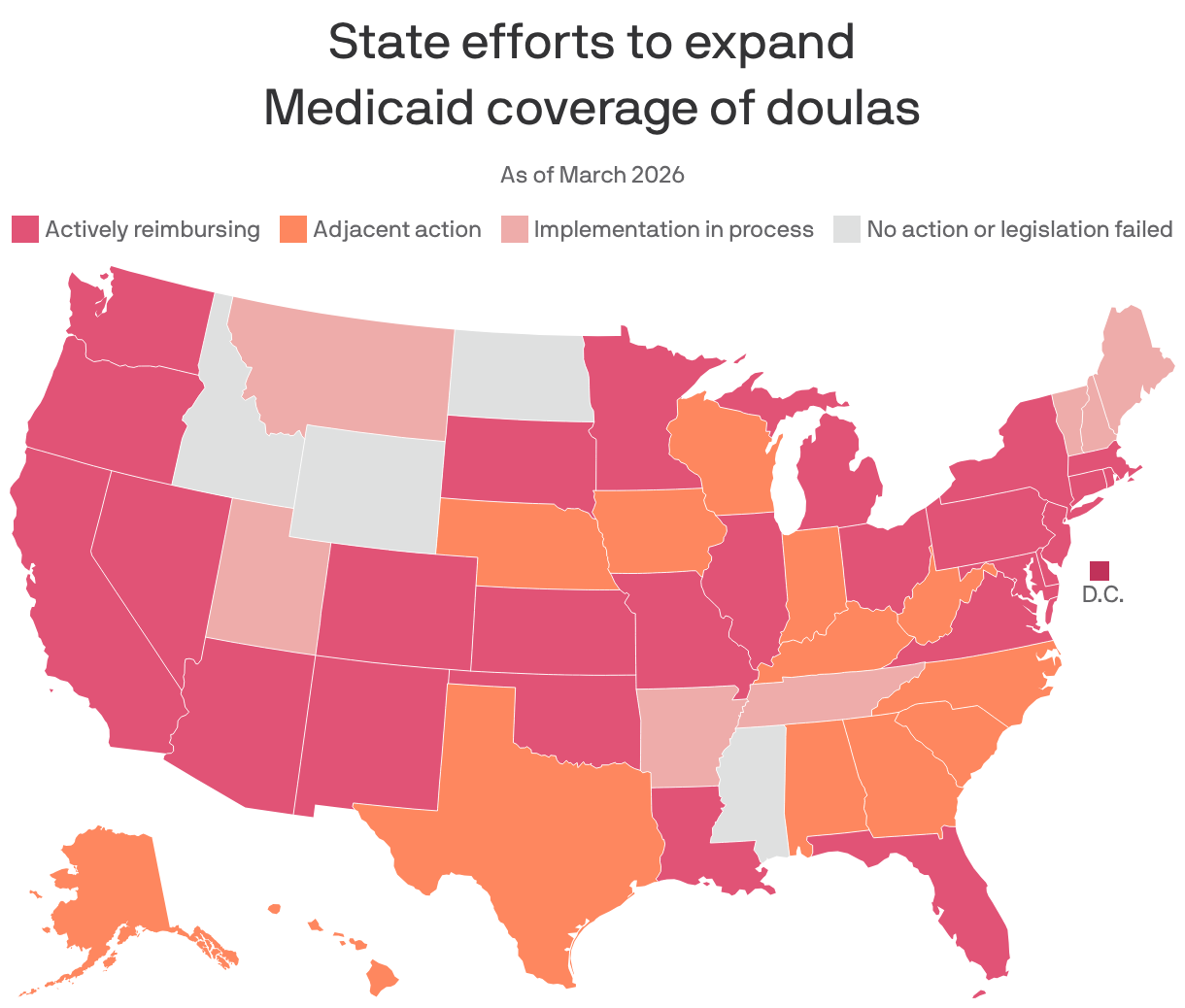
Doula care has gone from a niche birth option to a Medicaid-covered benefit in more than half of U.S. states.
Why it matters: Research has linked doula support to lower cesarean rates and fewer preterm births.
- And a new review of clinical trials published Tuesday in JAMA Network Open found doula support was most consistently associated with lower maternal anxiety, higher breastfeeding initiation and better postpartum follow-up care.
By the numbers: 26 states and D.C. are actively reimbursing for Medicaid coverage of doula care, according to the National Health Law Program.
- Before 2020, only Oregon and Minnesota offered Medicaid coverage for doula care — that's "a lot of progress" in a few years, says Amy Chen, senior attorney at the National Health Law Program.
- Between the lines: In the NHeLP map, "in process" states have a defined path toward Medicaid doula coverage but aren't reimbursing yet, while "adjacent action" states have taken related steps around doulas without a concrete plan to cover doula services through Medicaid, Chen says.
The latest: UnitedHealthCare recently announced it would allow for coverage of doula care in employer-sponsored programs nationwide.
- Only a few states require or are in the process of implementing doula coverage as part of private insurance plans.
A doula is a trained birth support professional who offers emotional and physical support during pregnancy, labor and postpartum. That's not the same as a midwife.
- While a midwife might perform medical tasks like checking blood pressure, doing cervical checks and catching the baby, a doula offers continuous nonmedical support — like delivering affirmations, helping with position changes in labor and advocating for the patient's desires in the hospital — says Nicole Sessions, an experienced doula and maternal mental health researcher.
Zoom in: During her first birth, Chen says her doula helped her and her partner advocate to avoid an unwanted incision.
- Chen's positive doula experience directly motivated her later policy work on Medicaid coverage for doula care. She had a doula for her next two births.
Zoom out: Improving outcomes for birthing people and infants also reduces the total cost of giving birth on the health care system, UHC tells Axios.
- Doula care has become a key tool for addressing the disproportionately high rate of maternal death among Black women.
Yes, but: Expanding coverage could create a catch-22 for the profession.
- The more doulas get folded into insurance and Medicaid systems, the more regulated they become. But doulas' effectiveness may stem precisely from being unregulated and fully answerable to their patients, Sessions says.
- "The insurance model isn't quite savvy enough to hold the nuances of the profession just yet," she says, citing limits insurers may place on billable hours for postpartum visits as one example.
- Experienced doulas may not sign on if reimbursement rates fall below their typical charges. Maximums vary by state and proposed plan, from less than $800 to more than $3,000, per NHeLP data.
The big picture: Even as doula care spreads, Sessions worries it's becoming "a band-aid" — absorbing pressure that should be driving deeper reform of the overall obstetric system.
What we're watching: Whether the states currently "in process" on the map follow through — or quietly stall, as Montana already has amid President Trump's cuts to Medicaid.
