Sam Altman's "proof of human" company pushes into mainstream services

Add Axios as your preferred source to
see more of our stories on Google.
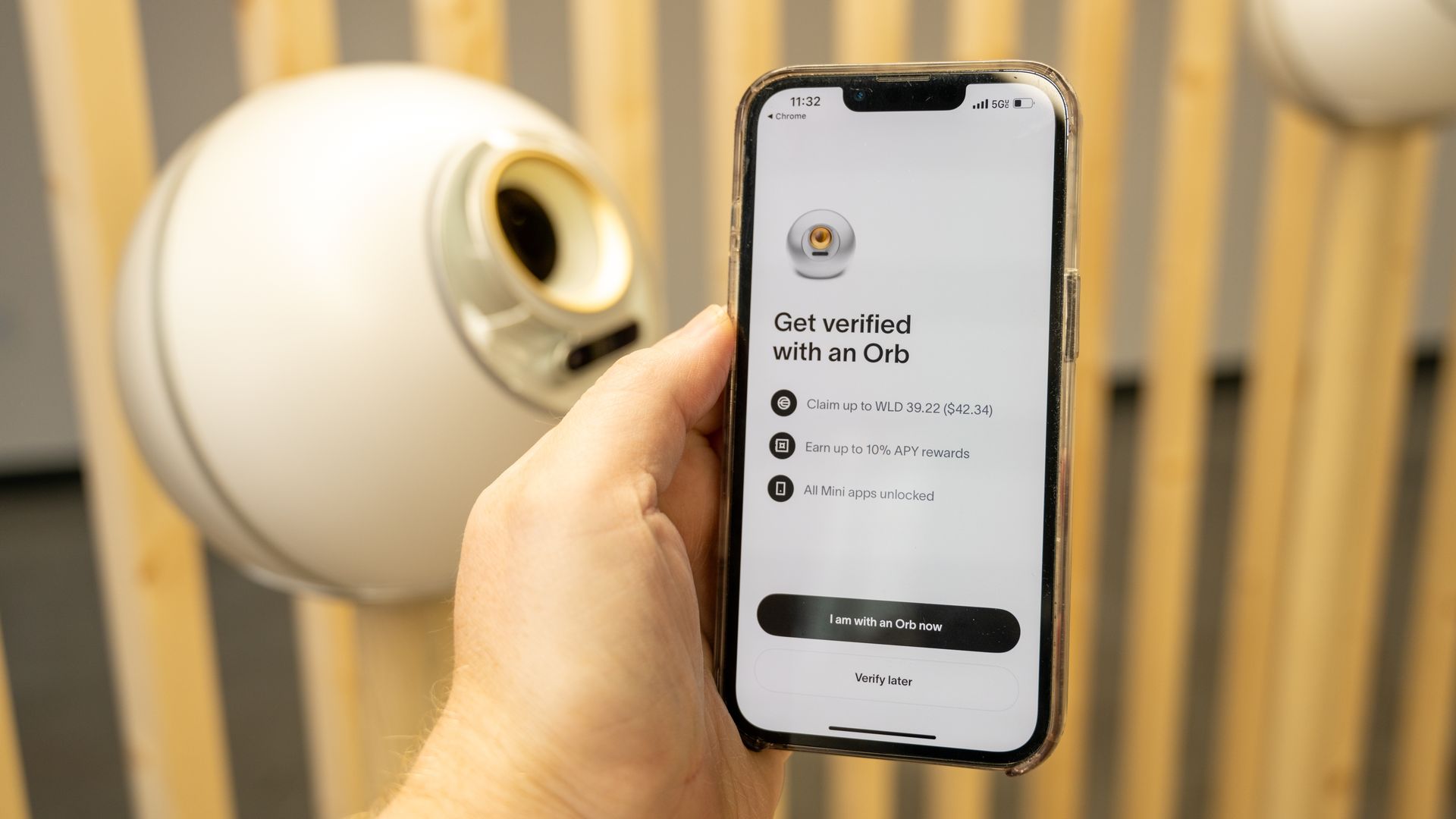
A smartphone displaying the World app for Worldcoin identity verification with orb scanning device in background in San Francisco. Photo: Smith Collection/Gado/Getty Images
A company co-founded by OpenAI's Sam Altman and known for its iris-scanning orbs announced new and expanded integrations on Friday with companies including Zoom, DocuSign, Tinder, Okta, Shopify and VanEck as it looks to grow its user base.
Why it matters: World, formerly known as Worldcoin, has struggled to convince everyday internet users to sign up for its identity verification system.
- But as AI agents proliferate, companies are increasingly looking for ways to verify not just who users are, but whether a real human is behind an online interaction at all.
Driving the news: World upgraded the protocol behind its identity tool, World ID, and is open-sourcing it so any app can integrate it as an authentication layer.
- The company is also launching a standalone World ID app, where users can store credentials and use them to log into other services.
Between the lines: The announcement bundles together a range of previously introduced ideas — from AI agent verification tools to non-biometric sign-in options — as World tries to push its technology into more mainstream use.
- World argues that verifying humans is becoming more urgent as AI companies roll out new agents and work towards AGI — making it harder to distinguish AI from real people.
- "When anything can be fake, you don't know who and what to trust," Tiago Sada, chief product officer at Tools for Humanity, which develops World, told Axios.
How it works: World ID is designed to function more like a CAPTCHA replacement than a traditional identity system, Sada said.
- The protocol has three-tiers for how users can validate their identities: taking a selfie, submitting an official government-issued ID, and going in-person to an "orb" to scan your iris.
- Each company that uses World ID to verify someone's "humanness" decides which level of verification they require.
Zoom in: World is now leaning on partnerships to drive adoption.
- Zoom plans to integrate World ID to help verify participants on video calls and guard against deepfake impersonation.
- DocuSign is testing World ID as a way to confirm that a real human — not a bot or compromised account — is behind a digital signature.
- Okta and Vercel are working with World on tools to verify that a real human approved certain actions taken by AI systems.
- Tinder is expanding a previous pilot in Japan to the U.S., allowing users to verify that a real person is behind a profile.
- VanEck is testing an in-office "orb" for employee verification.
- World is also launching a "Concert Kit" tool designed to help artists reserve tickets for verified humans and cut down on bot-driven ticket scalping.
By the numbers: About 17.9 million people have signed up for World ID globally, according to the company.
- The Wall Street Journal reported last month that roughly 1.1 million of those users are in North America.
Yes, but: Analysts have called the program "problematic on many levels," due to the security and governance concerns.
What to watch: World will soon expand the number of "orbs" available in San Francisco, New York City and Los Angeles so most people in those cities are within about 5-10 minutes from one, Sada said.
- World also plans to bring its "orb-on-demand" service to San Francisco after piloting it in Argentina last year, Sada added.
