OpenAI launches new AI model for life sciences research

Add Axios as your preferred source to
see more of our stories on Google.
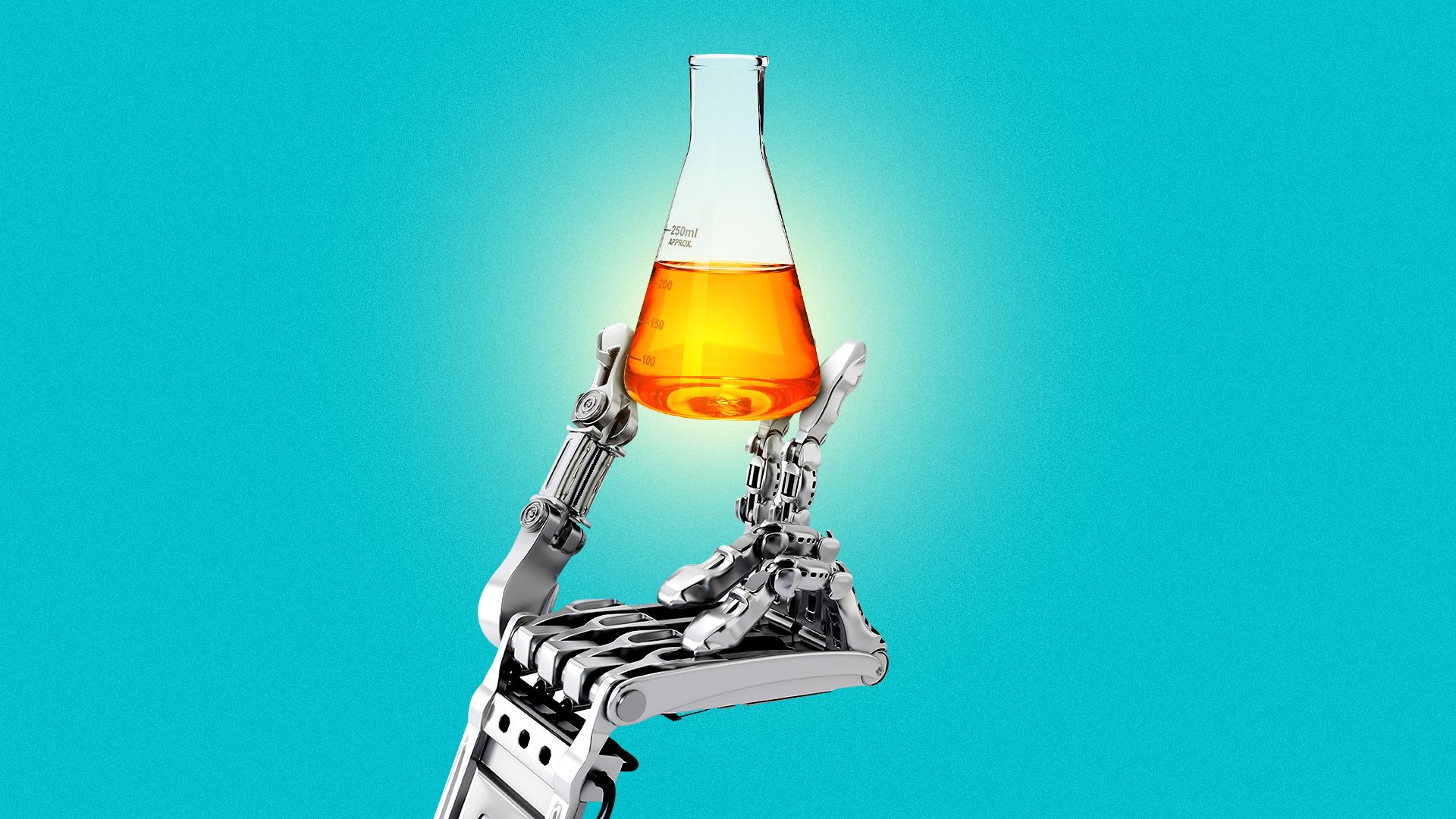
Illustration: Aïda Amer/Axios
OpenAI announced a new series of AI models built to help life sciences researchers work faster.
Why it matters: Biology research is increasingly computational, but scientists are drowning in data across fields like genomics, protein analysis and biochemistry.
By the numbers: Right now it takes roughly 10 to 15 years to go from target discovery to regulatory approval for new drugs in the U.S., according to OpenAI.
- Only one in 10 drugs entering clinical trials ultimately gets approved.
- More than 30 million Americans and 300 million people globally living with rare diseases are waiting for better treatments.
The big picture: OpenAI designed the first Life Sciences model — GPT-Rosalind — to be better at fundamental reasoning in fields like biochemistry and genomics, Joy Jiao, OpenAI's life sciences research lead, told a group of reporters on Wednesday.
- The company says the models won't replace scientists, but rather help them move faster through some of the most time-intensive and analytically demanding work of the scientific process.
- While there's an industry-wide effort to reduce AI hallucinations overall, OpenAI stresses that these new models are designed to synthesize evidence, generate hypotheses, and support analysis — not replace expert judgment or real-world validation.
- Humans, they say, still belong in the loop.
Fun fact: OpenAI named the model after British chemist Rosalind Franklin, whose research helped reveal the structure of DNA and laid the foundation for modern molecular biology.
Zoom in: The company launched the frontier reasoning model to accelerate research, drug discovery and translational medicine, which basically means turning scientific discoveries into better health outcomes.
- The model includes "enterprise-grade security controls" and access management, suitable for highly-regulated scientific environments, per OpenAI.
- The company already partners with Los Alamos National Laboratory on AI-guided protein and catalyst design.
Yes, but: Only a few AI-discovered or AI-designed drugs have reached clinical trials.
- No fully AI-discovered or AI-designed drug has made it through phase 3 trials.
The other side: The rollout comes as researchers warn that AI models trained on biological data could be misused to help design dangerous pathogens.
- An international group of more than 100 scientists have called for tighter controls on sensitive biological data used to train AI systems, Axios reported earlier this year.
Between the lines: OpenAI is launching the models in research preview to select enterprise customers through a "trusted access program."
- It will reserve access for organizations working on improving human health outcomes, conducting legitimate life sciences research, and maintaining strong security and governance controls.
- It will be available Thursday for what OpenAI calls "qualified customers," including Amgen, Moderna, the Allen Institute, and Thermo Fisher Scientific.
- The goal of limiting the program is to maximize use while mitigating the potential for misuse, Yunyun Wang, OpenAI's life sciences product lead, said.
What we're watching: Domain-specific models might be AI's next big phase.
- If the life sciences models deliver, expect this strategy to expand to other fields fast.
