Republicans announce plan to end record-long DHS shutdown

Add Axios as your preferred source to
see more of our stories on Google.
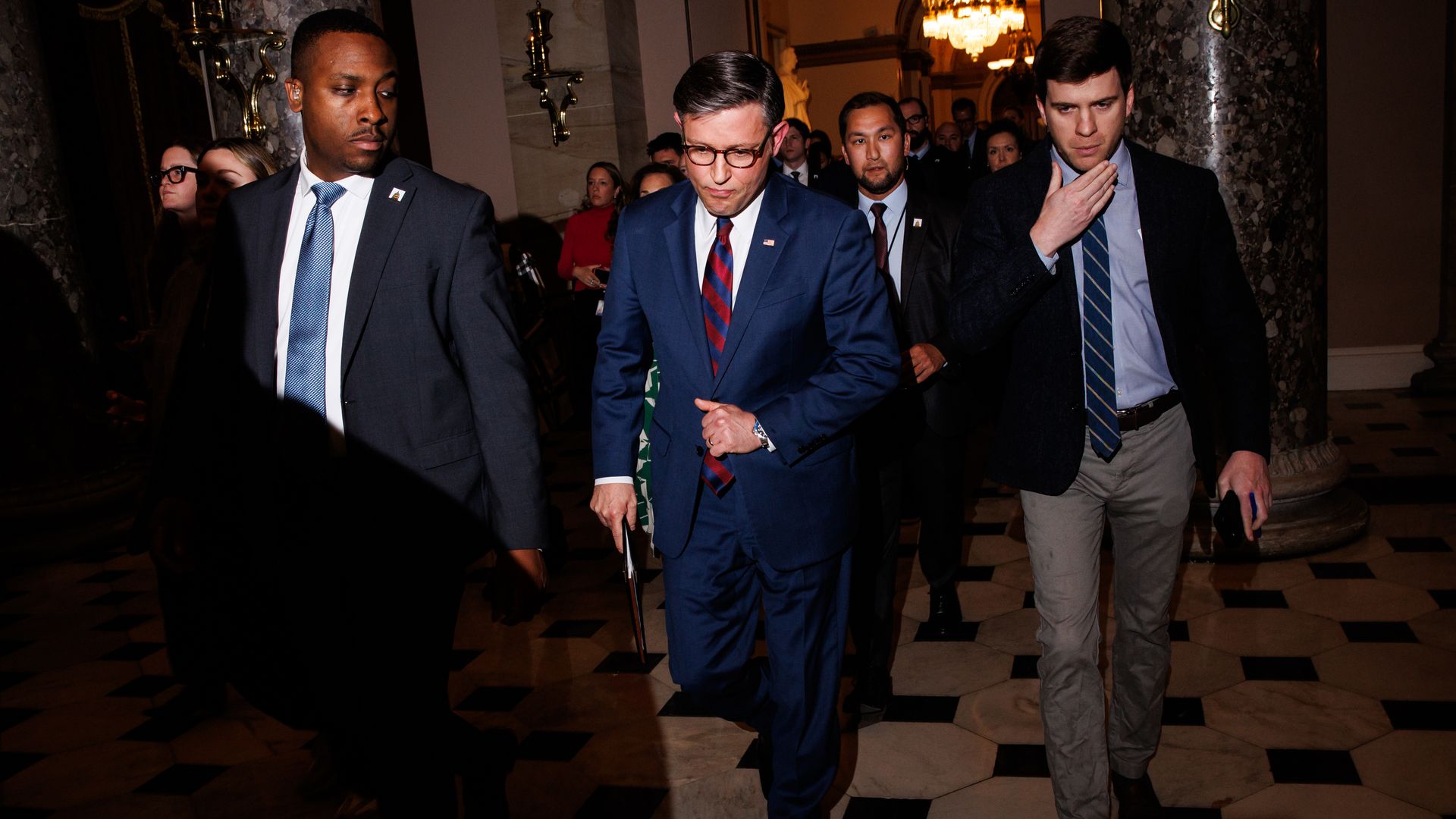
Speaker Mike Johnson on March 27. Photo by Samuel Corum/Getty Images
House Speaker Mike Johnson (R-La.) and Senate Majority Leader John Thune (R-S.D.) said Wednesday they'll advance a plan to fund the Department of Homeland Security — excluding ICE and CBP— with those agencies deferred to a later reconciliation bill.
Why it matters: House Republicans just five days ago rejected that approach, with some vowing to never support a DHS funding package without money for ICE and CBP.
- "In following this two-track approach, the Republican Congress will fully reopen the Department, make sure all federal workers are paid, and specifically fund immigration enforcement and border security for the next three years so that those law-enforcement activities can continue uninhibited," Thune and Johnson wrote in a joint statement.
- The plan mirrors what the Senate proposed and passed with unanimous consent just last Friday: a bill to fund all of the department, excluding ICE and CBP.
- Johnson on Friday called the Senate bill a "joke," vowing that "Republicans are not going to be a party to this," referencing excluding ICE and CBP funding from the appropriations package.
Catch up quick: House Republicans quickly rejected the idea of taking up the Senate-passed bill, with members of the House Freedom Caucus railing against it.
- "It is absolutely offensive to the people that we represent that the Senate would send over a bill that doesn't fund Border Patrol and the four core components of ICE," Freedom Caucus member Chip Roy (R-Texas) said Friday morning.
- That prompted Johnson to put a 60-day continuing resolution to fund all of DHS on the floor.
- The stopgap measure passed the House with unanimous Republican backing late Friday, but Senate Democrats made clear it was not something they would support.
Driving the news: Trump, in a Wednesday Truth Social post, called on Congress to fund ICE and CBP through the reconciliation process by June 1, essentially the Senate's plan that he'd lambasted just days ago.
- Johnson and Thune argued in their statement that Democratic opposition to the House's short-term fix left them with no alternative.
- They also pointed to momentum from the Senate Budget Committee on crafting a reconciliation package as justification for the shift.
Yes, but: Johnson was still publicly opposing that approach as recently as Tuesday.
- Just one day before the announcement, Johnson said on Fox News: "They sent us a bill that literally put the number zero in the bill for the funding of border security and customs and immigration enforcement. We can't do that."
What they're saying: Several House Republicans have been deeply skeptical that another reconciliation bill could get through Congress this year.
- Rep. Eric Burlison (R-Mo.) told Axios that it would need to move quickly and have healthcare reforms included.
- Rep. David Valadao (R-Calif.) told Axios on Tuesday that "leaving parts [of DHS] unfunded to be resolved in reconciliation is a bad idea."
What's next: The Senate is expected to take up the DHS bill and try to pass it by unanimous consent Thursday morning, with House action to follow at an undetermined time.
- Johnson hasn't yet decided whether he will call lawmakers back to Washington from a two-week recess that began Monday.
- The reconciliation process will also start in the Senate, with a Trump-set deadline of June 1.
