Jensen Huang: AI's biggest buildout is still ahead

Add Axios as your preferred source to
see more of our stories on Google.
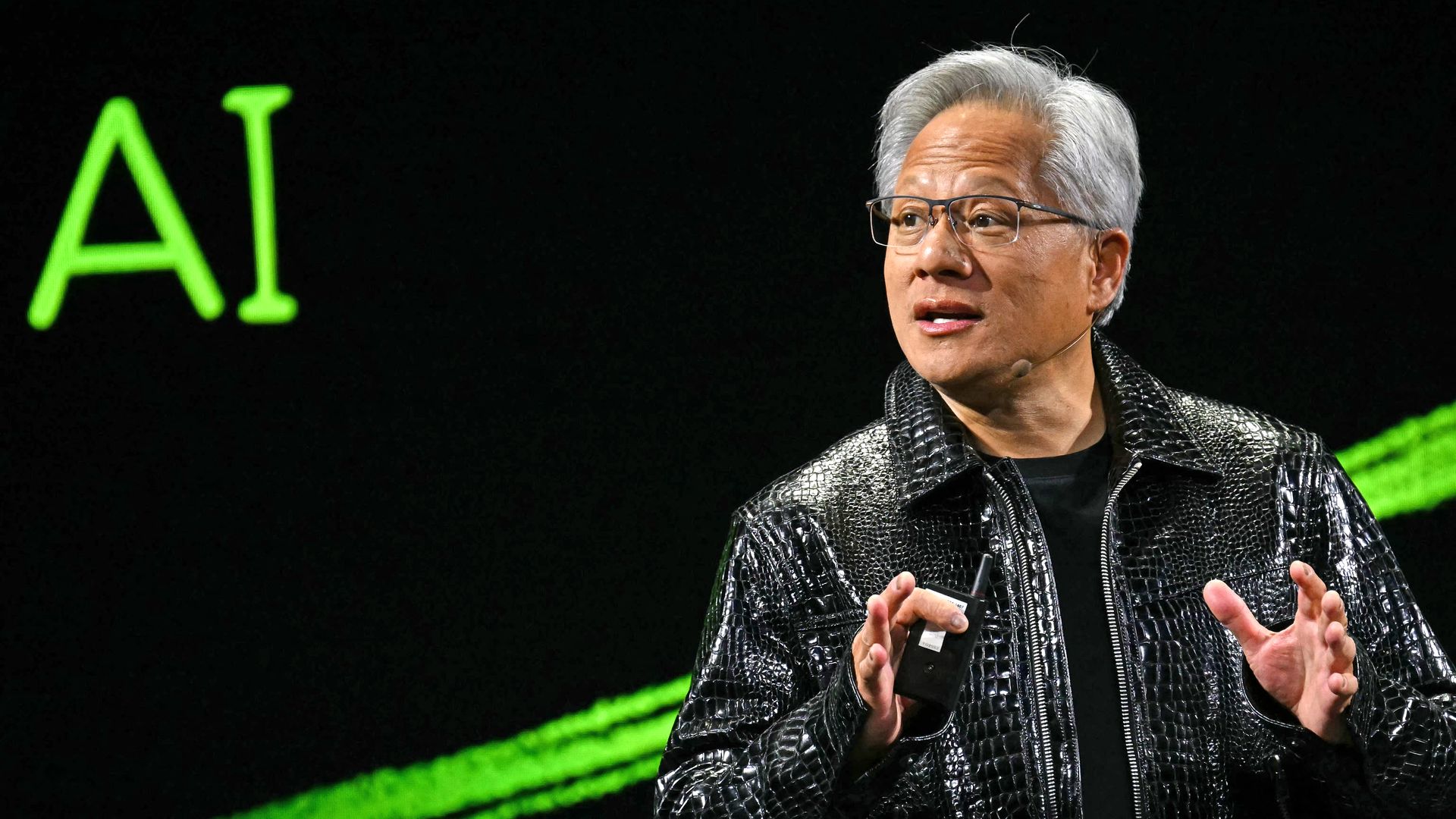
Nvidia CEO Jensen Huang delivers a keynote address at the Consumer Electronics Show in Las Vegas on Jan. 6, 2025. Photo: Patrick T. Fallon/AFP via Getty Images
Nvidia CEO Jensen Huang wrote in a blog post Tuesday that decisions about how fast to build AI, who gets access and how to govern it will determine the technology's legacy.
Why it matters: Huang — whose company underpins the AI boom — rarely publishes long essays about the tech's broader impact, offering other industry players and investors a rare window into his thinking.
The big picture: Huang argues that chip demand, expansion and hiring are still in the early stages of what he calls a long buildout.
- "AI is one of the most powerful forces shaping the world today. It is not a clever app or a single model; it is essential infrastructure," he writes in his seventh blog post since 2016.
- "Every company will use it. Every country will build it."
AI is different from software
Huang made the case that AI breaks the model of how traditional software worked.
- Traditional software runs on pre-written rules coded by humans. AI systems, he argues, generate answers in real time based on context.
- "Every response is newly created. Every answer depends on the context you provide. This is not software retrieving stored instructions. This is software reasoning and generating intelligence on demand," he writes.
The boom can create more jobs
Huang argues AI will create new kinds of jobs, especially in infrastructure and skilled trades.
- As the technology handles routine tasks, he writes, companies can serve more customers and expand. This dynamic, he says, ultimately drives hiring.
- "Productivity creates capacity. Capacity creates growth," he writes.
Reality check: There's relentless debate on how AI impacts the labor market, including how it speeds up work and makes people busier.
- Huang has previously suggested "everybody's jobs will be different" from AI. He also famously said at the Milken conference in 2025: "You're not going to lose your job to an AI, but you're going to lose your job to somebody who uses AI."
AI is a five-layer cake
Zoom in: AI can be understood by looking at the "five-layer stack" that Huang describes as "Energy → chips → infrastructure → models → applications."
- "Every successful application pulls on every layer beneath it, all the way down to the power plant that keeps it alive," he writes.
Flashback: The "five-layer cake" framework was originally introduced at the World Economic Forum in Davos in January.
"Trillions" more needed for AI infrastructure
What's next: Huang notes that the AI boom is only just beginning and will require trillions of dollars in additional investment.
- "We have only just begun this buildout," he writes of data centers and infrastructure. "We are a few hundred billion dollars into it. Trillions of dollars of infrastructure still need to be built."
AI boom has only just begun
The bottom line: "We are still early. Much of the infrastructure does not yet exist. Much of the workforce has not yet been trained. Much of the opportunity has not yet been realized. But the direction is clear."
Go deeper: Nvidia CEO to Joe Rogan: Nobody "really knows" AI's endgame
