Shooting chaos puts spotlight on Waymo's remote human operators

Add Axios as your preferred source to
see more of our stories on Google.
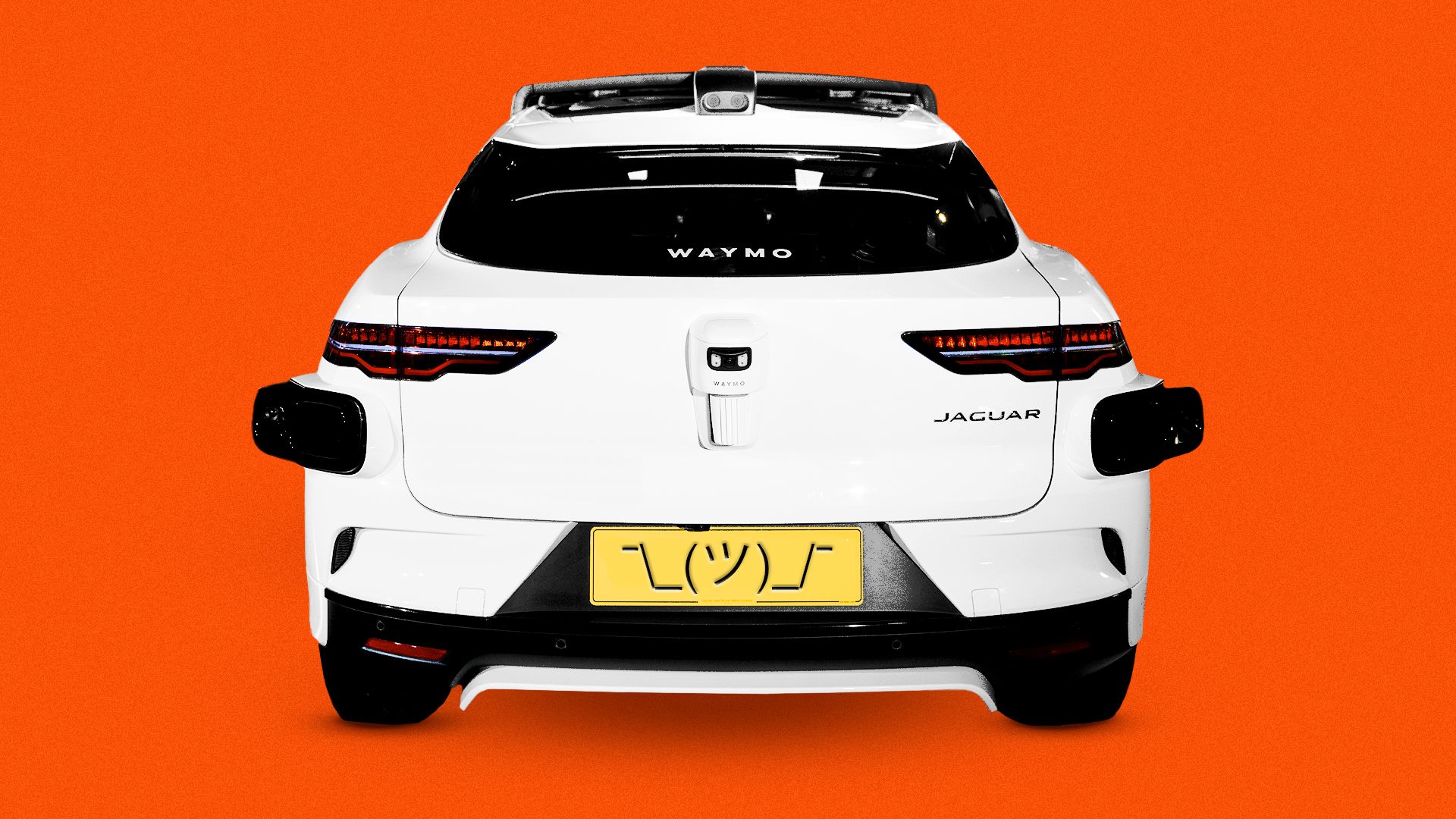
Photo illustration: Aïda Amer; Photo: Chris Ratcliffe/Bloomberg via Getty Images
When a confused Waymo robotaxi blocked an ambulance from reaching the scene of last weekend's mass shooting in Austin, Texas, it wasn't a remote Waymo agent coming to the rescue.
- Instead, it was a local police officer who got in and manually drove the car out of the way.
Why it matters: The incident exposes the limits of remote supervision systems in AV networks when vehicles — or the public — need urgent intervention.
The big picture: Congress has started asking questions about how remote assistance works in autonomous vehicles. Much of that concern has focused on how supervisors located far away — in Waymo's case, some of them 8,500 miles away in the Philippines — could pose risks to passengers, other drivers or even national security.
How it works: Waymo's remote assistants don't directly control the cars, the company explained in a blog post and a letter to U.S. Sen. Edward Markey (D-Mass.) after a recent committee hearing.
- They respond to specific requests from the robotaxi when its driving system asks for help, providing digital guidance to help the vehicle navigate tricky situations, like construction zones.
Driving the news: Few situations are more complex than a mass shooting, like the one that unfolded early Sunday morning in Austin.
- A Waymo robotaxi picking up a passenger near the site blocked an ambulance from reaching the scene, according to a bystander video circulating on social media and confirmed by Waymo and Austin police.
- The nearly two-minute video shows the Waymo stopped sideways in the road, as it attempted to make a U-turn amid the chaos, with an ambulance behind it trying to get by.
"Waymo! Come on! Go!" a woman can be heard pleading at the unresponsive car.
- "Yo, we just need to get into it, I think," a man answers.
A police officer arrived about 30 seconds into video of the standoff, and used his cellphone to scan a QR code on the side of the vehicle to contact Waymo specialists, following protocol in Waymo's training guide for emergency responders.
- After about 30 seconds, he was able to access the vehicle and climb into the front seat.
- It took nearly a minute for the officer, in communication with Waymo, to disengage the autonomous driving system and manually drive it into a nearby parking garage.
- The entire episode lasted under three minutes, according to Waymo.
Between the lines: Waymo's most experienced remote assistance agents are part of a U.S.-based "Event Response Team" whose primary purpose is to resolve field events like interactions with police, collisions or towing.
- At any given time, approximately 70 remote assistance agents are on duty worldwide, overseeing a fleet of more than 3,000 vehicles across six U.S. cities, the company says.
- Half are located in Arizona or Michigan; the other half are in two cities in the Philippines.
The impact: In Austin, the ambulance sought another route — and police say the incident didn't have serious consequences.
- "Our first responders are trained on how to manage driverless vehicles that become stopped or unresponsive," a spokesperson for Austin-Travis County Emergency Medical Services told Axios.
Yes, but: Safety advocates questioned AVs' abilities to handle emergencies, pointing to similar episodes in San Francisco, a major AV testing hub.
- "Blocking an ambulance during any emergency scenario, and especially during a mass-casualty response, is an unacceptable operational failure," said Cooper Lohr, senior policy analyst for transportation and safety at Consumer Reports.
- "If Waymo or another company's autonomous driving system can't handle flashing lights and sirens in a crisis, it isn't ready for public roads, and it should be removed from service until the company proves it will handle the situation appropriately."
Zoom out: Waymo's car in Austin got stuck thinking, balancing two things it was trying to do at once in a dynamic situation.
- "While humans are not perfect drivers, they have an amazing ability to muddle through a novel situation with high uncertainty, which is precisely where machine learning is at its worst," Carnegie Mellon Emeritus Prof. Philip Koopman, an expert in embodied AI safety, said.
The bottom line: As AV fleets grow worldwide, companies will need to improve remote oversight capabilities to ensure cars drive safely and can move quickly out of dangerous situations.
