The U.S. government is treating DeepSeek better than Anthropic

Add Axios as your preferred source to
see more of our stories on Google.
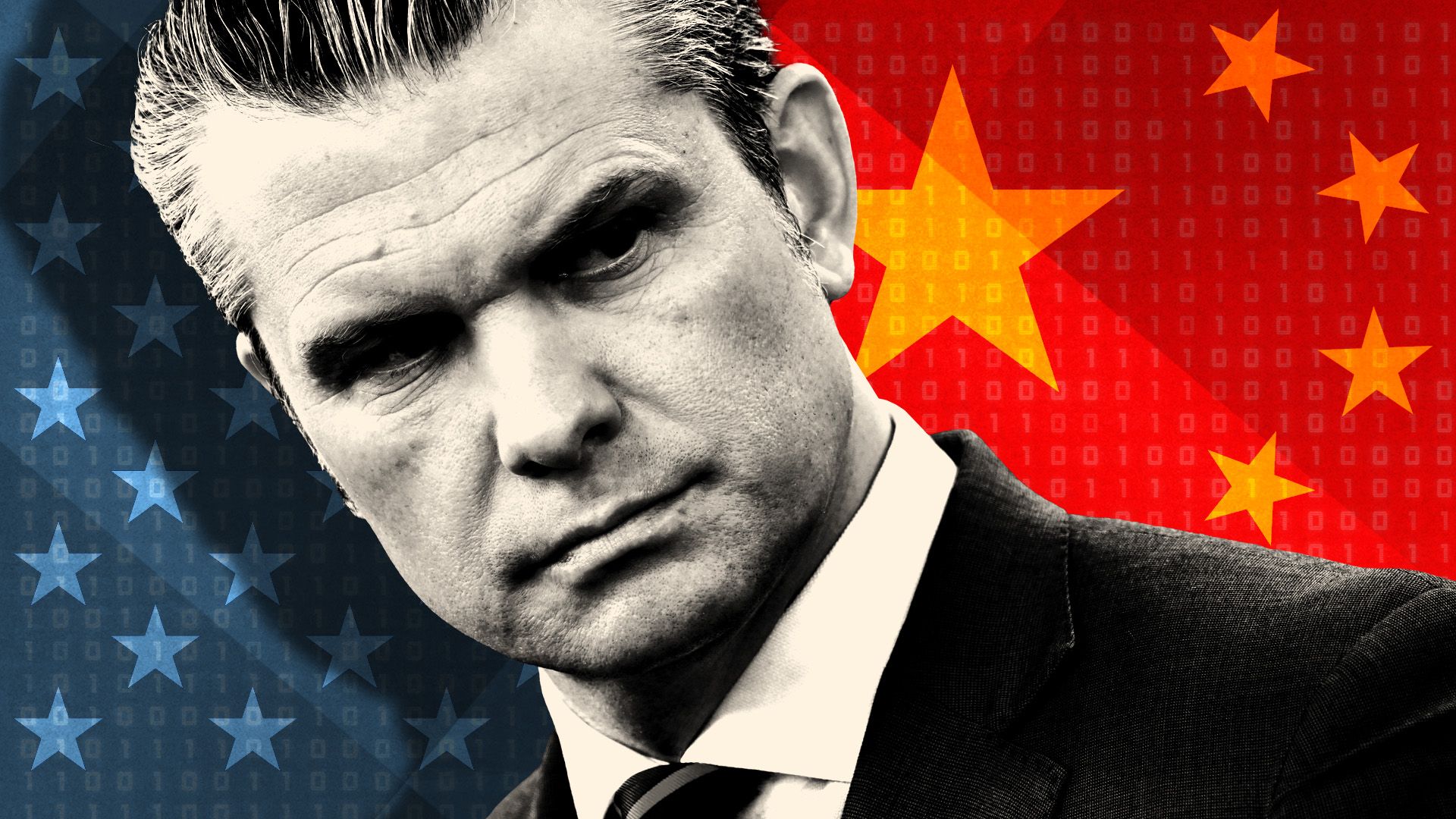
Photo illustration: Sarah Grillo/Axios. Photo: Brendan Smialowski/AFP via Getty Images
The Pentagon says it's threatening to blacklist top American AI lab Anthropic, without putting similar restrictions on Chinese rivals.
Why it matters: By penalizing a domestic leader for its safety standards, the U.S. is creating a market opening for cheaper, unregulated models from competing countries.
State of play: Secretary of Defense Pete Hegseth said on X he was directing his department to label Anthropic a supply chain risk, a designation typically reserved for foreign adversaries.
- President Trump instructed every federal agency to stop using Anthropic's technology "IMMEDIATELY" in a Truth Social post.
- The designation effectively bars any company doing business with the Department of Defense from using Anthropic's technology, potentially wiping out dozens of major enterprise customers.
The other side: DeepSeek, despite its ties to China, is not designated a supply chain risk. It's also rumored to release its latest model this week.
- Its popularity is growing: Per Sensor Tower data, DeepSeek's U.S. downloads grew 20% in one day after OpenAI landed its Defense Department contract.
What they're saying: "Anthropic is being villainized in a way that these Chinese open source labs aren't," Brexton Pham, global co-head of AI Infrastructure at Cantor Fitzgerald, told Axios.
- "This very public kind of blowup or fallout will result in the United States government not being able to leverage some of the best models that the United States has," Cole McFaul, senior research analyst at the Center for Security and Emerging Technology, told Axios.
Zoom in: The Pentagon has previously described Anthropic's models as superior to alternatives.
- Anthropic's AI tools remain deeply embedded in military deployment, most recently used during the U.S. intervention in Iran.
- Because the Pentagon has used Claude for longer, McFaul says, training context and efficiency is now at risk.
- "This is a failure for the United States," he added.
Zoom out: "Chinese models have already taken over the market," May Habib, CEO of AI firm Writer told Axios, as American AI startups are increasingly leaning on cheaper, open-source Chinese models to fine-tune their own.
- This allows enterprise users to avoid the high price tag that comes with relying on leading U.S. AI companies.
- It's not just startups: Airbnb CEO Brian Chesky has confirmed the company is using Chinese models because they are cheaper.
Between the lines: If corporations and the government can use Chinese models, but can't use the top U.S. AI models, that could give China a competitive advantage.
- The U.S. government's treatment of Anthropic could cause a "chilling effect to innovation" leaving an opening for Chinese labs with different ethical standards, Jennifer Huddleston, senior fellow in technology policy at the Cato Institute, told Axios.
- The spread of DeepSeek "provides a channel for promoting Chinese propaganda in the West," according to a report from the Estonian Foreign Intelligence Service.
- DeepSeek's privacy policy also states that it stores user data on Chinese servers, governed under Chinese law and complying with government requests for data.
Flashback: Anthropic has argued that Chinese labs are actively trying to extract insights from U.S. frontier models to improve their own.
- If the Pentagon limits access to a domestic lab while foreign rivals continue advancing, critics say that could widen the competitive gap Washington is trying to avoid.
Yes, but: The military has made clear in several other ways that it doesn't want employees using Chinese models.
- The U.S. Navy banned the use of DeepSeek, and so did the Pentagon after discovering employees were using the chatbot on work computers.
- But a supply chain risk designation isn't the same as just banning use of a company's product: It weaponizes procurement, forcing any company with government ties to separate from the firms deemed supply chain risks.
The bottom line: By restricting Anthropic, a leading U.S. AI firm, the government could give Chinese competitors — already expanding in the U.S. market — a strategic opening.
- "If the White House were serious about AI leadership, it wouldn't try to kneecap a top frontier lab," McFaul wrote on X.
