New measles surge revives doubts over fed response

Add Axios as your preferred source to
see more of our stories on Google.
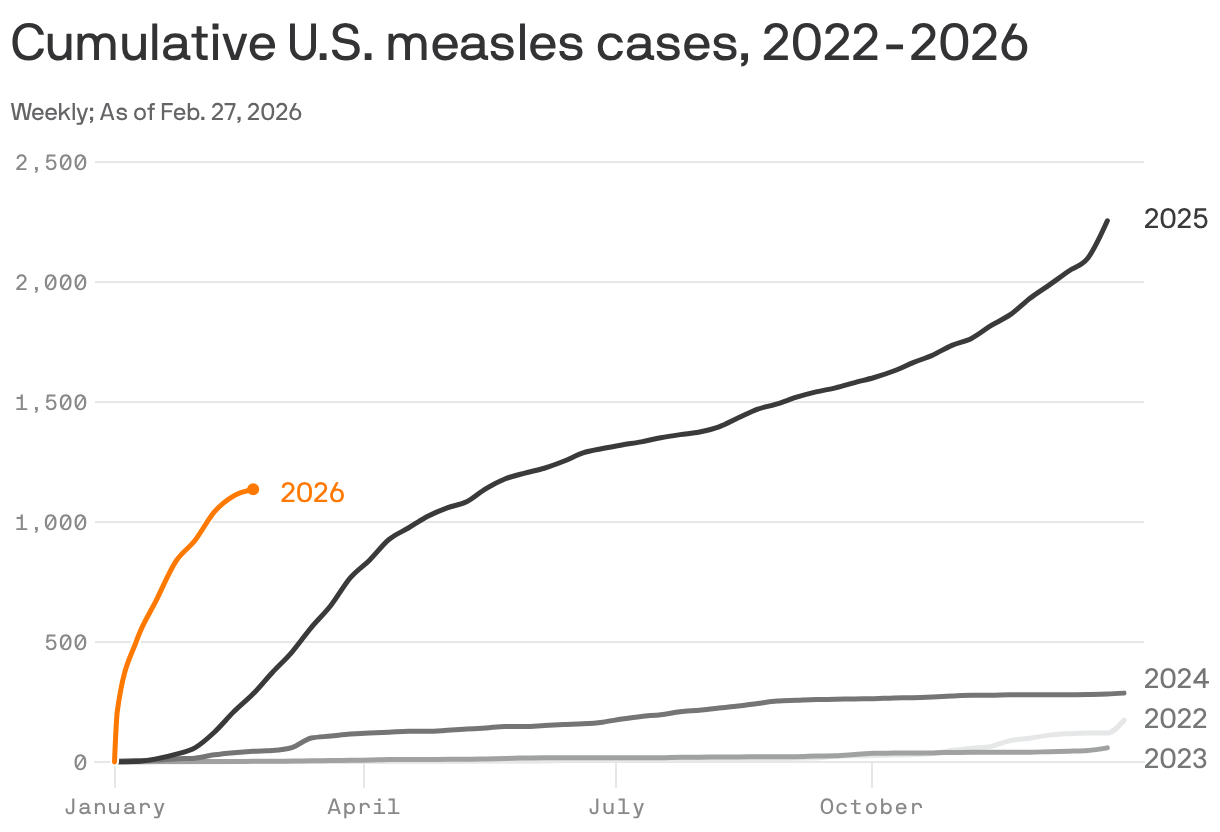
A surge of recent measles cases nearing half of the 30-year high recorded in 2025 is stoking more criticism of the Trump administration's lukewarm endorsement of vaccines.
Why it matters: There have already been more than 1,100 measles cases this year, overwhelmingly in unvaccinated people, putting the U.S. at risk of losing its measles elimination status.
- While top officials have stressed that the MMR vaccine is the most effective protection, they've repeatedly portrayed vaccination as a personal choice and ruled out new mandates.
Driving the news: Senate health committee Chair Bill Cassidy (R-La.) repeatedly pressed President Trump's surgeon general nominee, Casey Means, at a hearing last week on whether she would encourage vaccination against measles in response to outbreaks.
- Means said she supports the shots but added that everyone should talk to their doctor "before putting a medication in their body."
- Health Secretary Robert F. Kennedy Jr. has a long history of vaccine criticism that has fueled mounting criticism that he could be doing more to fight the outbreaks.
- "RFK isn't 100% to blame — but he helped fuel the [vaccine] hesitancy we're dealing with," Jerome Adams, President Trump's first surgeon general, wrote on X on Sunday. "Now HE is in charge of the (clearly failing) response."
What they're saying: "Typically, for something like this, you would see the secretary of health or the head of [Centers for Disease Control and Prevention] ... at a community clinic where people are getting vaccines, and congratulating them, giving them a sticker saying, 'I vaccinated,'" said Richard Besser, a former acting head of the CDC.
- "Promoting vaccination, not this sense of 'Well, you know, it's just a matter of choice,'" said Besser, now CEO of the Robert Wood Johnson Foundation.
The CDC remains in upheaval and hasn't had a full-time political leader since Susan Monarez was fired amid a dispute over changing vaccine recommendations.
- Acting CDC director Jay Bhattacharya did encourage vaccination in a video on X on Monday and said the agency is working closely with states and stands ready to help with technical support and vaccines "upon request."
- Mehmet Oz, the head of the Centers for Medicare and Medicaid Services, offered one of the Trump administration's strongest vaccine messages last month when he said on CNN, "Take the vaccine, please."
Between the lines: Kennedy initially downplayed the measles threat when an outbreak hit West Texas last year, killing two children. He later said "the federal government's position, my position, is people should get the measles vaccine."
- But in the same interview with CBS, he also warned that "right now we don't know the risks of many of these products."
- And Kennedy personally directed the CDC to change wording on the agency's website so that it left open the question of whether vaccines cause autism, a view long rejected by the medical community.
Health and Human Services spokesperson Emily Hilliard said in a statement: "Vaccination remains the most effective way to prevent measles, and the secretary has been clear and consistent on this point."
- An HHS official also said CDC has made $8.5 million available to seven jurisdictions with measles outbreaks to support activities like contact tracing, lab testing and vaccine efforts.
State of play: The current focus of measles spread is in Spartanburg County, South Carolina. The state has had almost 1,000 cases in the outbreak, with almost all unvaccinated.
- There have been 58 measles hospitalizations nationwide so far this year, according to the CDC.
- "For people that don't have immunity to measles, this is a pretty concerning spread ... that's happening here in South Carolina," said Jennifer Grier, an associate professor at the University of South Carolina School of Medicine Greenville.
- "Our vaccination rates are lower than we would really like for protection against measles, and we're seeing that turn into these hundreds of infections, because measles just spreads so quickly," she added.
One school in the outbreak zone in South Carolina had a vaccination rate of just 21%.
- Experts say 95% is needed to prevent outbreaks.
- "I think we're at the point in America where accomplishing 95% measles vaccination is going to be pretty much impossible in a lot of communities because it's been so politicized," Besser said. "And that's really tragic."
What's ahead: Any political fallout from losing measles elimination status won't be felt before the midterm elections.
- A meeting of international experts to make a determination has been delayed from April until November, to give the panel more time to review data.
