The AI boom belongs to capital, not workers

Add Axios as your preferred source to
see more of our stories on Google.
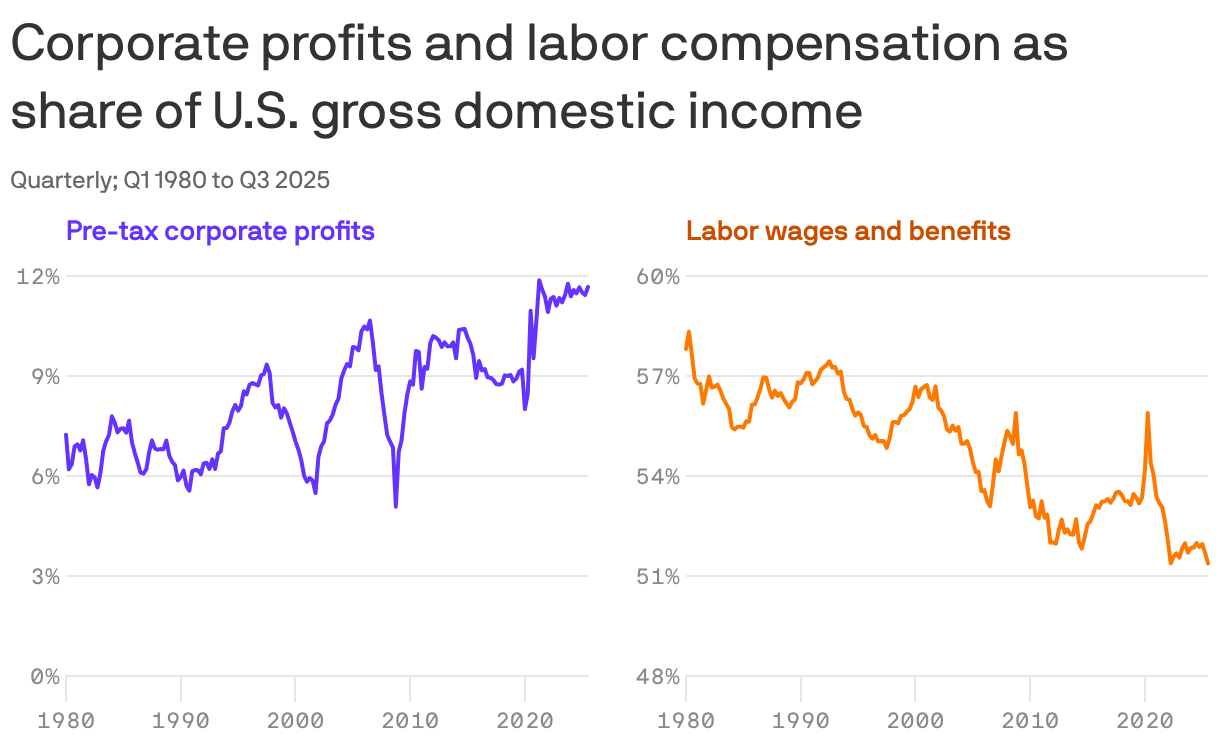
The United States is experiencing an investment boom from AI and the infrastructure that makes it possible — but much of those economic gains aren't reaching workers.
Why it matters: Job openings have become scarce and workers' wages are no longer rising that rapidly.
The big picture: That disconnect between strong growth and comparatively anemic results for workers may sound like a unique challenge of 2026, but in fact, it is part of a longer-run phenomenon.
- Since the 1980s, the share of national income accruing to labor has fallen markedly, and the share going to capital has risen.
- There are technological and structural reasons for this, which the current AI boom looks poised to exacerbate.
- The lopsided distribution of the economic pie helps explain why public opinion on the economy has remained in the toilet despite decent overall data — and why surveys point to Americans being pessimistic about the job market ahead.
What they're saying: "The divergence between capital and labor helps explain the disconnect between a buoyant economy and pessimistic households," writes the Wall Street Journal's ace economic columnist Greg Ip.
- "It will also play an outsize role in where the economy goes from here."
By the numbers: As Ip points out, the share of gross domestic income going to employees' wages and benefits was 51.4% in the third quarter, down from 58% in 1980.
- Over the same span, the share of income going to corporate profits rose from 7.2% to 11.7%.
- If labor were to return to its 1980 share, it would mean an extra $2 trillion in annual compensation — an average of $12,000 a year for each employed American.
Flashback: The shift over the last several decades involves many factors.
- Technological change is part of it. Forty years ago, an auto factory had scores of workers manually attaching parts to a car. Now robots do most of the heavy lifting and factory floors are comparatively sparse.
- That means more of the economic returns for selling a car go to owners of those robots — namely auto company shareholders —‚as opposed to taking the form of workers' wages.
- Shifts in workers' power — particularly with the decline of private-sector unions — are likely a factor as well, as is the rise of globalization and foreign outsourcing that gives companies more leverage to keep a lid on pay and benefits.
Yes, but: There's a case to be made that it was the business investment that generated the productivity that made higher incomes for workers possible.
- In this telling, the economic pie is so much bigger that workers are still better off even if their slice represents a smaller share of the total.
- Inflation-adjusted median household income, for example, was $23,00 higher in 2024 than in 1984 — a 39% rise.
What's next: The AI boom threatens to turbocharge that long-term trend. Data centers may reflect billions of dollars of investment while providing ongoing employment for a comparative handful of workers.
- Meanwhile, AI stands to make it possible for more white-collar work to be done by machines and software programs, much as robotics and similar advances displaced factory work a generation ago.
The bottom line: Americans are showing discontent with the current precarious economic balance, and the divvying-up of the national income helps explain why.
