Fed leaves rates steady, cites "solid" growth


Add Axios as your preferred source to
see more of our stories on Google.
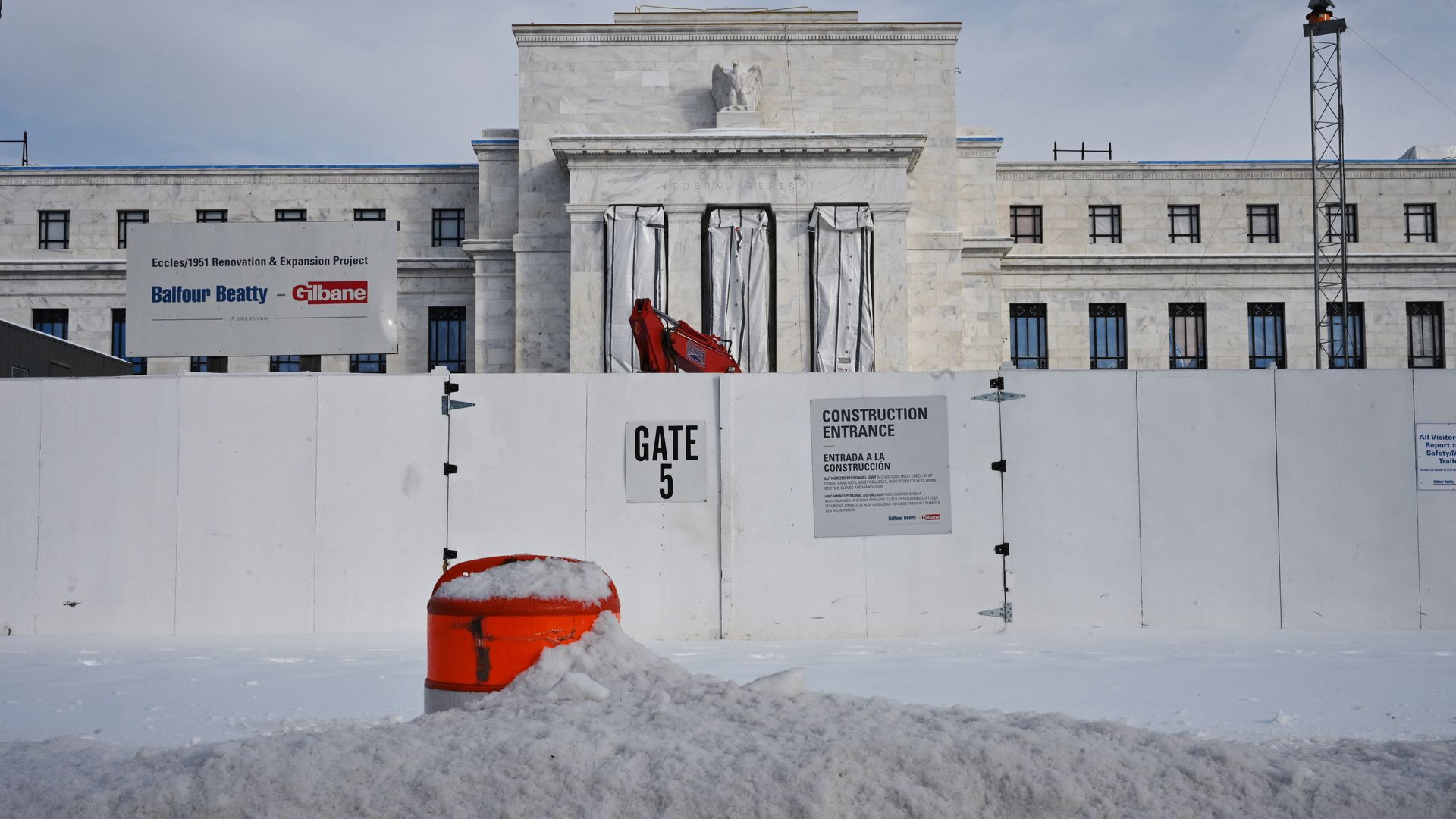
The under-renovation Federal Reserve headquarters building. Photo: Mandel Ngan/AFP via Getty Images
The Federal Reserve left interest rates unchanged on Wednesday, noting "solid" growth and a stabilizing job market, as the central bank navigates a delicate economic and political moment.
The big picture: The central bank's policy committee took a breather after three consecutive rate cuts in the final meetings of last year, showing greater confidence in the economy. But policymakers gave no hints as to when they may adjust borrowing costs again.
- The announcement of no rate move, at the conclusion of a two-day meeting of the Federal Open Market Committee, comes against the backdrop of a swirl of drama involving the central bank.
- That includes a criminal investigation of chair Jerome Powell, a looming Supreme Court ruling over whether the president can fire a governor, and a reality show-like selection process for the next Fed leader.
Driving the news: The FOMC left its target for the federal funds rate at 3.5% to 3.75%.
- In an accompanying statement, the committee said that economic activity "has been expanding at a solid pace," an upgrade from the "moderate" pace the officials saw in December.
- The committee also noted that "the unemployment rate has shown some signs of stabilization," in contrast with December, when it noted that the unemployment rate had "edged up."
- Similarly, the statement deleted language from the previous statement that the committee "judges that downside risks to employment rose in recent months."
Between the lines: The adjustments to the statement language reflect an economic outlook that has firmed up since the Fed's rate-cutting late last year—but may disappoint President Trump, who seeks much cheaper money.
- "We haven't made any decisions about future meetings, but the economy is growing at a solid pace," Powell said in response to a question from Axios on Wednesday.
- Powell said the Fed would let the economic data "light the way for us," later noting that rates were within the range of neutral — that is, neither stimulative nor restrictive.
Zoom out: Powell refused to comment further on the Department of Justice's investigation after an uncharacteristically blunt message earlier this month about Trump's pressure on the Fed to lower rates.
- Powell did, however, defend his decision to attend last week's Supreme Court hearing — a case that could decide how much power the president can wield over the central bank. Treasury Secretary Scott Bessent criticized Powell for attending the hearings.
- "The case is perhaps the most important legal case in the Fed's 113-year history," Powell told reporters. "I thought it might be hard to explain why I didn't attend," he added.
- Powell said he was confident that the Fed would maintain longtime norms of political independence: "We haven't lost it. I don't believe we will."
Zoom in: There were two dissents, both by Fed governors appointed by Trump who preferred a quarter-point rate cut.
- One dissent was from Christopher Waller, an influential voice on the policy committee first appointed by Trump in his previous term. He is a finalist to be Trump's pick for Fed chair when Powell's term is up in May.
- Betting markets view his candidacy as a long shot, but the dissent favoring lower rates may help his standing in Trump's eyes.
- The other dissent was from Stephen Miran, who has favored lower rates at each of the four meetings he has attended. Miran's term expires this weekend, though he can continue to serve until a replacement is confirmed.
The intrigue: Asked to give advice to his future successor, Powell said: "Don't get pulled into elected politics. Don't do it."
Editor's note: This story has been updated with comments from Fed chair Jerome Powell's news conference.
