World leaders are at a crossroads over future of "ruptured" global economy

Add Axios as your preferred source to
see more of our stories on Google.
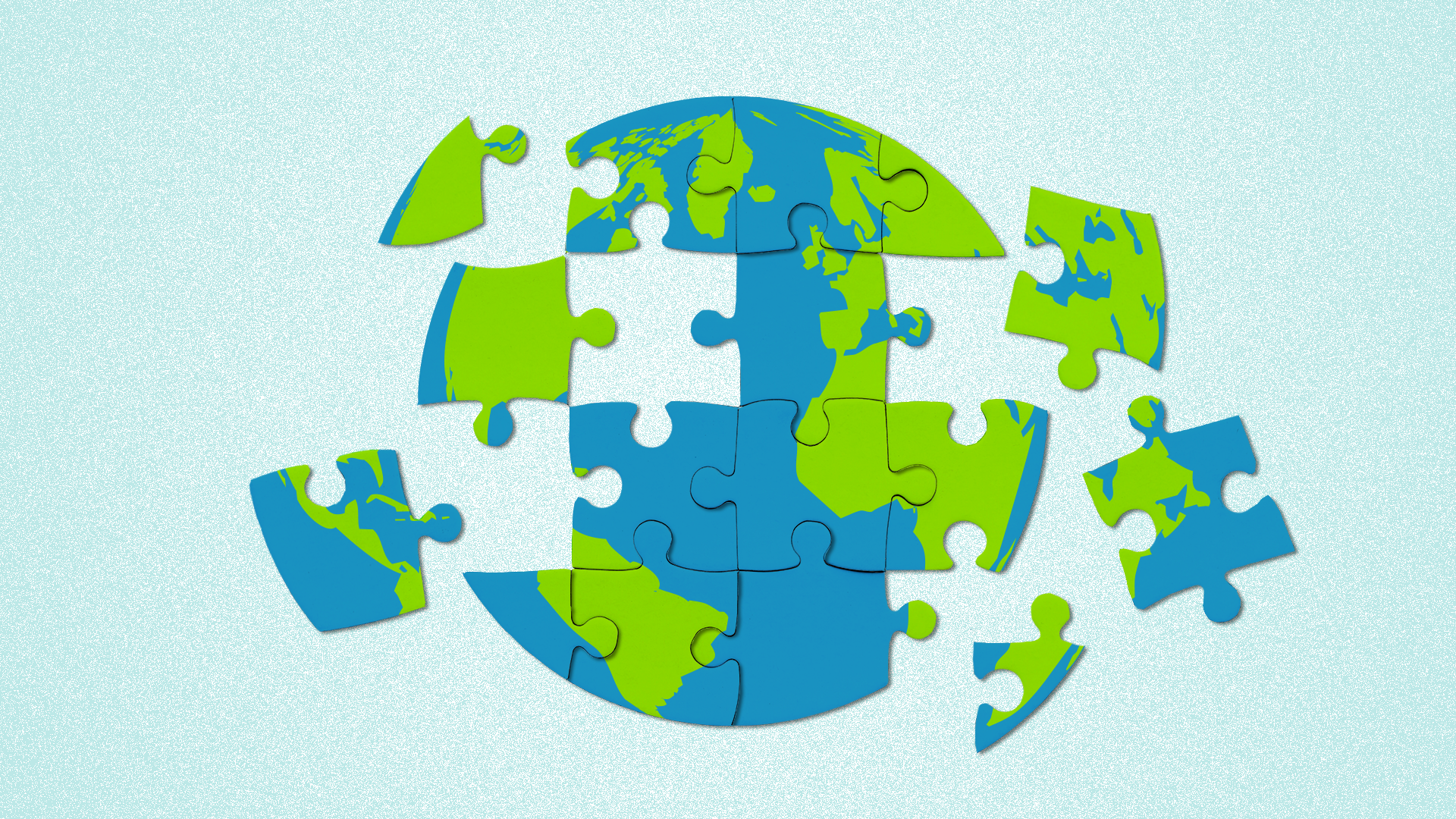
Illustration: Aïda Amer/Axios
A dismal outlook for a "ruptured" global economy set the backdrop for conversations among the world's top decision-makers.
- But those who stuck around as the World Economic Forum in Davos, Switzerland, emptied out on Friday got a much less gloomy view: There is still more keeping the world's largest economies together than there is dividing them.
Why it matters: Whichever view proves correct will be the defining feature of the global economy, one that will see longtime economic ties annihilated or simply altered.
What they're saying: "We depend on each other," European Central Bank president Christine Lagarde said on a panel.
- "We have these very strong links and binds," she added, noting that global suppliers were "sometimes in a position of strength."
- Lagarde said she is "not exactly on the same page" as Canadian Prime Minister Mark Carney, who delivered a barn burner of a speech a few days ago, warning that global economic norms have been irreparably shattered.
Zoom in: World Trade Organization director-general Ngozi Okonjo-Iweala, who spoke on the same panel, acknowledged that global trade was undergoing the largest shock in roughly 80 years, with rules that have been "undermined."
- "But I think the system has been put together in such a way that is quite strong, and it will take a lot to destroy," Okonjo-Iweala said.
- In a recent report, the WTO said that a record-breaking surge in G20 trade volumes subject to tariffs in the year through October was accompanied by a surge in policies that lowered trade barriers between nations.
Between the lines: Recent research found that the economic blowback from President Trump's trade policy has been less than feared.
- That's in part because tariffs never got as high as threatened, a result of U.S. trade truces that sought to keep goods flowing between nations — even if it meant higher prices for domestic firms and consumers.
Zoom out: Lagarde and Okonojo-Iweala offered a contrast to the gloomy outlook on the globally interconnected economy that Carney gave three days earlier on the same stage.
- "Let me be direct: We are in the midst of a rupture, not a transition," Carney said in a speech that received a standing ovation from his Davos peers.
- The speech mentioned neither Trump nor the U.S. by name, but it was clear Carney was referring to Trump-era America.
- "Great powers have begun using economic integration as weapons, tariffs as leverage, financial infrastructure as coercion, supply chains as vulnerabilities to be exploited," he said.
The big picture: The Canadian leader's remarks hit a crowd that was digesting Trump's willingness to weaponize tariffs to secure what he wants — in this case, Greenland — even if the tariff threat was taken off the table days later.
The bottom line: "We all have some interdependencies," Gary Cohn, IBM vice chairman and a top White House economic official in Trump's first term, tells Axios.
- "I think right now, the posture in the Trump administration is to have less interdependencies and to be more self-sufficient. But you can't get there overnight," says Cohn, who helped write Trump's Davos speech in 2018 that included the line: "America first does not mean America alone."
- Asked if he believes Trump 2.0 still embraces that idea, Cohn said, "Ultimately, yes."
