Why a humanoid robot isn't ready to take your job

Add Axios as your preferred source to
see more of our stories on Google.
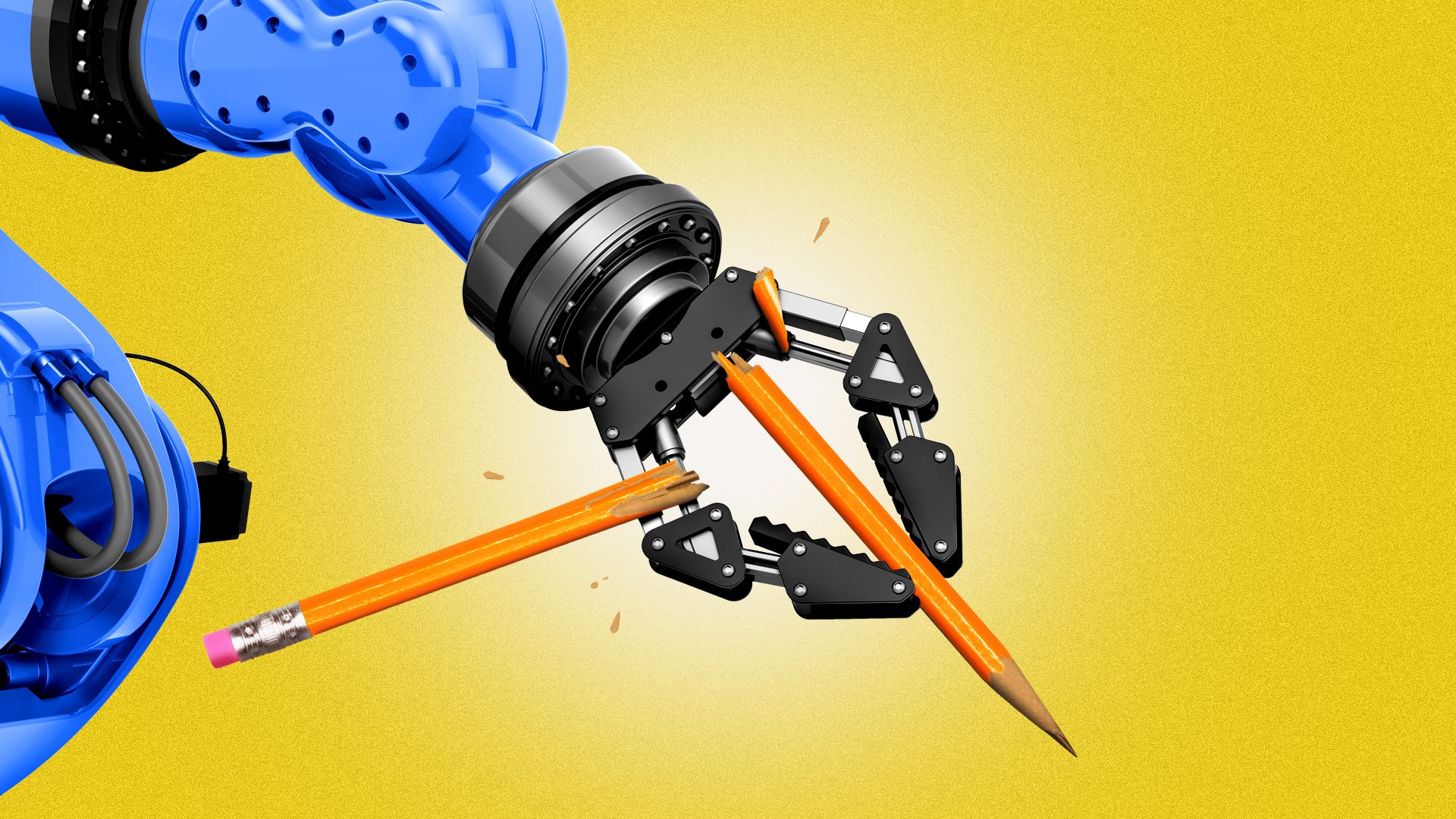
Illustration: Sarah Grillo/Axios
My dog is smart, but without an opposable thumb, he still can't open the door to let himself out. Humanoid robots have a similar problem.
Why it matters: Despite huge breakthroughs in artificial intelligence that enable these clever machines to learn from human feedback or their environment, their clawlike hands are still too clumsy for most jobs.
- Until engineers can design robotic hands that are as intricate and sensitive as their own, humanoids will be relegated to basic, repeatable tasks like carrying totes or grasping and sorting parts.
The big picture: In the coming decades, humanoids are forecast to revolutionize everything from manufacturing and logistics to elder care and home services like laundry or cooking.
- Nvidia CEO Jensen Huang predicts humanoids will be "one of the largest industries ever," while Tesla CEO Elon Musk says its Optimus robot could be "the biggest product of all time."
- Wall Street is on board with that narrative, with some analysts predicting global revenue from humanoid robots between $5 trillion and $10 trillion by 2050.
- Eventually, humanoids deployed could outnumber cars on the road, says RBC Capital Markets analyst Tom Narayan.
Reality check: None of this will happen quickly, due to a slew of technological, financial and societal hurdles.
The biggest technological challenge isn't training robots to think like humans — AI can do that. Rather, it's designing hands that are dexterous enough to properly complete a task.
- As adroit as humanoids appear running or doing cartwheels, their robotic hands are holding them back.
Zoom in: Human fingertips are remarkably sensitive, with thousands of sensors that enable people to apply just the right amount of force to pick up an egg, manipulate an object or lift a 20-pound bag of dog food, for example.
- "The more you study the human hand, the more incredible you realize the human hand is and why you need four fingers and a thumb, why the fingers have certain degrees of freedom, why the various muscles are of different strengths, the fingers are of different lengths," Musk explained on an investor call in October.
- "Designing the Optimus hand and forearm is an incredibly difficult engineering challenge," he said.
Then there are the wider obstacles. "I think it's easy to be excited about technology without understanding we also need the legal, the regulatory and the safety and the sort of interaction with people to come along," says UC-San Diego Professor Henrik Christensen, editor of the US National Robotics Roadmap.
- "Also, we need to get to a point where it makes business sense. A lot of these robots are extremely expensive" — $50,000 or more, limiting their advantage over human labor, he said.
What they're saying: "What's missing, apart from all the software, are the tiny motors and actuators to get you that level of motion and precision. Those motors don't exist today," Erik Nieves, founder and CEO of Plus One Robotics, tells Axios.
- "There's a reason you have only tendons in your hands, and muscles in your arm," he said. Robots would need tiny motors in every knuckle to match human dexterity.
- Instead, they've got the motor skills of a toddler stacking blocks, he said.
- "You can't tie your shoe if you're wearing an oven mitt."
The bottom line: When it comes to most jobs, humanoids are all thumbs.
