U.S. is modeling childhood vaccine policy after Denmark. How the countries differ

Add Axios as your preferred source to
see more of our stories on Google.
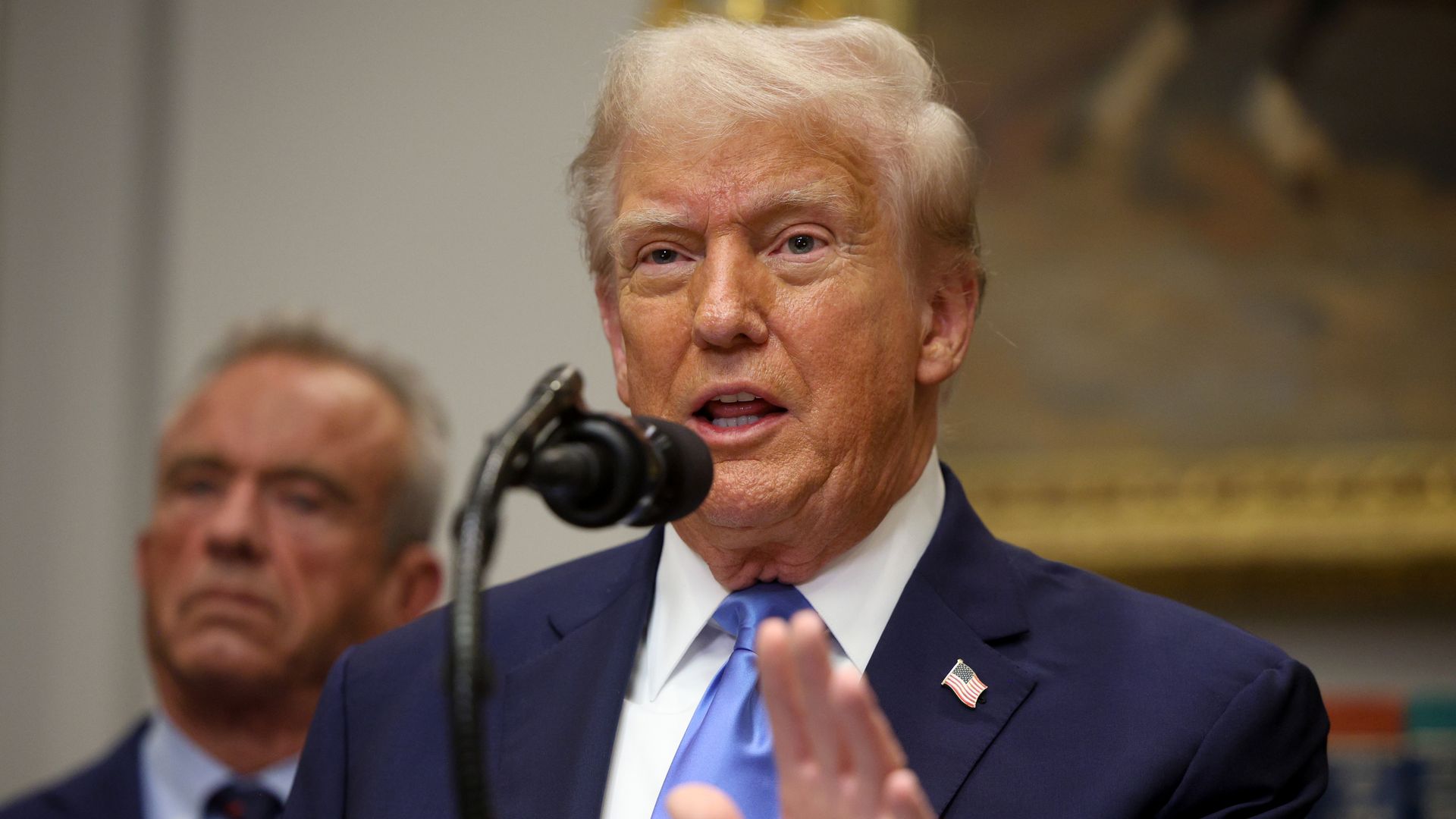
HHS Secretary Robert Kennedy Jr. (left) listens as President Trump speaks at the White House. Photo: Francis Chung/Politico/Bloomberg
The Trump administration dramatically narrowed the childhood vaccine schedule this week and aligned immunizations more closely with Denmark's recommendations — a move months in the making.
Why it matters: Though the U.S. is looking to adapt Denmark's playbook against childhood infectious diseases, it might not translate to a nation with almost 60 times more people and vastly different public health policies.
- Narrowing the vaccine schedule could cause widespread confusion and chaos and impact how freely available vaccines are in the U.S. today.
Driving the news: On Monday, the Trump administration dramatically overhauled its childhood vaccination schedule, slashing the number of recommended shots to 11. The government had recommended 17 prior to President Trump's second term.
- Health officials characterized the changes as driven by declining childhood vaccination rates, saying policies should be focused on what one official called "the most important diseases," including measles.
- The decision comes after Trump ordered federal health officials in December to review the decades-old childhood immunization schedule and consider pulling back on the number of required vaccinations.
Yes, but: The changes could result in a drop-off in the number of children who received non-recommended vaccines.
- It could also lead to a rise in prevalence in the diseases associated with those vaccines.
The new policy will closely resemble Denmark's vaccine strategy, with key differences.
Here's what to know.
The new US childhood vaccine policy
Zoom in: The Centers for Disease Control and Prevention will now recommend parents consult with physicians before vaccinating children for key diseases, including rotavirus, COVID-19, influenza, meningococcal disease, hepatitis A and hepatitis B.
- The CDC will continue to recommend vaccinations against diseases like diphtheria, tetanus, whooping cough, influenza type B pneumonia, polio, measles, mumps and rubella, human papillomavirus and chickenpox, or varicella.
- The HPV recommendation will shift from two doses to one.
What's similar to Denmark's vaccine schedule
Much of the new U.S. vaccine plan aligns with Denmark's vaccine policy.
- They both offer shots for a number of diseases such as whooping cough, hepatitis A and B, rotavirus, whooping cough, polio, measles, mumps and rubella, and HPV, among others.
- However, Denmark doesn't require vaccines for some of those vaccines in the childhood schedule.
- Both countries make the shots voluntary, though most American states require certain shots to attend public schools.
- The key, per the CDC, is the U.S. reducing the amount of childhood vaccines from 17 in 2024 for all children to 11.
Denmark's policy vs. previous U.S. plan
Denmark's vaccine policy is skimpier than most other European countries and offered key differences to the previous U.S. policy.
- Mainly, Denmark targets 10 different diseases in its vaccination schedule, while the U.S. targeted upward of 18 in 2024 and now aims at 11.
- Denmark offers fewer doses by age 18 than the U.S. did, and the country offers vaccinations against polio, diphtheria, tetanus and whooping cough on a different timeline than the U.S. previously did.
- Denmark also delays the first vaccine to three months, where as the U.S. previously recommended doses for newborns.
Why U.S. chose Denmark for vaccine policy
So why Denmark? Tracy Beth Høeg, the acting director of the FDA's Center for Drug Evaluation and Research, has been behind the push to align with the European nation.
- She said in a presentation to CDC vaccine advisors that fewer vaccines may reduce children's exposure to aluminum.
Some backers of the change praise Denmark's better health outcomes and attribute that to giving fewer vaccines.
- But public health experts say this is instead largely due to the country's government-funded health system that emphasizes free access, a subsidized child care system, less poverty and other factors.
Experts question U.S. copying Denmark's policy
The other side: Critics have suggested that Denmark is way too different from the U.S. for their vaccine policies to resemble each other, and the U.S. should build a policy based on its own population.
What they're saying: "They have different diseases in the Danish population, circulating at different levels than in the US," wrote University of Saskatchewan virologist Angela Rasmussen in a Substack post. "Because Denmark and the US are very different in all these areas, their populations have different risk-benefit profiles.
- "It makes sense for policy makers to implement a policy specific to their own country," she wrote.
José Romero, a member of the American Academy of Pediatrics' Committee on Infectious Diseases, argued something similar.
- "We don't follow Denmark's vaccine recommendations because we don't live in Denmark. Children in the United States are at risk of different diseases than children in other countries," he wrote on the academy's website.
More from Axios:
