Here's how the DOJ releases the Epstein files and how others are making them easier to read

Add Axios as your preferred source to
see more of our stories on Google.
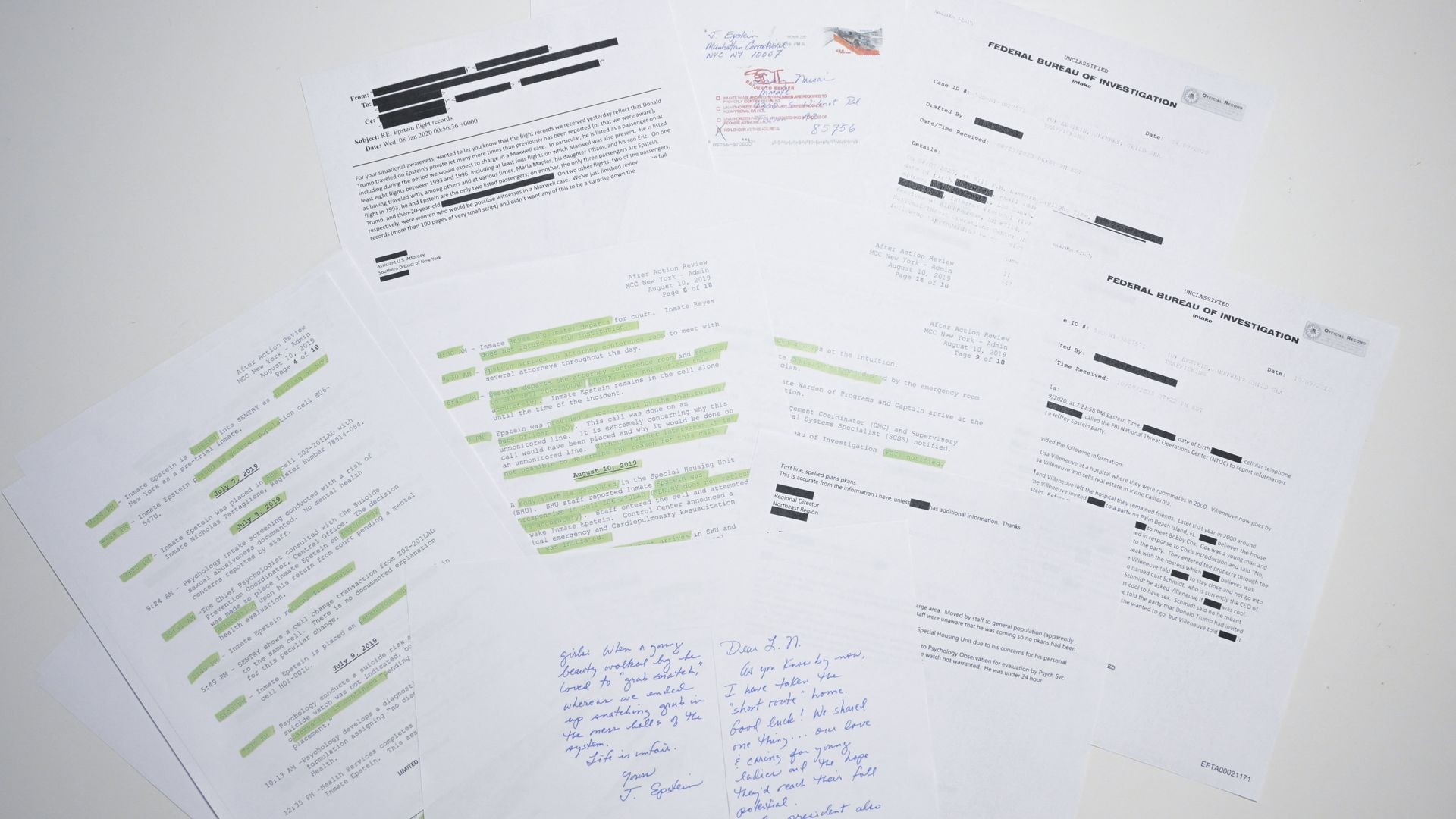
Files released by the U.S. government linked to Jeffrey Epstein are displayed in Washington, D.C., on Dec. 23, 2025, as part of a new batch containing about 8,000 documents, videos and audio recordings. Photo: AFP via Getty Images
The Department of Justice released a new batch of Epstein files on Tuesday, sending journalists and the public scrambling to read them.
Why it matters: The DOJ's massive file dumps — which come without warnings, context or descriptions — have caused widespread concern among the public, with many deeming the files inaccessible and unhelpful to understand the probe into the convicted sex offender Jeffrey Epstein.
- The Epstein files, which look into Epstein's crimes, have caused headaches for President Trump all year, stoking the flames of a MAGA civil war.
- And the latest batch of Epstein files, released surprisingly and with mentions of Trump, won't quiet that storm.
- To contend with the DOJ's data dumps and help the public read the documents easily, whiz kids have crafted entire websites and apps that share the documents in easy-to-read formats.
Here's a look at how the DOJ has released the files and what the public has done in response.
How the DOJ has released the Epstein files
The DOJ has been sharing files since February, when it published more than 100 pages related to the Epstein probe, including flight logs, a redacted contact book, masseuse list and an evidence list.
- In July, the department shared a memo that concluded Epstein died by suicide in prison and had no "client list."
- The DOJ also released a video — both in raw and "enhanced" versions — reportedly showing that no one entered Epstein's Manhattan prison cell on the night he died.
Last Friday, in accordance with the Epstein Files Transparency Act, the DOJ began dumping a trove of documents and images related to the probe, saying the files could be reviewed and redacted based on the federal law.
The files live on the DOJ's website, which includes a search bar reading "Search Full Epstein Library," with added text that says some "of these documents may not be electronically searchable or may produce unreliable search results."
- The public can comb through court records, DOJ disclosures, FOIA records and plenty of other items.
- Clicking through the subsections reveals files with non-descript titles such as "003.pdf" and "2022.03.17-2 Exhibit 2.pdf."

DOJ removed and reuploaded Epstein files
Over the weekend, the DOJ acknowledged it was removing and reuploading information from its website.
- The DOJ said on X that an entirely redacted grand jury document had been reuploaded with minimal redactions.
- The department also mentioned that the Southern District of New York flagged a photo of Trump for redactions to protect victims. That photo was reposted without alterations, the DOJ said.
- Many of the DOJ's files still come with heavy redactions.
What they're saying: "The only redactions being applied to the documents are those required by law — full stop. Consistent with the statute and applicable laws, we are not redacting the names of individuals or politicians unless they are a victim," the DOJ said on X.
DOJ's surprise file drops come without context
The Justice Department's releases of the Epstein files have mostly come without warning. Last Friday, U.S. Deputy Attorney General Todd Blanche told Fox News that thousands of files would be shared as part of a longer rollout.
- On Tuesday, when another batch of files was released, there was no warning, context or indication of how many files would be released, leaving the public to interpret the information on its own.
- The DOJ said in an X post Tuesday that some of the new documents, which mention Trump, "contain untrue and sensationalist claims made against" the president.
New ways to read the Epstein files
Influencers and online sleuths have been playing detective over certain news events, leading to false accusations and misinformation, without any consequences, Axios' Zachary Basu writes.
- Corrections appear to be rare, and any added context or changes often don't travel as far as the original posts.
The big picture: Since the Epstein files have been shared, social media influencers and users have begun posting file screenshots and quotes at random, pinpointing alleged new findings.
- Some commenters have asked for the actual link to the file being talked about, or more context to help understand it.
- This has led some parties to create their own tools to sift through the noise.
Case in point: Technologists Riley Walz and Luke Igel created a project called "Jmail.world," which publishes Epstein's emails, as well as those who communicated with him, in a format similar to the Gmail interface.
- They also added an AI interface called "Jemini" that allows people to search through the docs.
- Igel said in a Hacker News post that a group of collaborators worked together to create an "app suite" that allows the public to search through the files in an understandable way.
On Monday night, Igel wrote on X that a new batch of Epstein files was going to be uploaded into Jmail.
- "The government has not made these files visible on their main site yet," he wrote, adding: "This volume contains an incredible amount of video footage that someone ought to index. More soon."
More from Axios:
