CCOs gain power and pay as companies navigate AI and political turmoil

Add Axios as your preferred source to
see more of our stories on Google.
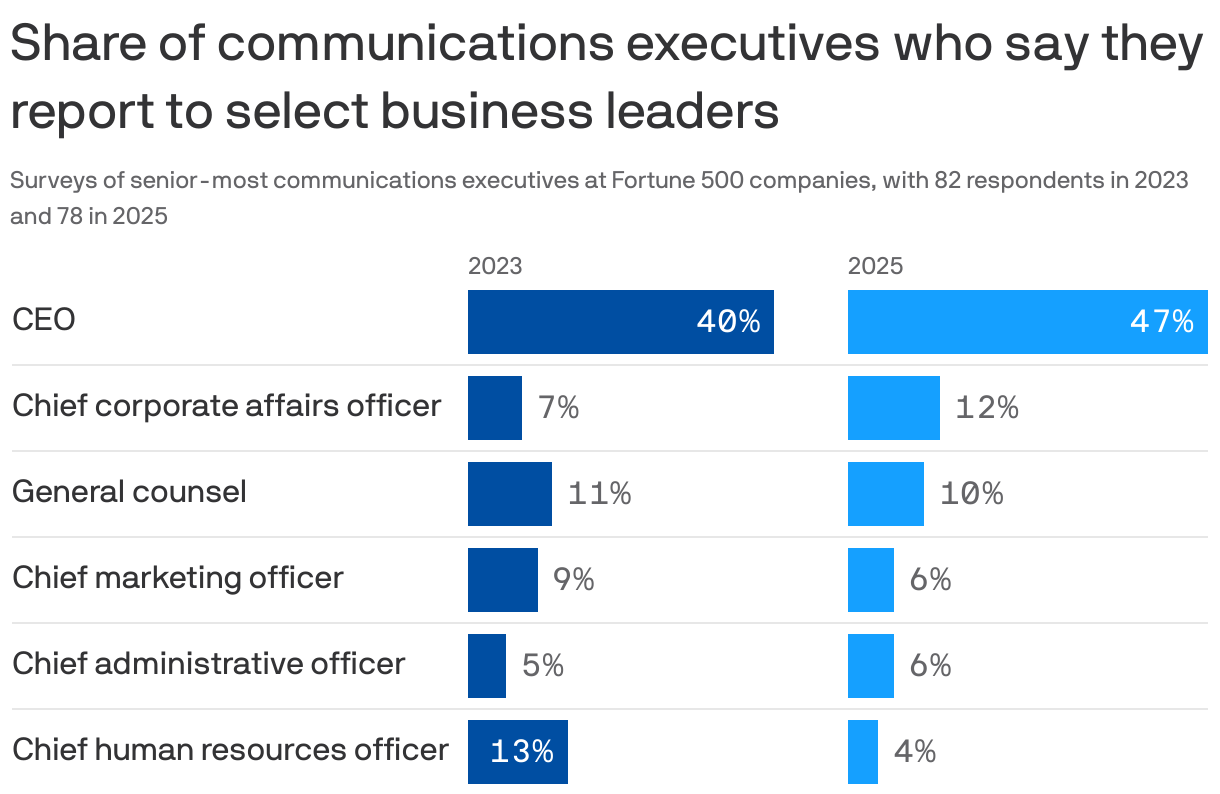
Communication leaders are continuing to gain influence in the C-suite and are making more money than ever before, according to a new report from executive search firm Korn Ferry, shared exclusively with Axios.
Why it matters: A function that used to be seen as a cost center is now an indispensable alignment mechanism, guiding businesses through AI transformation, political upheaval and a fractured information landscape.
By the numbers: Korn Ferry surveyed the senior-most communications professionals across Fortune 500 companies between Aug.1 -Sept. 30, 2025, and found that more than half now sit on their company's executive committee.
- Plus, communications is unbundling with marketing, legal and human resources.
- Since the survey was last conducted in 2023, there has been a 17% increase in the number of comms chiefs who report directly to the CEO.
- Corporate boards are also paying more attention to the role, says Richard Marshall, Korn Ferry global managing director of corporate affairs & investor relations.
- "The evolution of this role continues to get bigger, more strategic, and more important to not only the CEOs, but to boards," he says. "Corporate boards are under greater scrutiny now, and they want to be involved in the selection of a communications person."
Zoom in: The team makeup under the newly empowered CCOs also looks different, per the report.
- Most CCOs (62%) lead centralized teams.
- Those who work in industrials and consumer markets sectors, however, were more likely to report working in a matrixed organizational structure, and those in consumer markets were more likely to have a decentralized team.
- 9 in 10 say they oversee corporate communications, executive communications, internal communications, issues and crisis management and media relations.
- Other common functions under the CCO's purview include social and digital media (81%), community relations (38%), philanthropy and impact (32%) and marketing (26%) — none of which fall in the traditional comms remit.
- Public policy and government relations are on the rise at 18% and 14%, respectively, while only 3% report overseeing investor relations.
Of note, the majority (54%) say their communications function budget is over $5 million.


Follow the money: On average, base compensation for CCOs has increased from 12%-14% since 2023, according to the report.
- The median base salary sits between $400k and $450k, with the median total compensation coming in around $900k–$1m.
- Nearly half of those surveyed earn seven-figure compensation and about 1 in 7 earn more than $2 million annually.
What they're saying: "We have seen comp figures continue to rise and be more competitive in the last several years, and that trend continues," says Annie Lohmeyer Riva, Korn Ferry principal of global corporate affairs and investor relations.
What's next: AI is still a big question mark for a lot of these comms leaders.
- While 96% report using AI, about one-third of respondents have not defined their approach to how their team supports AI-driven communication efforts.
- Of those who have, the most common approaches include having AI-focused leads or champions (47%) or an internal AI center of excellence (41%).
- Right now, AI is being deployed to tackle the low-hanging fruit: like content creation (86%), media monitoring (67%) and internal communications (59%).
What to watch: These senior comms leaders are looking to hire and build an AI-savvy team.
- "It reminds me of 2009-2010, when everyone was hiring for a head of social media, but no one knew what they were doing with social media because it hadn't evolved yet to be functionally usable for every single organization, every single industry, but everyone knew they had to kind of use it," says Peter McDermott, Korn Ferry senior client partner and head of corporate affairs practice, North America.
More on Axios:
