Congress rebuilds this rare "Hail Mary" tactic into a major new weapon

Add Axios as your preferred source to
see more of our stories on Google.
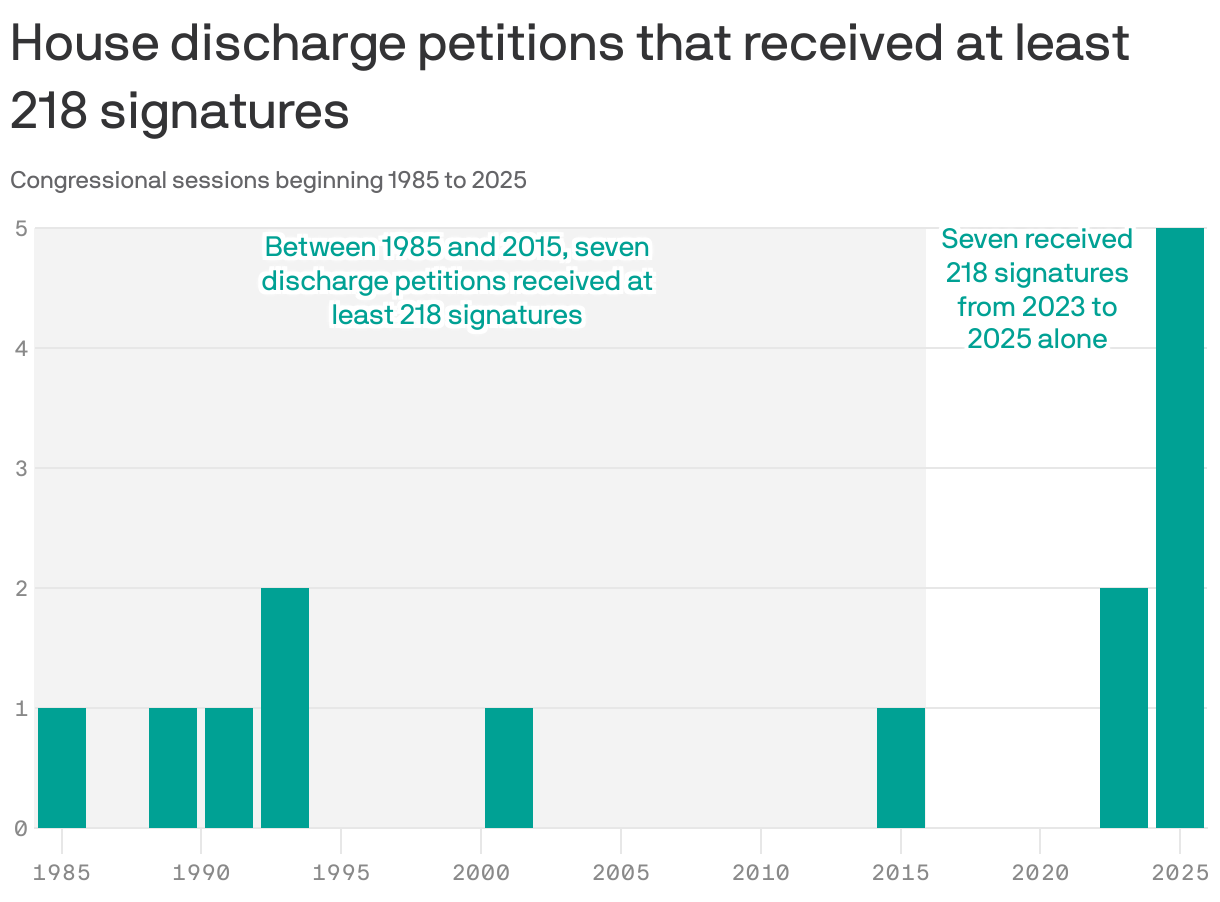
Discharge petitions are all the rage on Capitol Hill.
The big picture: Discharge petitions have been around for decades and have been mostly seen as a "Hail Mary." But recently, they've become more of a QB sneak, to mostly positive results.
- "The success rate for discharge petitions this year is mind-blowing," Sarah Binder, professor of political science at George Washington University told Axios.
By the numbers: Seven discharge petitions filed in the past two years received the 218 signatures needed for a House vote, according to data collected by Axios.
- Prior to that, only seven petitions received all 218 votes in the previous 40 years.
- There have been 13 discharge petitions filed in 2025, including Wednesday's, that will force a vote on ACA tax credit extensions.
Here's what to know about discharge petitions and how they've become a new weapon for lawmakers.

How discharge petitions work
The discharge petition is generally seen as the only way that members can see a measure considered without gathering "cooperation from the committee of referral, or the majority-party leadership," according to the Congressional Research Service.
- "For this reason, discharge is designed to be difficult to accomplish and has rarely been used successfully," per CRS.
- An early version was presented in 1910 as a form of revolt against House Speaker Joseph Gurney Cannon (R–Ill.). The current version wasn't adopted until the 1930s, and originally required one-third of the House to vote for it. The majority rule was adopted in 1935.
Discharge petitions originate from lawmakers, who must file them to the House clerk.
- The discharge petition requires half the House (218 members) to provide their signature so lawmakers can bypass leadership and force a floor vote.
- If the votes are there, there's a seven-day wait before the petition can be introduced to the floor.
- The House speaker then has two days to bring it up for a floor vote. Any action, though, won't be immediate.
What's next: Any bill that passes the House would then move onto the Republican-controlled Senate (as recently seen with the vote over the Epstein files release) and would have to be signed by President Trump.

Historic discharge petitions
Until recently, successful discharge petitions were exceedingly rare.
- Only seven of the 676 petitions filed have been passed into law since 1935.
- Just 44 of those 676 received 218 votes.
In the 1980s, a discharge petition was used to pass the Firearm Owners Protection Act, which scaled back gun laws.
- Originally passed by the Senate, the bill was killed by the House until the National Rifle Association advocated for the bill to pass in the House through a discharge petition.
- The petition garnered the necessary votes. A Senate version of the bill was later passed.
In 2002, a discharge petition was used to successfully pass the Bipartisan Campaign Reform Act, which is a law on regulating financing for federal political candidates and campaigns.
- There were several attempts by the House and Senate to bring it to the floor for a vote through the discharge petition.
In 2015, a bipartisan group of lawmakers used a discharge petition to force a vote to reauthorize the Export-Import Bank of the U.S., which is the federal government's official export credit agency.
The recent success of discharge petitions
Successful discharge petitions really started to take off in 2024 and 2025 — a time of high political polarization.
- This year, they've been aided by razor-thin margins in the House.
In May 2024, a discharge petition was filed on a bill that would provide tax relief for losses over federally declared disasters.
- It was successful through the House and Senate, then signed by President Biden.
In September 2024, another discharge petition reached the 218 signatures needed — that one presenting a bill eliminating some provisions that reduced Social Security benefits to some seniors.
- That similarly passed through the House and Senate, and then was signed by President Biden.
In March 2025, a discharge petition was introduced to allow proxy voting for members who gave birth or whose spouse had given birth.
- However, the petition was tabled in April as the House leadership approved vote-pairing measures.
Congress saw a second discharge petition in 2025 that received the 218 signatures. This one called on lawmakers to vote on the Epstein Files Transparency Act.
- The bill passed the House, 427-1, and unanimously in the Senate before being signed by Trump.
A third 2025 discharge petition came in November for a bill looking to restore collective bargaining rights for most federal employees.
- The House vote overturned Trump's executive order and represented the first time that the House had enough votes to repeal one of Trump's orders.
- It's unclear how this bill will fare in the Republican-led Senate.
The final petition of 2025 (so far, at least) came on Wednesday, with the push to authorize a three-year extension of the ACA tax credits.
- In a stunning revolt, Republicans defied Speaker Mike Johnson (R-La.) and aligned with Democrats to sign House Minority Leader Hakeem Jeffries' (D-N.Y.) discharge petition on a "clean" three-year ACA extension.
- The defying Republicans gave Democrats the 218 signatures needed for the discharge petition to see the House floor.
- It's unclear if it will pass the Senate, as Senate Majority Leader John Thune (R-S.D.) seemed noncommittal about bringing action to the floor.

Crackdown on discharge petitions
What we're watching: After the Epstein petition passed, Johnson was considering a crackdown on House discharge petitions, Axios' Kate Santaliz reports.
- Johnson told Axios that the petitions were becoming "too common" and would consider new House rules to make them harder to obtain.
- House Republicans warned that discharge petitions could be eliminated because of their recent rise.
The other side: Rep. Thomas Massie (R-Ky.) told Axios that he was worried about the tool's survival, deeming it a "last vestige of democracy."
- Massie said he was "brainstorming" with Democrats on more discharge petitions.
More from Axios:
"It's idiotic": House moderates fume at Johnson over inaction on ACA
Mike Johnson's new set of promises to squash a House GOP revolt
