Inside Emmer's strategy to fight K Street "rumor mills"

Add Axios as your preferred source to
see more of our stories on Google.
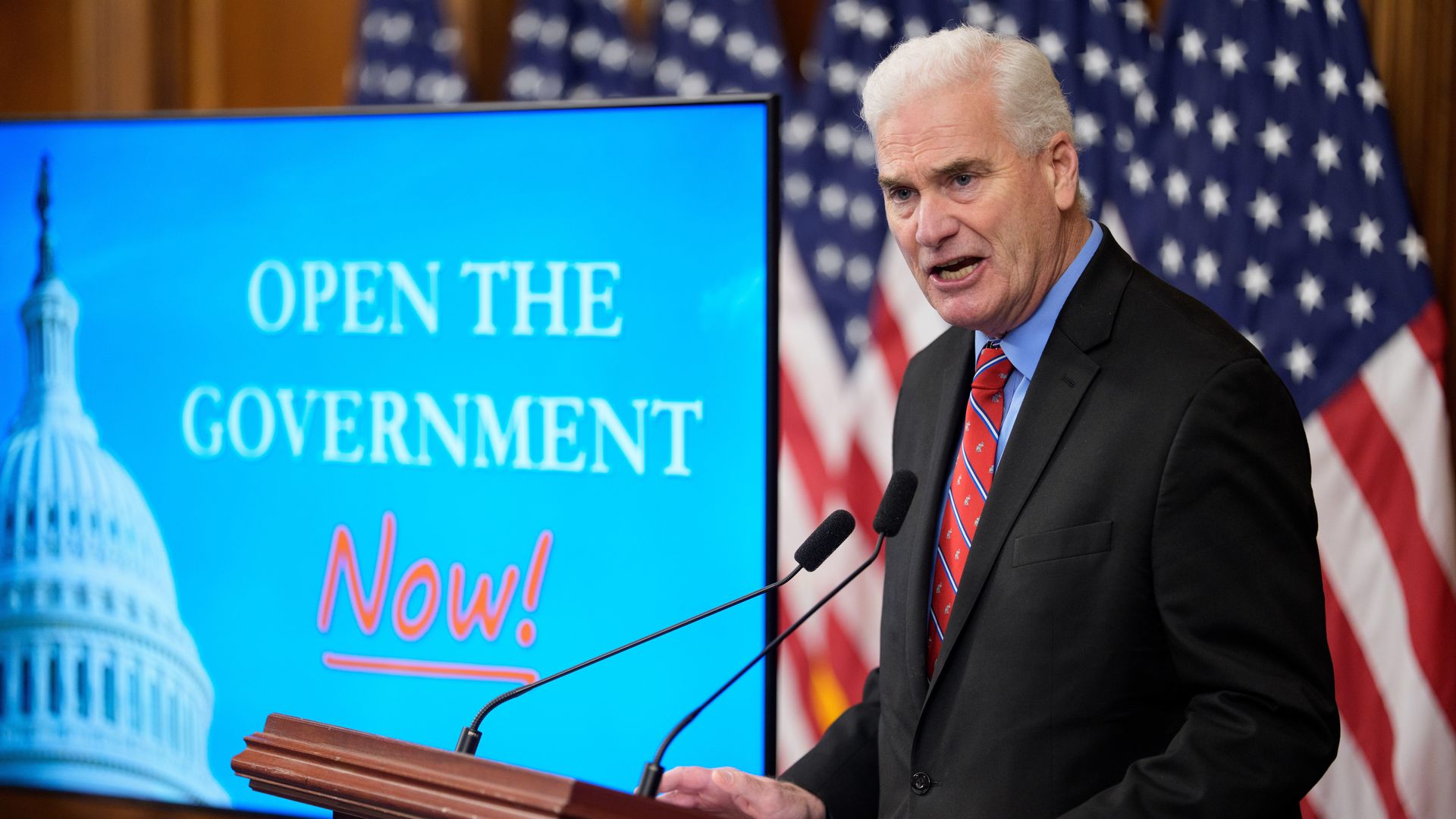
Rep. Tom Emmer during a news conference at the Capitol on Nov. 3. Photo: Aaron Schwartz/Bloomberg via Getty Images
House Majority Whip Tom Emmer's office is turning a shutdown-era experiment into a standard practice for how they engage with K Street:
- During the shutdown, Emmer's (R-Minn.) staffers starting holding in-person briefings at K Street offices for lobbyists and clients instead of on Capitol Hill.
Why it matters: When the House was gone for the entirety of the October government shutdown, Emmer's office needed a way to keep information flowing downtown.
- The briefings offered firms an opportunity to get candid answers from House leadership at a chaotic moment, and for leadership to get constructive feedback from businesses.
- Emmer's chief of staff Robert Boland and coalitions director Annie Brody held 22 meetings with 14 firms, both Democratic and Republican. Three more are on the books for January.
- "We want them to feel comfortable. We want them to know that it is a total open door policy in our office, and that we are a conduit and a liaison for them to the Hill," Brody told Axios. "It's a different feel," she added, speaking of going directly to the firms.
Driving the news: The briefings began as a way to quell feelings of uncertainty during the funding standoff.
- The sessions helped untangle downtown's "echo chamber," where misinformation can spread quickly, Boland told Axios.
- "The more uncertainty there is, the more the rumor mills start expanding and you start losing control of messaging."
- Boland and Brody said questions around appropriations dominated the meetings, but topics quickly broadened: rural school programs, energy permitting, redistricting, NDAA and health care packages.
Between the lines: Emmer's team said the operation wasn't coordinated with Speaker Mike Johnson's (R-La.) office, but Boland said they were "always very deferential" to Johnson and Majority Leader Steve Scalise (R-La.).
- He said he assumed someone in the speaker or leaders' offices might want in: "There's no reason they can't… but we never got any pushback."
The big picture: Emmer's team sees the operation as part of the traditional whip role.
- "Internally, it's the votes of the members. Externally, it's the support from these outside organizations and corporations. So that is the traditional role of the whip, and so we felt that really falls in our lane," Brody said.
- The team held meetings with a wide array of firms, including Holland & Knight, S-3 Group, Brownstein Hyatt Farber Schreck, Harbinger Strategies and more, according to the whip's count.
- The January briefings are set to tackle appropriations, health care, transportation reauthorization and other big legislative items.
What they're saying: "Getting out of the Capitol and meeting with stakeholders across every industry to build a broad coalition of support for the House Republican agenda is, honestly, a genius strategy," Matt Bravo, a managing partner at S-3 and former senior leadership staffer, told Axios on Monday.
- Jennifer Lukawski, Senior Government Relations Expert and Strategic Policy Advisor at BGR, told Axios the whip team's approach is a key reason they stand out as one of the conference's most effective.
