Inside Consumer Reports' lead-testing quest

Add Axios as your preferred source to
see more of our stories on Google.
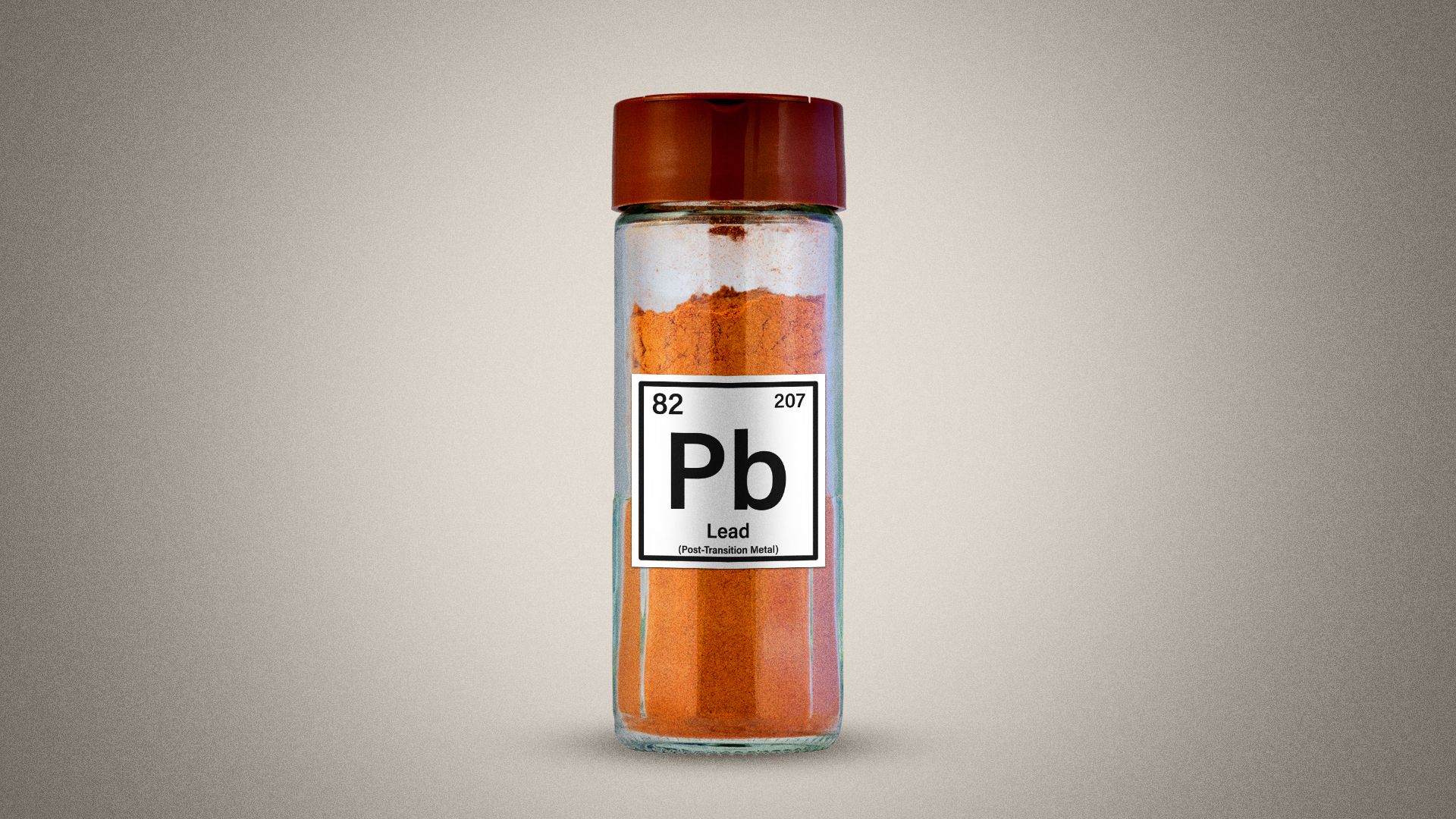
Illustration: Maura Kearns/Axios
Some brands of common household items — think protein powder, cinnamon and cassava — have concerning amounts of lead, recent Consumer Reports (CR) testing has found.
Why it matters: CR's lead-testing campaign both fills a consumer protection need and reminds us that food and supplement vetting doesn't always go as far as we might like it to.
Driving the news: The nonprofit's latest inquiry, into protein powders and shakes, had shocking results — especially considering America's ongoing protein obsession.
- "For more than two-thirds of the products we analyzed, a single serving contained more lead than CR's food safety experts say is safe to consume in a day — some by more than 10 times," CR's analysis found.
- More than 40,000 people have signed the organization's petition asking the U.S. Food and Drug Administration to limit lead in protein powders.
- Similar CR research into cinnamon found that "12 of the 36 products measured above 1 part per million of lead — the threshold that triggers a recall in New York," the only state regulating heavy metals in spices.
How it works: CR chooses categories to test based on prior research and ingredients, zooming in on "highly-consumed foods" that people eat daily, Jen Shecter, CR's vice president of content, tells Axios — adding that they sometimes get tips, as was the case with cassava.
- After picking a category, CR chooses a variety of popular brands and anonymously purchases samples over a few months from various retailers nationwide.
- Samples are then anonymized and sent to an accredited lab to be tested for lead and other heavy metals.
- CR reaches out to companies about its reporting and test results so they have time to react and comment.
What they're saying: Some companies respond quickly and positively (by issuing recalls, for example) while others get defensive, Shecter says.
- Some have said their product has no lead at a certain detection level, for example.
- But "the FDA is very clear," Shecter says. "There is no safe level of lead, period."
Yes, but: CR strives not to be alarmist.
- Its protein story notes that even the products with the highest levels of lead have "far below the concentration needed to cause immediate harm."
- This is about "chronic exposure over time, which is why we say 'don't panic,'" Shecter says. "There are choices. You have choices."
The big picture: CR advocates for changes on consumers' behalf, but lets the market drive corporate behavior, Shecter says.
- "There is this assumption that people are testing and testing at the same level, and people are shocked when they discover that is not the case."
- "And so who's filling the void? I would argue that's the value of Consumer Reports, which is we are a non-partisan, very transparent organization that is just trying to move the marketplace and offer people better choices, and not tell them what to do — people can make their own decisions."
Flashback: CR's lead reporting dates back nearly a century, to the publication's first issue in 1936, which included a story about lead in children's toys.
What's next: Look for CR to revisit heavy metals in rice later this winter.
- "Companies don't always tell us if they've made changes, but when we do follow-up testing ... we are very curious as to where the market has gone," Shecter says.
