Lucid Motors eyes home power, new European sales

Add Axios as your preferred source to
see more of our stories on Google.
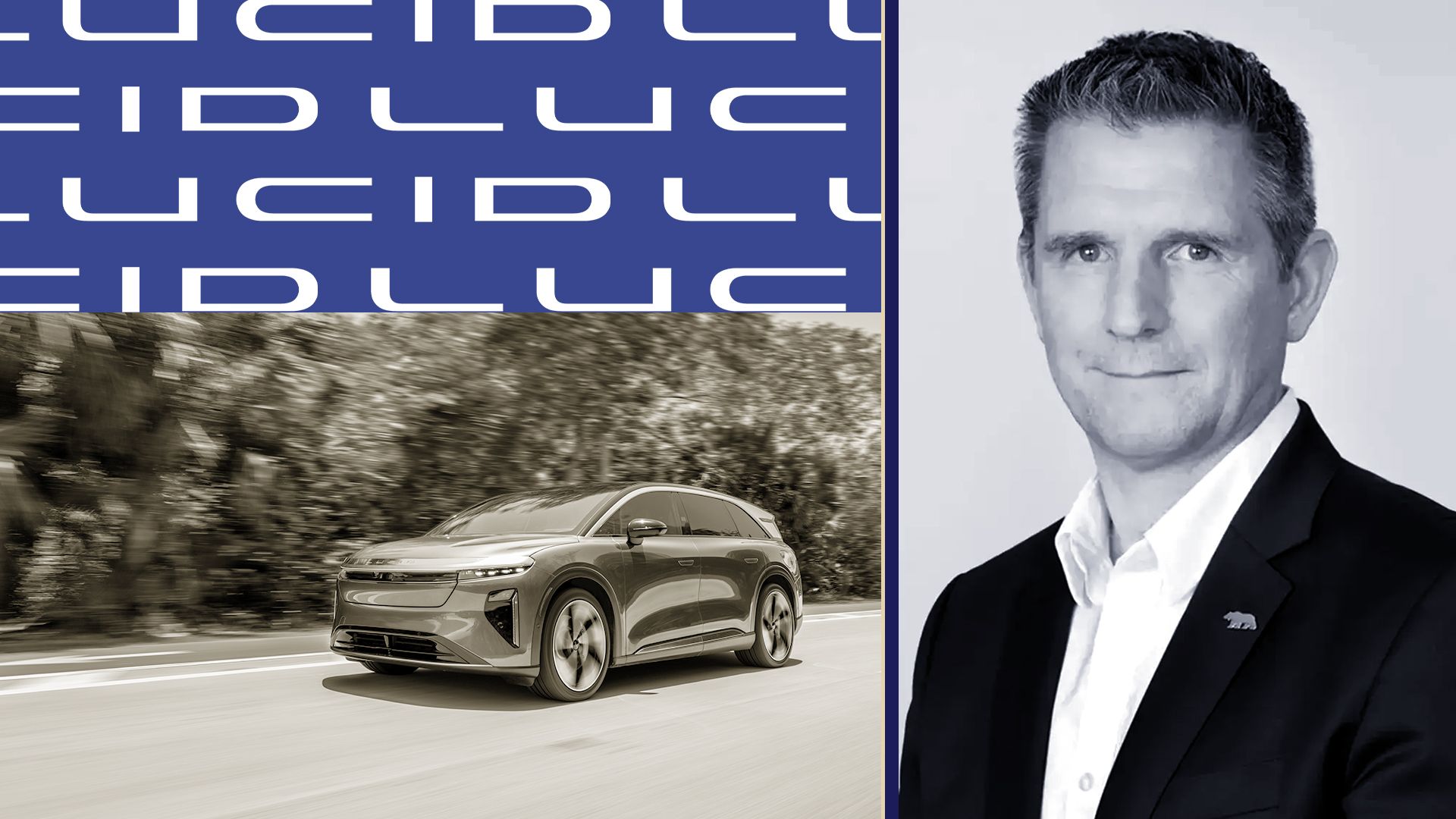
Photo illustration: Axios Visuals. Photos: Courtesy of Lucid Motors
Lucid Motors will soon unveil a vehicle-to-home power product, and the luxury EV startup is also talking with third-party dealerships in Europe — a departure from its direct-to-consumer model.
Why it matters: Those steps, shared by interim CEO Marc Winterhoff in an interview, illustrate how Lucid is adapting on the fraught, expensive road from buzzy startup to commercial-scale automaker.
Driving the news: Vehicle-to-home tech allows EV owners to send power back into their residence.
- The bidirectional capability, increasingly available in EVs, can provide emergency backup power or help lower bills when electricity is expensive.
- "I don't want to steal the thunder yet. We will announce it in the not-too-distant future," Winterhoff said.
What we're watching: The luxury EV maker is evolving its sales model in Europe, which now is a small share of its U.S.-dominated sales, but a growth market.
- Showrooms would still have a "Lucid look and feel" but would not be owned by the automaker, Winterhoff said, calling it a way to add "additional channels" for sales.
- It's a way to work with people who have "established connections" in various markets there, he said.
Driving the news: Winterhoff was in Washington, D.C., for the announcement of a new tech partnership with Nvidia.
- Lucid plans to eventually sell midsized EVs with truly self-driving, or "L4," autonomy via integration with Nvidia tech.
- The aim is to become "the first true eyes-off, hands-off, and mind-off (L4) consumer owned autonomous vehicle," the rollout states.
The intrigue: The partnership — a major expansion of Lucid's driver-assistance work — is a shift in corporate positioning, he said.
- He didn't previously view Lucid as needing to lead in providing such high levels of autonomy for consumer models.
- "That's something that...I have changed earlier this year, because that is a very important topic that our customers also ask for," he said.
- "We cannot stand still...It is up to the customer, whether the customer wants to pay for it or use it, and therefore we need to provide it," Winterhoff said, calling it a revenue opportunity.
The big picture: EV makers are grappling with the loss of federal consumer purchase and lease subsidies, but Lucid has less to lose than some others.
- Its current offerings were the sticker price ceilings for purchases anyway, and Winterhoff doesn't see loss of the leased-vehicle credits — which don't have those limits — as a big deal.
- "We definitely see an impact," he said, but added that Lucid is "not that exposed."
State of play: Its planned crossover starting at a $50,000 price point — dubbed "project midsize" — would have qualified.
- But those offerings, which Lucid teased with new images this week, don't start rolling out until late 2026. The EV market will have "normalized" by then, he said
What's next: Lucid reports quarterly earnings on Nov. 5.
