How space comms teams balance safety and showmanship

Add Axios as your preferred source to
see more of our stories on Google.
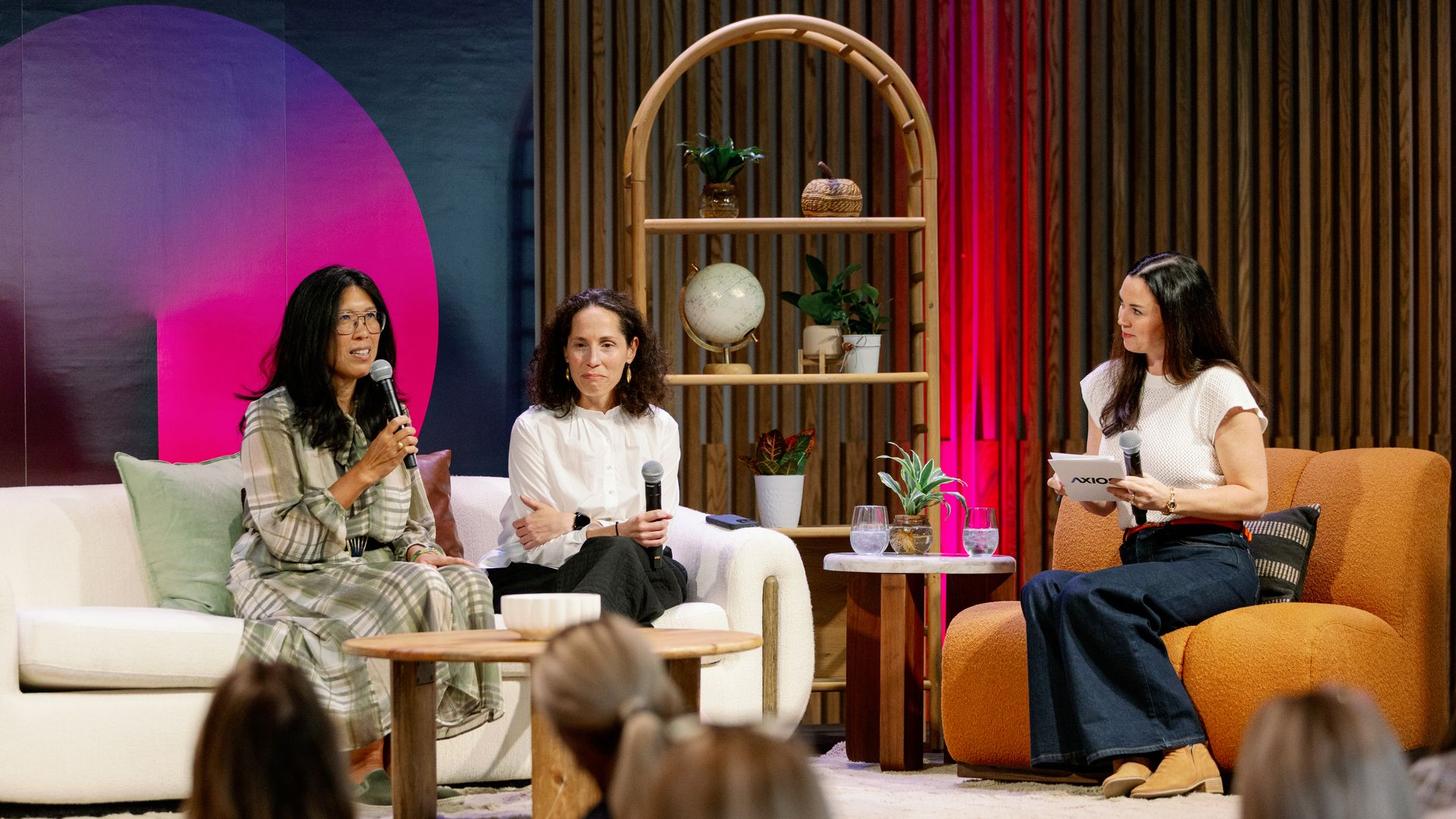
M13's Christine Choi and Intersect's Sara Blask with Axios' Eleanor Hawkins. Photo: Stacey Conant
Sara Blask, Blue Origin's former principal of launch communications, referred to her team as the "Seal Team 6" of crisis communications during on an-stage interview at MB Live.
Why it matters: Space tourism is a highly technical, highly regulated industry that is viewed with skepticism by many — making proactive storytelling and crisis planning priorities for the comms teams.
State of play: After a fatal Virgin Galactic crash in 2014, the then-head of communications Christine Choi was tasked with navigating the public relations fallout and reputation rebuild that followed.
- "Our job is to slow everything down in the speed of the moment. You think you're supposed to act fast and talk fast. But in fact, our job is really hard. It's to slow down. It's to think clearly and to also act like a human," she said.
- Plus, you have to follow the lead of the NTSB investigators, she added. "NTSB leads first, and that was that's the hard message to relay to someone like Sir Richard Branson, whose reputation was on the line and who viewed every single minute as a wasted opportunity to defend the reputation of the team and company."
What they're saying: For these communications team, it's also about getting beyond the "billionaire space race narrative."
- "For founders who are greatly invested in space, it is beyond existential," Blask says. "For them, it is about maintaining dynamism and growth on Earth. And in order to do that, you have to move into space."
- "Some of the most moving moments for us at Virgin Galactic were the opportunities for Richard to be flanked by the people who are actually making space possible, the engineers who are toiling away on the flight line or working on rocket motors, or are in the hangar — everyone who's involved in making space access possible, and not just the person funding it," Choi added.
And when it comes time for a launch, the comms strategy is a combination of safety and showmanship.
- "The launch itself is really the middle of the story," Blask says. "You have to think about it from the sort of macro storytelling, and then each person on the flight has their own storytelling platform. And then you are having to carefully choreograph this to a launch countdown that is all about safety procedures that dictate the pace of the show."
- "It's coordinating with the astronauts. It's making sure the telemetry on screen — which shows the speed of the rocket — is projecting and accurate. There's the aerial assets who are capturing video.… It's all part of the storytelling and understanding what that hero image is," she added.
What to watch: The space narrative has shifted from a pure science story to a complex mix of tech, travel and business stories. The same can be said for many innovative industries, products or technology.
- Regardless, Choi and Blask say that keeping humans at the center of storytelling is key.
- "In so many ways, space is one of the most inspiring stories humanity has ever told, and I always will feel a responsibility to tell it in that kind of way," says Blask.
More on Axios:
