Fed's Powell defends bond purchases amid Trump allies' attacks

Add Axios as your preferred source to
see more of our stories on Google.
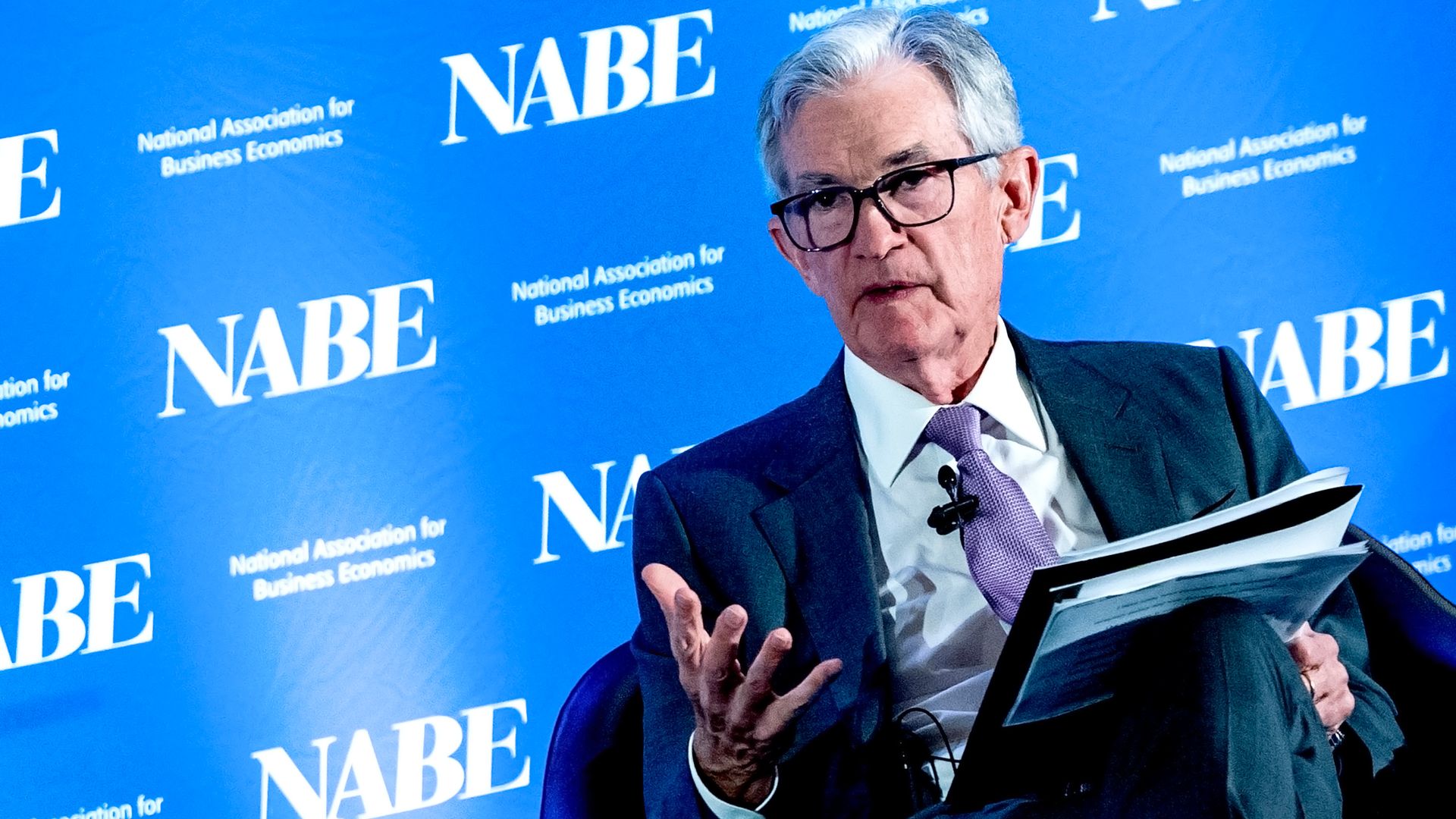
Federal Reserve chair Jerome Powell. Photo: Seth Herald/Bloomberg via Getty Images
Federal Reserve chair Jerome Powell defended the central bank's management of its $6.6 trillion balance sheet, implicitly rejecting criticism from the Trump administration.
Why it matters: As the president weighs Powell's replacement, the Fed chief argued that large-scale bond purchases helped keep the economy from the abyss during the pandemic, and can be an important tool in the future.
The big picture: Powell's speech, before the National Association of Business Economics in Philadelphia, also suggests that the Fed remains on track to cut interest rates again later this month.
- He said that, paucity of government data due to the shutdown notwithstanding, "it is fair to say that the outlook for employment and inflation does not appear to have changed much since our September meeting."
- That implies that the Fed is on track to cut rates again when it meets in two weeks, as most officials thought likely at their last meeting.
What they're saying: Powell offered a full-throated defense of the Fed's use of its balance sheet — including large-scale bond purchases and targeted liquidity programs — to combat the economic disruption caused the pandemic.
- "The Fed's balance sheet serves as a critical policy tool, especially when the policy [interest] rate is constrained by" an inability to fall below zero, Powell said.
- "When COVID-19 struck in March 2020, the economy came to a near standstill and financial markets seized up, threatening to transform a public health crisis into a severe, prolonged economic downturn."
- Even as the immediate crisis passed, in later 2020 and 2021 "we continued purchases in order to avoid a sharp, unwelcome tightening of financial conditions at a time when the economy still appeared to be highly vulnerable," he said, noting that such episodes occurred previously in 2013 and 2018.
Between the lines: Powell's speech comes as allies of President Trump have assailed the Fed for its accumulation of bonds during the pandemic and its outsized balance sheet, which they argue fuels inflation and financial imbalances.
- "By extending its remit into areas traditionally reserved for fiscal authorities, the Fed has blurred the lines between monetary and fiscal policy," Treasury secretary Scott Bessent wrote in an op-ed last month.
- "The central bank's balance-sheet policies directly influence which sectors receive capital, intervening in what should be the domain of markets and elected officials," he continued.
- Bessent is leading a process to select Powell's successor when his term as chairman ends in May.
Yes, but: "With the clarity of hindsight, we could have — and perhaps should have — stopped asset purchases sooner," Powell acknowledged.
- The experience "does suggest that we can be more nimble in our use of the balance sheet," he said, "and more confident that our communications" will help markets reprice quickly.
Zoom in: Powell also defended including Fed purchases of mortgage-backed securities in the pandemic QE program, which helped dive down home borrowing costs and fueled an overheated housing market.
- Powell also said that in the coming months the Fed "may approach that point" where it can cease shrinking its balance sheet, its process known as quantitative tightening.
- However, he added that the Fed's balance sheet is unlikely to return to its pre-pandemic size due to higher demand for reserves due to "growth of the banking system and the overall economy."
Of note: As opposed to arguments from both some Democrats and Republicans on Capitol Hill, Powell argued that the Fed's payment of interest to banks that park money at the Fed is an essential tool for controlling rates, and that the financial losses it has caused in the last couple of years are an aberration.
- "If our ability to pay interest on reserves and other liabilities were eliminated, the Fed would lose control over rates," he said.
- "The stance of monetary policy would no longer be appropriately calibrated to economic conditions and would push the economy further away from our employment and price stability."
