How states are making their own rules for AI

Add Axios as your preferred source to
see more of our stories on Google.
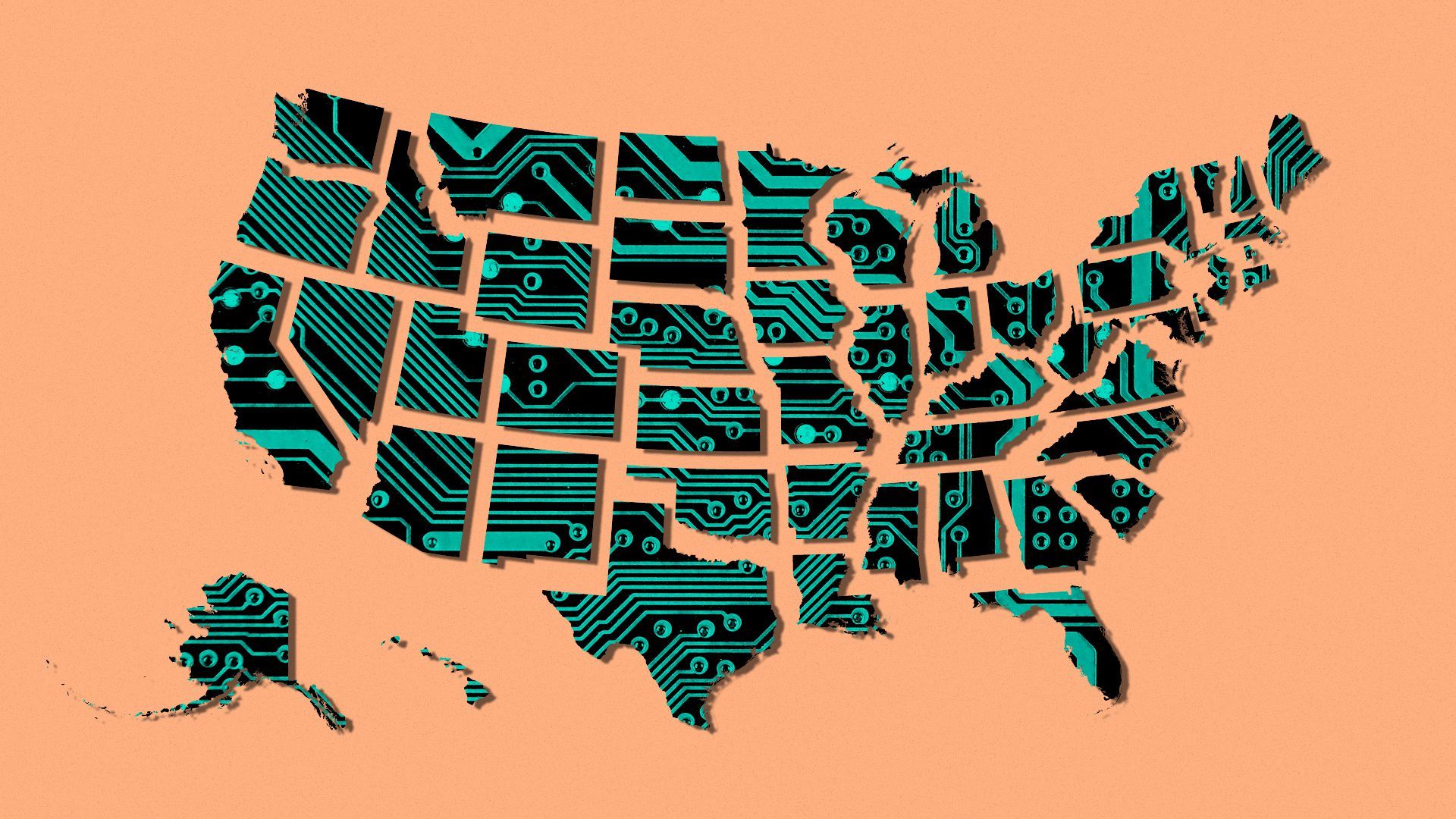
Illustration: Megan Robinson/Axios
States across the country are forging ahead with their own rules for AI procurement and use in an effort to boost government efficiency and improve public services.
Why it matters: With Congress stalled on comprehensive AI legislation, several states are providing early examples of how governments can use the technology at scale.
Axios spoke to a number of state chief information, data and AI officers across the country to get a taste of what they're doing. Here's a sampling of what we found:
Vermont: Human-centered AI is the core of Vermont's approach, Denise Reilly-Hughes, state CIO and secretary of the Vermont Agency of Digital Services, told Axios.
- Vermont's AI Commission created a code of ethics that guides how state employees use the technology in their work, Reilly-Hughes said, and they've kept it nimble with the "understanding that those guardrails will have to be continuously challenged."
- The state has created a "pilot factory" for different AI applications across state government.
- One area where Reilly-Hughes would caution against AI use is in critical decision-making with human impact.
New Jersey: Dave Cole, the state's chief innovation officer, told Ashley that it's been full speed ahead on generative AI since 2023, when Gov. Phil Murphy issued an executive order charging the state government with finding ways it can improve services for residents and boost the economy.
- The state government launched the NJ AI Assistant, and 20% of the state workforce has used the system in the last year, Cole said.
- New Jersey has contracts with Microsoft, Google and Amazon Web Services, and employees have been evaluating how each AI system works for the problem they're trying to solve.
- The state hasn't pursued any chatbots for the public yet, Cole said, because of the potential to give residents false information: "We want to hold the line on quality and really get to a very high bar."
- Cole said one notable AI case study for the state involved his office working with the state agriculture department to collect data and use AI to identify children who were eligible for a summer food benefit. It identified more than 100,000 benefit recipients who then got automatically enrolled in the program.
North Dakota: It's early days for AI experimentation in North Dakota, and that's partly due to the state's every-other-year legislature schedule and a lack of new funding specifically for AI implementation, Corey Mock, the state's CIO, told Axios.
- Mock said state employees are using Microsoft Copilot and testing enhanced search engines for potential public use.
- "We have not rolled out anything public facing... that would require more guardrails for deployment."
Pennsylvania: The Keystone State kicked off a pilot with ChatGPT Enterprise for employee use last January, the first state in the U.S. to do so, and plans to expand it, per Gov. Josh Shapiro's communications director, Dan Egan.
- Any further AI tool procurement will follow Shapiro's 2023 executive order on AI in state government, which focuses on accuracy, transparency, fairness, security and employee empowerment, Egan told Axios in an email.
- More than a dozen Pennsylvania agencies have tested AI for draft communications, summarizing public feedback and analyzing permitting data, with employees reporting time savings, Egan said.
We'll be back next week with part two in our series examining how states are using AI.
Editor's note: This story has been corrected to say Dave Cole is New Jersey's chief innovation (not information) officer.
