Student loan plan impacting 2 million people resumes. Here's who's eligible.

Add Axios as your preferred source to
see more of our stories on Google.
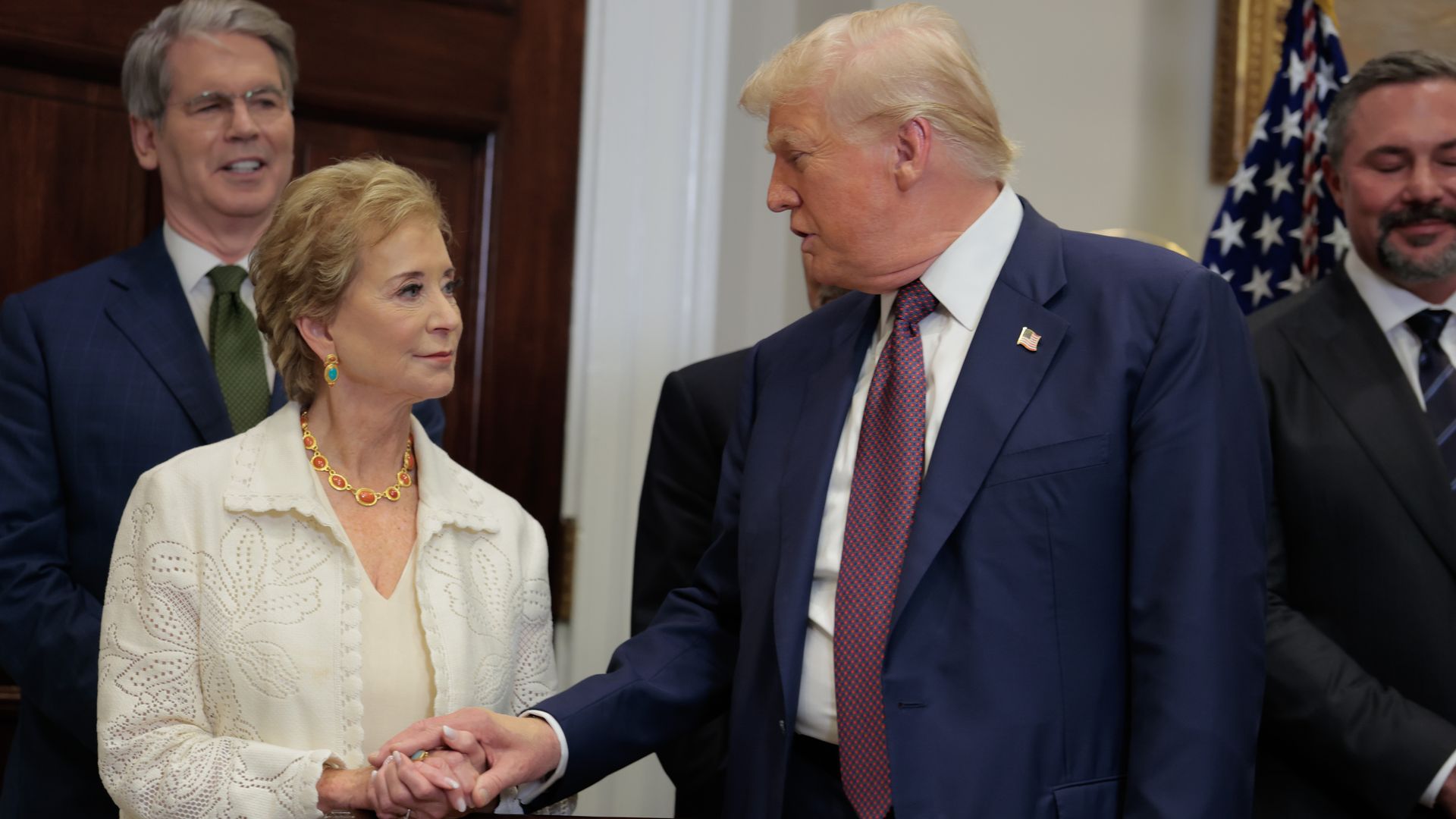
President Donald Trump and Secretary of Education Linda McMahon in July, during an executive order signing ceremony where he revived the Presidential Fitness Test in public schools. Photo: Anna Moneymaker/Getty Images
The Department of Education has resumed a key student-loan forgiveness program, which it paused in July.
Why it matters: About 2 million borrowers are enrolled in the Income-Based Repayment (IBR) plan.
Driving the news: Student-loan borrowers on the IBR plan have started to receive emails from the department notifying them that they've met the payment threshold and qualify for debt cancellation, multiple outlets reported this week.
- Business Insider reported that these emails had the subject line: "You're eligible to have your student loan(s) discharged."
- The emails said that department is working with servicers — whom the department assigns to handle billing and other services — to process relief "over the next several months," and that the department will send the borrower's discharge information to their servicer after Oct. 21.
What they're saying: "It's the first proof that forgiveness is still happening for long-term borrowers after months of uncertainty," Stanley Tate, a consumer lawyer who specializes in student loans, tells Axios.
- He added that IBR is the only form of income-driven forgiveness still available, while the SAVE, PAYE and ICR plans remain tied up in court.
- "Because the tax exclusion under the American Rescue Plan Act expires after 2025, getting these discharges finalized this year could spare borrowers from big federal tax bills next year."
Scott Buchanan, executive director of the Student Loan Servicing Alliance, a trade group for federal student loan servicers, confirmed to CNBC that IBR discharges have resumed.
- Several servicers also confirmed the resumption to The Washington Post.
The Education Department did not respond to Axios' request for comment, citing the government shutdown in an automated email.
Here's what to know:
The IBR pause
Flashback: When the Education Department paused IBR in July, it was the only current income-driven student loan forgiveness plan not subject to a legal challenge or court injunction.
- The pause came as Trump's One Big Beautiful Bill Act was enacted, which significantly cut back on repayment options for borrowers.
At the time, the Education Department said it was pausing the plan due to required changes to forgiveness calculations caused by court actions affecting the related SAVE Plan.
- "Currently, IBR forgiveness is paused while our systems are updated," the department said in an FAQ. "IBR forgiveness will resume once those updates are completed."
How it works: Income-Based Repayment is one of four federal plans that establish monthly payments based on earnings and family size over a 20- or 25-year period.
- Monthly payments are generally equal to 15% of a person's discretionary income (10% if you are a new borrower on or after July 1, 2014), divided by 12, per the DOE.
- After the 20 or 25 years, remaining loan balances are eligible for forgiveness.
"Eliminating debt and one less monthly payment immediately frees up discretionary income," Bethany Hubert, a financial aid expert at Earnest, a student loan servicer, tells Axios.
- "This could mean making ends meet, preventing defaults on other debts, or finally saving toward a major goal like a down payment."
- Nearly a third of federal student loan borrowers are behind on payments, according to a survey that credit reporting agency TransUnion released last month.
How to know if you're eligible for forgiveness
State of play: Emails have started going out this week, and borrowers showing 300 qualifying payments under IBR are the ones getting emails, according to Tate, the consumer lawyer.
- Under the original IBR plan, borrowers will see their remaining balances discharged after 300 payments, or 25 years of payments, per the nonprofit Institute for College Access & Success.
- "Everyone else, even those who've crossed 300 since January, is still waiting," Tate says. "That pattern tells me this isn't a broad rollout; it's a strategic restart meant to show progress while the litigation and system rebuild continue."
How to opt out of IBR relief
Borrowers who want to opt out of the IBR relief must do so by Oct. 21 as well, per Business Insider.
- The emails said that borrowers can do so by contacting their loan servicer and saying that they are not interested.
- The department said in its email that one reason to opt out might be to avoid a state tax liability, also noting that those who do opt out are required to continue making payments on their loans.
