Carrie Wibben Kaupp: Supply chain insights are a "national security imperative"

Add Axios as your preferred source to
see more of our stories on Google.
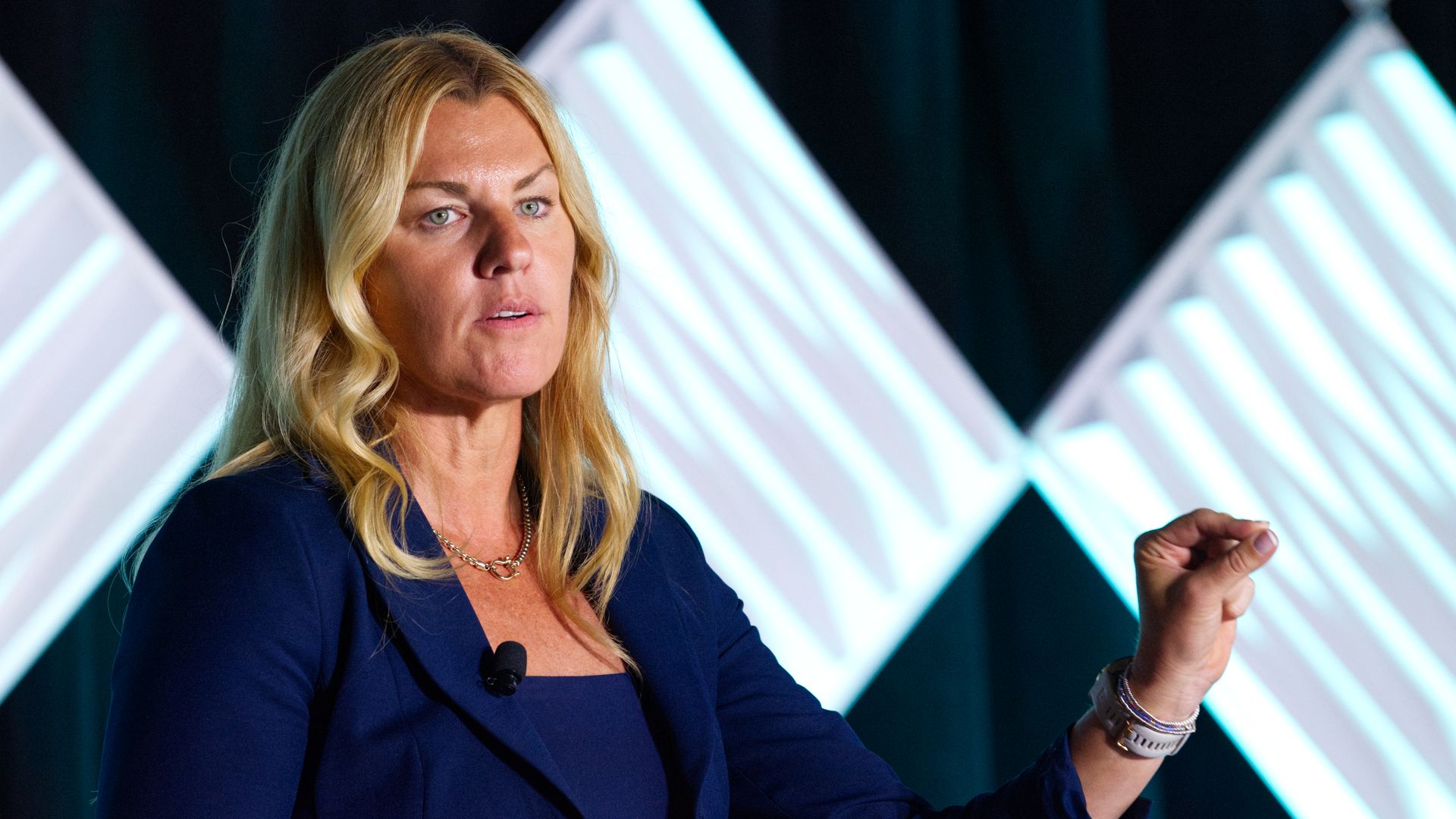
Carrie Wibben Kaupp speaks at the Reindustrialize conference in July. Photo: Colin Demarest/Axios
Supply-chain intelligence is no longer "an economic nice-to-have," according to Carrie Wibben Kaupp, the president of Exiger. Today, it's "a national security imperative."
- "We've done countless projects for the U.S. government on strategic ports, shipping lanes, how the adversary China, primarily, can exploit them and where they have dominance in ways that we don't even appreciate or understand," she told Axios in an interview.
Why she matters: Kaupp's a West Point graduate; a former Defense Counterintelligence and Security Agency deputy director; and was the first woman to serve as commander of the guard for the Tomb of the Unknown Soldier.
Q: When you hear "future of defense," what comes to mind?
A: A couple things.
- First, the future of defense is pretty inextricably linked to artificial intelligence. No surprise in that response, I'm sure, because it's really the only scalable response to the modern threat landscape.
- The second that comes to mind is tomorrow's battlefield isn't fought traditionally, through weapons. It's really fought through supply chains. I think supply chains are the new front lines.
- We, at Exiger, are just intensely focused on building the arsenal of tools that will help Team USA win the nonkinetic battle of the future.
Q: What region of the world should we be watching? Why?
A: You'd expect me to say China, but everyone's watching it. Again, the signal's broken through the noise. I think it's really our own backyard.
- You can't defend what you can't see. Resilience begins at home, and national security really starts with knowing and protecting the ground under our feet and having full visibility into those dependencies within our supply chains.
Q: How many emails do you get a day, and how do you deal with them?
A: Like everyone, I get too many. Hundreds? I don't know if I've ever tipped the scale on 1,000. But it's a lot. I can't even tell you in the time we've been talking how many have come in.
- I quickly scan, triage, flag, respond. My team knows — my direct reports know — the threshold of things that they are to call me on immediately.
- And I always say: Don't let bad news sit.
Q: What's your secret to a successful overnight flight?
A: I actually don't do a lot of overnight flights. I really try to avoid them.
- When I do have long flights, I take full advantage of that time. It's almost a luxury to have that quiet time on the plane.
