Sep 30, 2025 - Health
Opioid use disorder cases jumped post-pandemic

Add Axios as your preferred source to
see more of our stories on Google.
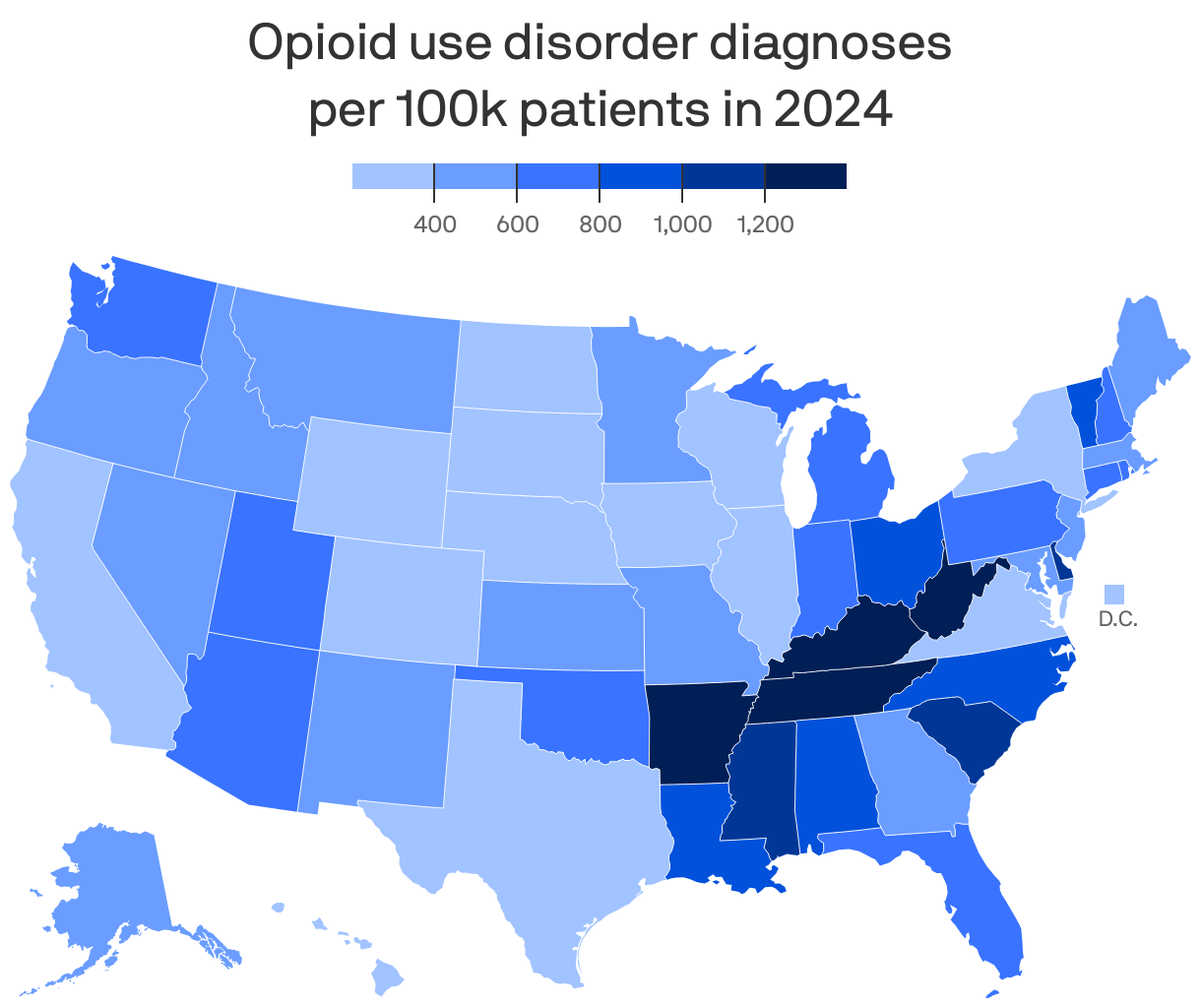
Diagnoses of opioid use disorder among the commercially insured jumped nearly 40% nationwide between 2021 and 2024, according to data from FAIR Health's Opioid Tracker shared first with Axios.
Why it matters: The finding suggests the opioid crisis cuts across demographics and income levels, putting health systems and insurers coming out of the pandemic under mounting pressure to manage addiction treatment.
By the numbers: There were 539 patients with opioid use disorder diagnoses per 100,000 in 2024, an increase of 39.8% from 386 per 100,000 in 2021.
- Tennessee had the highest rate, with 1,447 patients diagnosed with opioid use disorder per 100,000. It was followed by West Virginia (1,323), Kentucky (1,281), Arkansas (1,218) and Delaware (1,165).
Between the lines: Over that time, the data shows a shift in where opioid use disorder is treated.
- In-office care fell from 43.8% of claim lines in 2021 to 38.6% of claims in 2024.
- At the same time, teleheath services for OUD grew from 4.3% in 2021 to 6.3% in 2024 and care in nonresidential treatment facilities ticked up from 1% in 2021 to 9% in 2024.
