Exclusive: Hawley and Blumenthal unveil AI evaluation bill

Add Axios as your preferred source to
see more of our stories on Google.
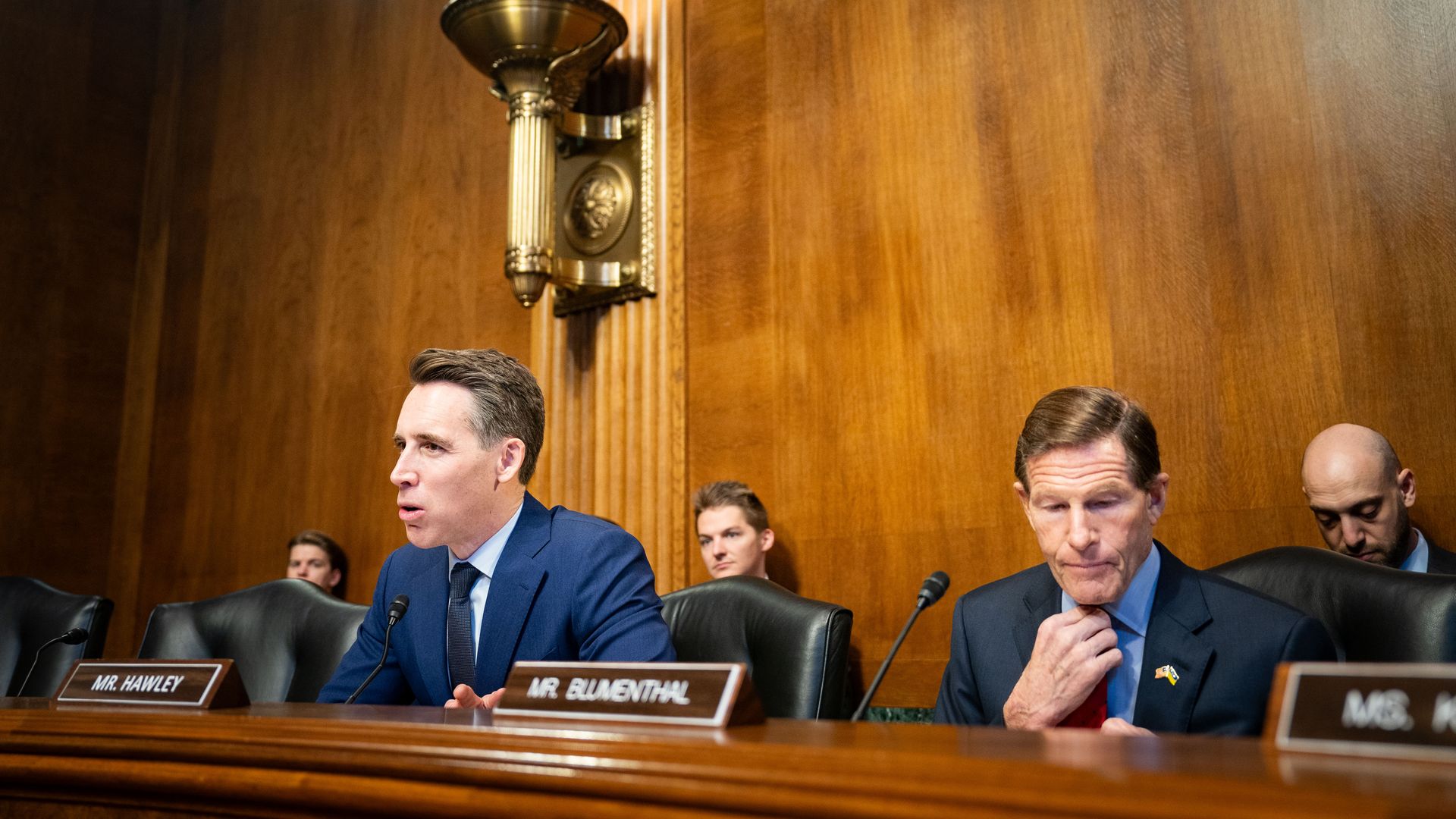
Sens. Josh Hawley and Richard Blumenthal on Jan. 10, 2024. Photo: Kent Nishimura/Getty Images
Sens. Josh Hawley (R-Mo.) and Richard Blumenthal (D-Conn.) are introducing an AI risk evaluation bill on Monday, per an announcement shared exclusively with Axios.
Why it matters: There's still bipartisan appetite on Capitol Hill to address the biggest risks of AI — even as the White House warns regulation could hamper innovation and U.S. competition with China.
Driving the news: The Artificial Intelligence Risk Evaluation Act would house an evaluation program at the Department of Energy for advanced AI systems to "collect data on the likelihood of adverse AI incidents, such as loss-of-control scenarios and weaponization by adversaries," per a memo shared with Axios.
How it works: Developers of advanced AI would be required to submit information to the program, and could not deploy until complying with its requirements.
- The Energy secretary would also be required to annually report to Congress with recommendations for federal oversight of AI.
- "While some proposals would take a hands-off approach to AI, this new bipartisan legislation... would guarantee that there is common-sense government oversight of the most advanced AI systems to better inform and protect the public," a description of the bill shared with Axios reads.
Flashback: Blumenthal and Hawley in July introduced a bill to protect content creators from AI, and last Congress they backed a bipartisan legislative framework to establish guardrails for AI.
What they're saying: "Congress must not allow our national security, civil liberties, and labor protections to take a back seat to AI," Hawley said in a statement.
- "This bipartisan legislation would guarantee common-sense testing and oversight of the most advanced AI systems, so Congress and the American people can be better informed about potential risks."
- Blumenthal: "Our legislation would ensure that a federal entity is on the lookout, scrutinizing these AI models for threats to infrastructure, labor markets, and civil liberties."
Sign up for Axios AI+ Government, our new Friday newsletter focusing on how governments encourage, regulate and use AI.
