Why Ford's CEO is screaming about an ignored chunk of the AI economy

Add Axios as your preferred source to
see more of our stories on Google.
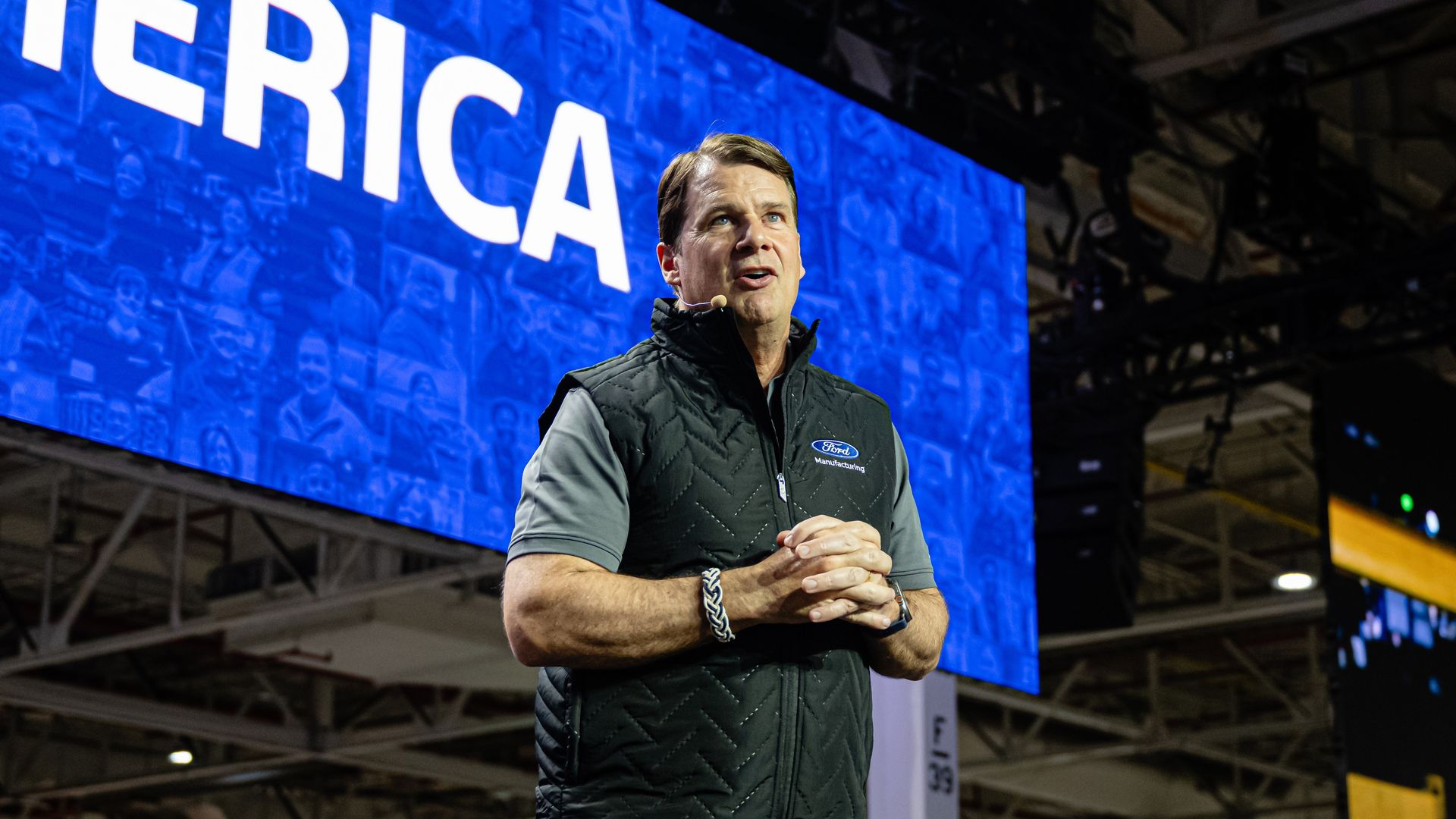
Ford CEO Jim Farley speaks at the Ford Kentucky Truck Plant in April. Photo: Ford Motor Co.
The Trump administration's ambition to lead in high-tech manufacturing and AI won't succeed if it ignores foundational blue-collar industries, Ford CEO Jim Farley tells Axios in an interview.
Why it matters: For all the talk about how AI will wipe out white-collar jobs (including from Farley himself), he says not enough attention is paid to the "essential economy" — industries like construction, maintenance and skilled trades.
New factories, supply chains and data centers won't get built without skilled electricians, construction workers and other tradespeople.
- But the U.S. hasn't invested in the necessary job training, regulatory reform or innovation to support these backbone industries.
The big picture: Tariffs and immigration policies make it harder for companies in blue-collar industries that want to expand, but don't have the workforce.
- "I think the intent is there, but there's nothing to backfill the ambition," Farley told Axios. "How can we re-shore all this stuff if we don't have people to work there?"
Driving the news: Alarmed by the trend, Farley is rallying leaders in business, technology and government to draw attention to the issue.
- He's hosting a first-of-its-kind summit, "Accelerate the Essential Economy," on Tuesday in Detroit, drawing big-name CEOs: Roger Penske (Penske Corp.), David Burritt (U.S. Steel), John Stankey (AT&T), Raj Subramaniam (FedEx), Barbara Humpton (Siemens USA) and Joe Shoen (U-Haul), among many others.
- Labor Secretary Lori Chavez-DeRemer plans to attend, along with workers and entrepreneurs on the front lines of these blue-collar businesses.
Zoom out: There's a mounting divide in productivity between the white-collar and blue-collar sectors of the economy, according to a recent study by the Aspen Institute.
- Technologies like cloud computing and AI have led to a 28% surge in productivity in digital industries, including professional business and services, researchers found.
- But productivity in industries that build, power, move and maintain the physical world declined over the same period.
- The U.S. needs 600,000 more manufacturing workers, 500,000 construction workers and 400,000 automotive technicians, Farley wrote in a recent blog post.
Between the lines: That productivity crisis drives up prices and shrinks profitability for businesses large and small.
- Consumers have to wait longer to get their car repaired, their toilet fixed or their house remodeled. They spend more time in traffic because road repairs take longer.
- A shortage of construction workers contributes to the lack of affordable housing.
What he's saying: "On the surface, this looks like a people problem, and most are. But it's actually not that simple. It's an awareness problem. It's a societal problem," Farley said.
- "If I were to take the typical American family and say, 'Would you rather your kid be a software programmer making $170,000 or be an HVAC specialist to make $97,000, which one would you prefer?', I would say many, many Americans would prefer the software engineer."
A culture shift is needed, he says, along with policy changes at all levels of government.
- Faster permitting and regulatory reform will help advance projects tied up in red tape.
- More funding for technical and vocational training, including incentives for apprenticeship programs like those in other countries, is also needed.
- Support for innovation — including robots, augmented reality and AI — would help plumbers, carpenters and auto mechanics be more productive.
The bottom line: Farley calls his "Accelerate" summit a first step toward developing policies that support the growth of these critical sectors of the economy.
- "If we are successful — when we are successful — we'll take on bigger, higher-class problems. Right now, the problems we're trying to solve are pretty practical," he says. "I need 6,000 technicians in my dealerships on Monday morning."
