Tesla leads the next wave of EV charging infrastructure

Add Axios as your preferred source to
see more of our stories on Google.
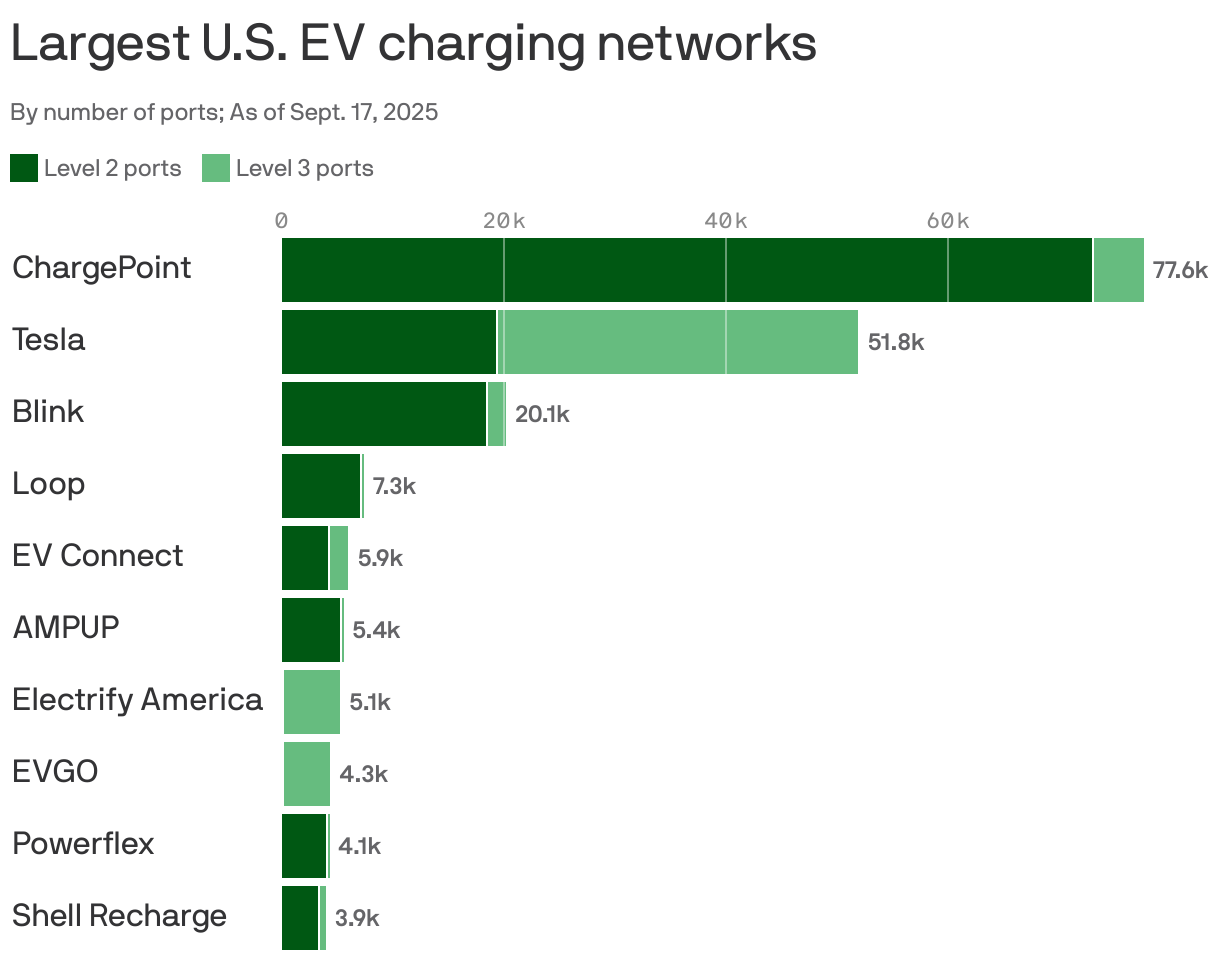
There's a shakeout coming in the EV charging industry as financial challenges mount for some of the early players, according to analysts at Bloomberg Intelligence.
Why it matters: Companies that dominated the charging business to date aren't the ones that will lead the next phase of growth, per their 2026 EV charging outlook.
- Instead, it will be vertically integrated networks owned or backed by automakers that already have billions of dollars at stake in electrification.
The growers: Tesla, with more than 32,000 ports in its Supercharger network, plus another 19,000 slower Level 2 chargers, is on track to nearly double its Supercharger network by 2030, Bloomberg estimates.
- Ionna, a joint venture between eight automakers (BMW, General Motors, Honda, Hyundai, Kia, Mercedes-Benz, Stellantis and Toyota), plans to add 30,000 fast-charging ports by the end of the decade, from 300 today.
- GM (with EVGo) and VW (through Electrify America) are also expanding beyond Ionna.
Lagging behind: Companies like ChargePoint and Blink, which have dominated Level 2 charging, the most common type of public infrastructure.
- Their growth has stalled amid lower-cost competition for Level 2 chargers, and they don't have the capital to fund DC fast-chargers. Bloomberg Intelligence argues.
What they're saying: "I don't think we need that many Level 2 public chargers, other than in public garages and apartment buildings," says the report's lead analyst, Steve Man.
- "DC charging is the way to go to increase adoption" of EVs, he told Axios.
The other side: "Level 2 charging is where we're really lacking," says Gabe Klein, former executive director of the U.S. Joint Office of Energy and Transportation in the Biden administration.
- "We desperately need more in cities now," he says.
The bottom line: Electrification is still in the early phases, and so is EV charging.
