RFK Jr.'s vaccine panel makes few policy changes


Add Axios as your preferred source to
see more of our stories on Google.
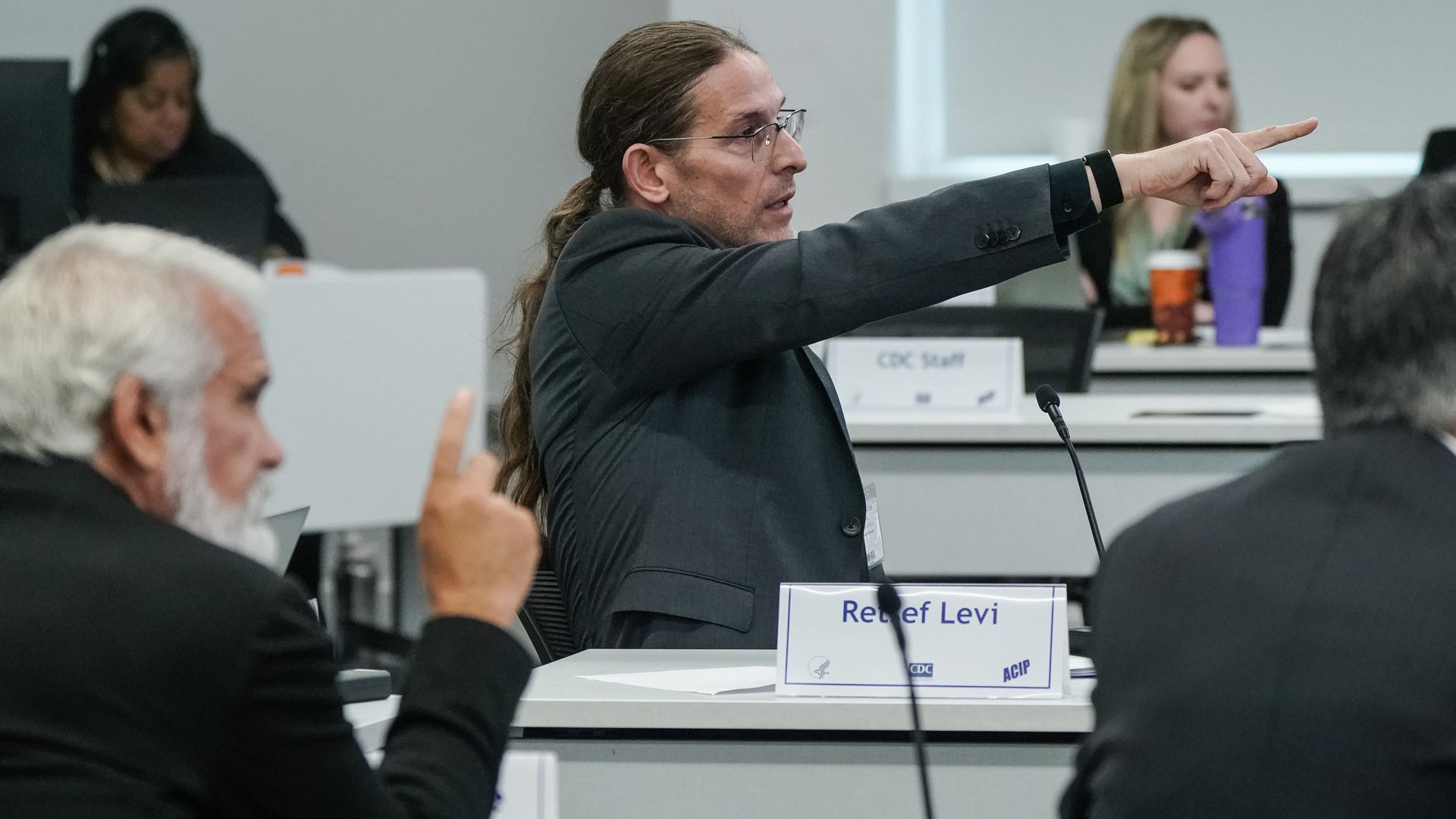
ACIP member Retsef Levi points to a slide while speaking during a meeting of the advisory panel. Photo: Elijah Nouvelage/Getty Images
Health Secretary Robert F. Kennedy Jr.'s vaccine advisers insisted they were upholding the "gold standard" science late last week — even as they cited unvetted studies and dismissed concerns about the lack of rigorous review while discussing risks around COVID-19, hepatitis B and MMRV shots.
The big picture: It was a rocky debut for the newly constituted Advisory Committee on Immunization Practices, as some on the 12-member panel over two days struggled with procedural questions and at times didn't appear to understand what they were voting on.
- In the end, the panel didn't recommend dramatically changing vaccine policy. But medical professionals said airing doubts about vaccine safety and amplifying pharma critics' arguments risk destabilizing decades of progress in public health and undercutting scientific evidence.
- "They're responding not to scientific signals but to the mob they're beholden to," said Amesh Adalja, senior scholar at the Johns Hopkins Center for Health Security. "They need to score points with the anti-vaccine movement because that's ultimately who gave them power."
State of play: The new ACIP — which Kennedy installed this summer after dismissing the previous cohort of academics and physicians — voted to recommend limiting the availability of a combined shot for measles, mumps, rubella and varicella, the virus that causes chickenpox.
- The panel had to vote twice on whether the Vaccines for Children Program should continue to pay for those shots after it was pointed out the original vote contradicted their stated recommendation against and might result in a two-tiered vaccination system.
- They then punted on whether the hepatitis B vaccine should be given to newborns, citing concern about the clarity of what they were voting about as well as insufficient data about side effects.
- Members also approved recommendations beyond the scope of their deliberations, including that all pregnant women get tested for hepatitis B.
The closely watched discussions about COVID-19 boosters on Friday featured heated debate on whether people getting shots need a doctors' prescription.
- ACIP stressed getting an updated shot came down to "individual decision-making" and personal choice, and narrowly defeated a call to require a script, with chair Martin Kulldorff breaking a tie and casting the deciding vote.
- "It's essentially going to be a barrier for people to have access to this vaccine, and that is not the role of ACIP," said committee member and Dartmouth pediatrics professor Cody Meissner, countering arguments that the vaccine deserved the same amount of consultation as starting blood pressure medication.
Liaisons from medical organizations questioned the process and quality of data the panel reviewed.
- Jason Goldman of the American College of Physicians called on the panel to define the process they'll use to properly vet and discuss all future vaccines.
- "Some of the statements by the COVID-19 work group chair were way out of bounds in terms of the science behind COVID-19 vaccines," said Sean O'Leary, American Academy of Pediatrics' infectious disease chairman.
- "The focus of a lot of the discussion that we saw today around COVID vaccines was around myths, anecdotes, case series, case reports ... they were not focused at all on the actual science."
The other side: "I commend the committee for bringing overdue scientific debate on vaccination to the American people," said Deputy Secretary of Health and Centers for Disease Control and Prevention acting director Jim O'Neill, who still has to approve the recommendations before they become official policy.
- Health and Human Services noted that the MMRV vaccine doubles the risk of seizures in toddlers without conferring additional protection from varicella compared with standalone vaccination. The majority of kids in the U.S. already currently get separate MMR and chickenpox vaccines.
- HHS said ACIP's emphasis on individual decision-making could mean talking to a doctor, nurse or pharmacist — and that the recommendations, if finalized, allow for coverage through all public and private insurance.
The bottom line: Some clinicians think ACIP has descended into anarchy and that licensed physicians should instead use guidance from medical associations like the American Academy of Pediatrics and the American College of Obstetricians and Gynecologists.
- Dorit Reiss, a law professor at UC Law San Francisco, posted on LinkedIn that the panel as constituted "cannot be revived ... the rookie, biased, uninformed committee destroyed its legitimacy."
