This CEO wants to forge "a new generation of military medicine"

Add Axios as your preferred source to
see more of our stories on Google.
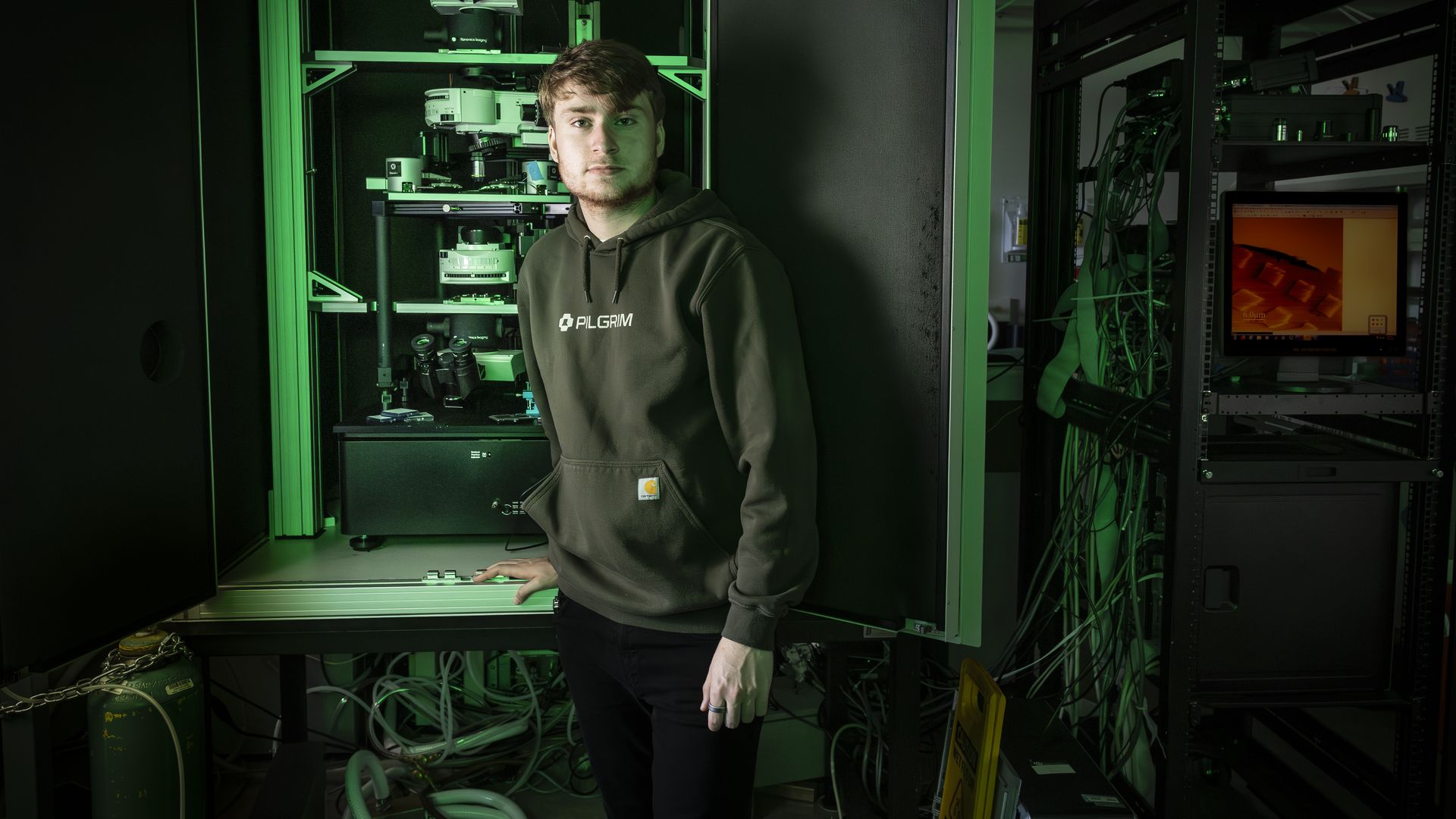
Jake Adler, the chief executive at Pilgrim. Photo: Courtesy of Pilgrim/via Day One Ventures
Jake Adler devoured science fiction when he was younger. He rocked an iPod Nano on his wrist — what he called an "early Apple Watch" — and wore Neurosity gear in his yearbook photos. Today, he helms Pilgrim, a defense biotechnology startup.
Why it matters: So much mainstream attention is paid to the pointy end of the stick: missiles, drones, bullets. Far less attention is paid to what happens when you get poked by that stick: triage, treatment, recovery.
The intrigue: Pilgrim exited stealth this summer. Adler, 21, told Axios he started the company with "the ambition of creating a new generation of military medicine."
- Central to his thesis is the belief that troops are being sent "into increasingly austere environments without the relevant medical tools or infrastructure in place needed for their own survival."
- "You can't have a force multiplier without the underlying force," he added. "If you can't stop the bleed, if you can't help that warfighter pick up their gun, then it doesn't matter."
Context: Any protracted fight with Russia or China — or both — will produce immense casualties. U.S. military leaders expect the numbers to dwarf those seen in the global war on terror.
Zoom in: Pilgrim has three main offerings:
- Kingsfoil, a hemostatic dressing for wounds
- Voyager, an inhaled countermeasure to chemical threats
- Argus, a chemical, biological, radiological and nuclear (CBRN) surveillance platform
Follow the money: The company, based in Redwood, California, raised a $4.3 million seed round. It's backed by Cantos VC, Thiel Capital, Day One Ventures, Refactor Capital and others.
Friction point: It does not have any active Defense Department contracts.
- But Adler said he's made headway with the Defense Threat Reduction Agency, Defense Health Agency and Joint Program Executive Office for CBRN Defense.
The bottom line: "We're really one of the only companies today that's betting on the human over the machine," Adler said.
- "I think many people have shifted the scales a little bit, and, frankly, we're trying to to be realistic with how conflicts are going to modernize and evolve."
Go deeper: At the Army Research Lab, an augmented-reality peek at future war
