Book examines myths and political life of Malcolm X

Add Axios as your preferred source to
see more of our stories on Google.
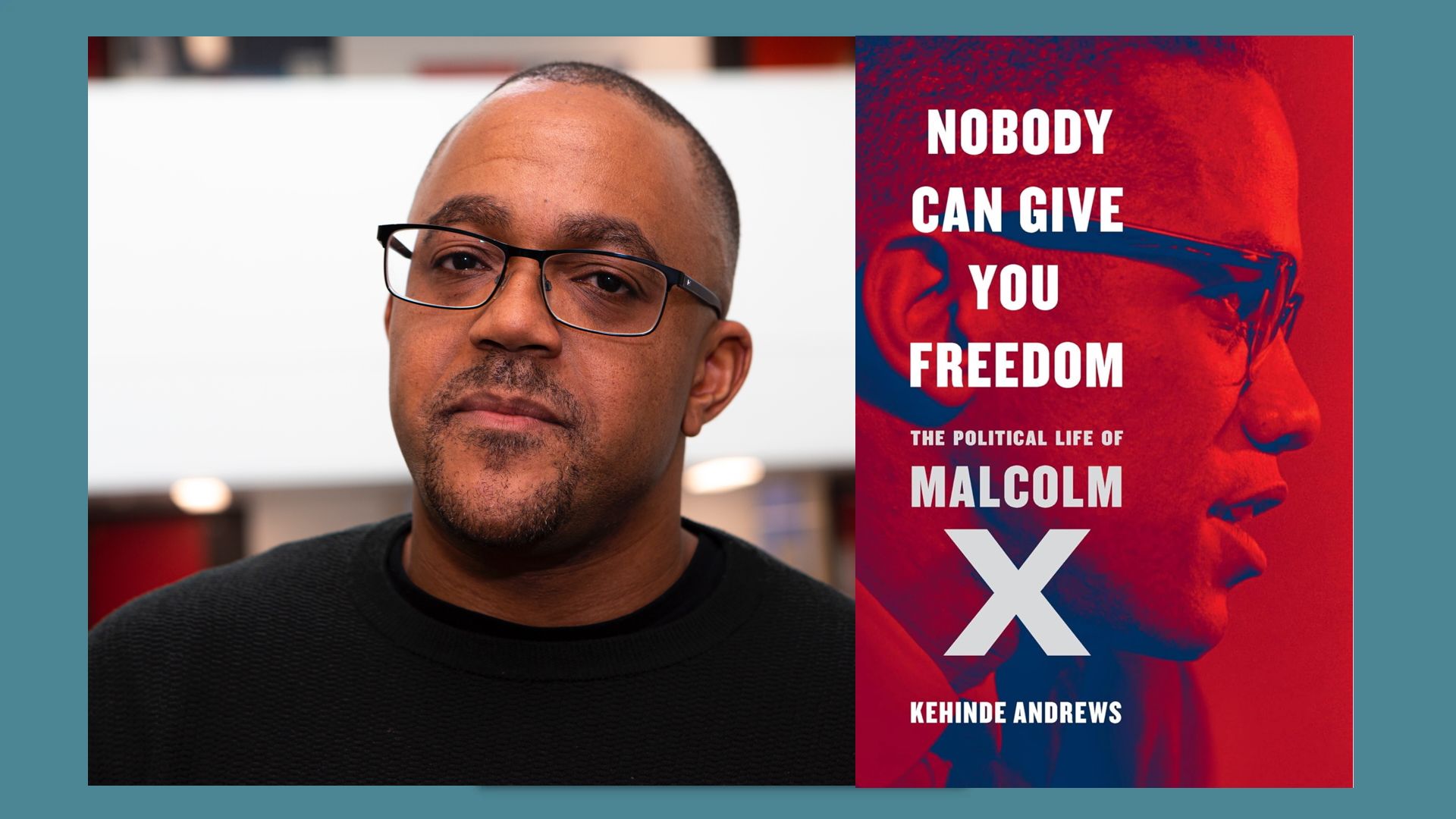
Kehinde Andrews and his new book, "Nobody Can Give You Freedom: The Political Life of Malcolm X." Photo: Courtesy of Bold Type Books.
A new book dives into the often misunderstood political life and evolution of Malcolm X — an instrumental figure who helped shape the narrative about people of color in the U.S.
The big picture: Malcolm X has been the subject of many books in recent years amid new questions about his 1965 assassination and the 100th anniversary of his birth.
Zoom in: Kehinde Andrews, a Black Studies professor at Birmingham City University in England, is set to release a new work on Tuesday, "Nobody Can Give You Freedom: The Political Life of Malcolm X" (Bold Type Books, $30).
- The detailed, and often humorous book, seeks to puncture persistent myths that Malcolm X, later known as el-Hajj Malik el-Shabazz, advocated violence only to later embrace integration and non-violence like Martin Luther King Jr.
- In fact, Andrews argues that Malcolm never became the mainstream civil rights leader as portrayed in "The Autobiography of Malcolm X: As Told to Alex Haley" or in Spike Lee's 1992 feature film, "Malcolm X."
- Andrews has crafted one of the most engaging examinations of Malcolm X this decade by showing how Malcolm remained rooted in Black nationalism and liberation until his death.
The intrigue: In speeches, Malcolm X set the foundation for what would become critical race theory by using simple, nonacademic language that would resonate with people of color for generations, the book says.
In an interview with Axios from his home in Birmingham, U.K., Andrews said Malcolm had always played a role in his scholarship, but he grew angrier over the sanitized image of Malcolm developed over the years.
- "Malcolm really gives you his revolutionary politics, and particularly after he leaves the Nation of Islam and towards the end of his life, he's outlining what black radicalism looks like," Andrews said.
- No, Malcolm never was sold on the nonviolence tactics of MLK, and no, Malcolm never shed his Black radicalism for safe electoral politics, Andrews argued.
- "When you have Malcolm on a U.S. postage stamp...Malcolm with the pictures of the American flag, yeah, he's gonna become like this American figure, which is the absolute antithesis of what Malcolm really was."
Between the lines: Malcolm often argued that Black Americans were victims of systemic racism and would later look at anticolonialism brewing in Latin America and Asia.
- Before he died, Malcolm would visit Andrews' current hometown to examine how Asians in England were facing discrimination — all aspects of his life that have been ignored, the author writes.
Flashback: Malcolm X was assassinated at age 39 on February 21, 1965, while speaking at the then-Audubon Ballroom.
- He was shot 21 times by a group of men in front of his wife and daughters.
- Born Malcolm Little, he changed his name to Malcolm X after joining the Nation of Islam, but later left the organization after falling out with its leader, Elijah Muhammad.
Zoom out: The CIA and FBI put Malcolm X under surveillance after witnessing him drawing large crowds where he spoke of Black nationalism and urged Black Americans to defend themselves against violence.
- FBI leader J. Edgar Hoover and others in the U.S. government sought to prevent the rise of what they feared would be a Black "messiah" who could unify African Americans.
- Malcolm X, King and other Black leaders were all under FBI surveillance.
Bottom line: Andrews goes beyond Manning Marable's tabloid-esque 2011 Malcolm biography or Haley's questionable assessment to pose more questions about Malcolm's beliefs.
- Like Malcolm's original speeches, it makes one uncomfortable, which was the point.
Go deeper: In photos: Marking 60 years since the assassination of Malcolm X
