Jim VandeHei: America's crisis of hope

Add Axios as your preferred source to
see more of our stories on Google.
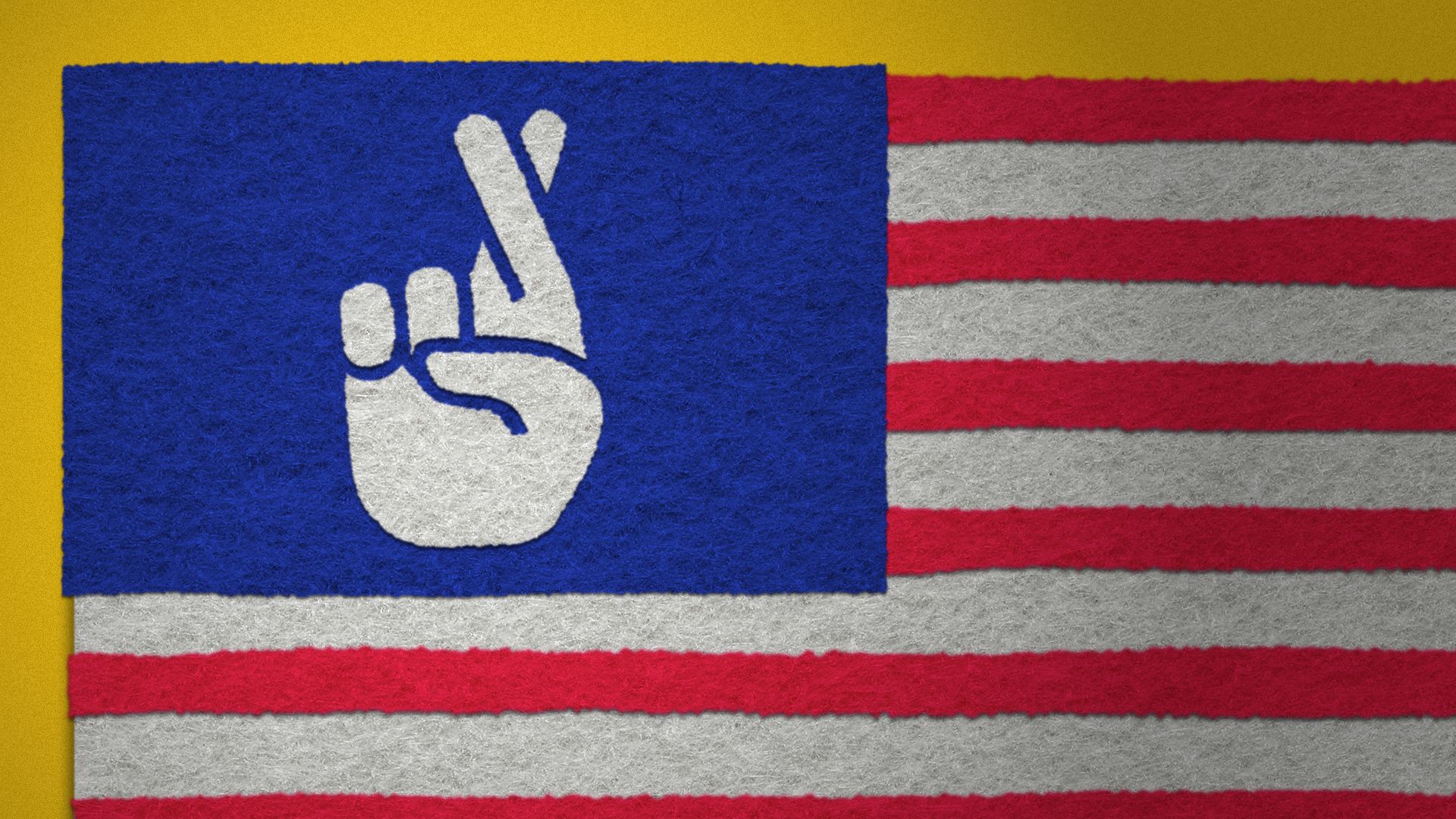
Illustration: Brendan Lynch/Axios
Axios CEO Jim VandeHei writes:
Two things jarred me on Tuesday.
- A morning poll in The Wall Street Journal showed that 75% of Americans see little hope for improving their economic status — a 35-year high. Almost 70% said the American dream (work hard, you'll get ahead) is dead, a 15-year high. "This is just sad," I texted Mike Allen. His response: "Yes, shrunken ambitions for 3/4s of America."
- Twelve hours later, we posted our Finish Line message to college students, arguing that reality is so much better than our social feeds and politicians tell us. I received an email a minute for hours upon hours — the most instant feedback on any column I've written. 90% of you lit up at seeing a hopeful lens on America; 10% felt I had downplayed a truly hopeless reality.
Why it matters: We have a crisis far bigger than nasty politics, surging screen time or economic angst. It's a crisis of hope.
- By countless measures, hope is fading. Based on the response to the column and conversations in our daily lives, there's an insatiable thirst for its return.
The big picture: This isn't a column prescribing ways to spur a hope renaissance or casting blame. Rather, it's a wake-up call — for me, for you, for America. If hope fades for long, bad things happen: Trust frays, suspicion rises, shared pursuits cease, us-vs.-them soars.
- The American experiment — long built on the belief that tomorrow will be better than today — suffers.
- This crisis is bigger than politics or this moment.
Just as Jonathan Haidt's "The Anxious Generation" jarred people into seeing the dangers of screen time, using data and real-world examples, the rising number of studies showing The Great American Funk is a giant, screaming wake-up call.
- The Wall Street Journal/NORC poll found that the funk is bipartisan — albeit expressed more unanimously by Democrats, given the GOP's current hold on power.
People's fears go beyond their own pocketbooks to the system of government that we've taken for granted for generations. In a Marist Poll for NPR and PBS News this summer, 76% of Americans said the issues that divide the nation pose a serious threat to democracy.
The big picture: Gloom is a bipartisan issue, even when economic data tells a brighter story. President Trump rose to power because people felt unheard, hopeless and like strangers in their own land. But similar feelings persist today.
Thank you to the 1,000+ of you who sent thoughtful notes over the past 24 hours in response to my message to college students, whether you loved or loathed what I said. Nothing fortifies my faith in the goodness of people more than honest, blunt replies.
- This note from a reader, Tim, captures the view of the 10% who wrote to criticize the college message:
"Your thoughts do not acknowledge that most people are struggling — that our democracy is threatened in a way not ever seen before in our history. That our healthcare is being threatened. Therapists say they have never seen such anxiety. ... Summer is usually their quiet season. Not this year. Normal? As far from the truth as you can be. ... My young adult children are scared. My daughter recently said: 'Why would I ever want to bring children into this world?' All so easy for you to say. Your words are attempts to improve our spirit. But life is not normal for most people — even though they may be putting on a good act in front of you."
Other notes reflect the widespread hunger for hope:
- Joanna Striplin of Gulfport, Mississippi — mother of two teenage sons — emailed to say her 19-year-old, Eli, who's majoring in Chinese at Ole Miss, sent her the column right away. "You are spot on," wrote Joanna, who gave us permission to share her thoughts. "Our children ... are so inundated with messages of divisiveness, defeat, fear and victimhood, it is leaving them paralyzed in a time when legitimately the sky's the limit. ... We're on the cusp of losing a generation of really talented kids because they are giving up before they even try."
- Dylan Turner, 21, a finance major who graduates in December from California Lutheran University in Thousand Oaks, California, emailed to say he's recently been making a point of consuming news from sources with strong biases from both sides of the spectrum — for example, watching both Fox News and MSNBC. "The most important thing I have learned from this practice," wrote Dylan, who said we could publish his note, "is that not only does each side tailor to their audience, they focus heavily on amplifying the polarization of the U.S. political landscape. Your explanation of negativity bias describes this phenomenon perfectly."
I'll die on this hill: I do believe we're being duped by our social media feeds and the loudest mouths in politics into thinking things are more hopeless than they are.
- I do think most Americans are normal, hardworking, patriotic and hungry to hope.
- And I do think our system, our nation, imperfections and all, always works its way through turbulence or tumult or hopelessness — emerging bigger, better, stronger. Hell, we fled kings, started colonies, birthed democracy, grew a nation, survived a civil war, and helped save the world in two global wars. We've been through worse.
- But the numbers don't lie: A growing number of us are downbeat about jobs … about institutions … about politics … about our kids' future.
What you can do: Start small.
- Don't just stop doom-scrolling — stop doom-sharing. Anything you drop into social media gets amped up as others share your sharing.
- Do something nice in your community. Volunteer. Say hello. Carry a box for an older neighbor. Grab that rollaboard out of the overhead. This stuff is contagious.
- Marinate in small cups of hope. Read something uplifting. Meditate. Pray. Watch something uplifting. Listen to music. Look up at the sky. Stare at the moon.
- Say thank you — maybe for a favor or a lesson from long ago. Random acts of gratitude make you feel better — and remind everyone around you that little things matter.
None of these will give you a raise or change our politics or fully rid you of stress. But ... it's a start. It's what you can do.
- Shoot us any brilliant thoughts on fixing this (beyond politics, please!): [email protected].
